
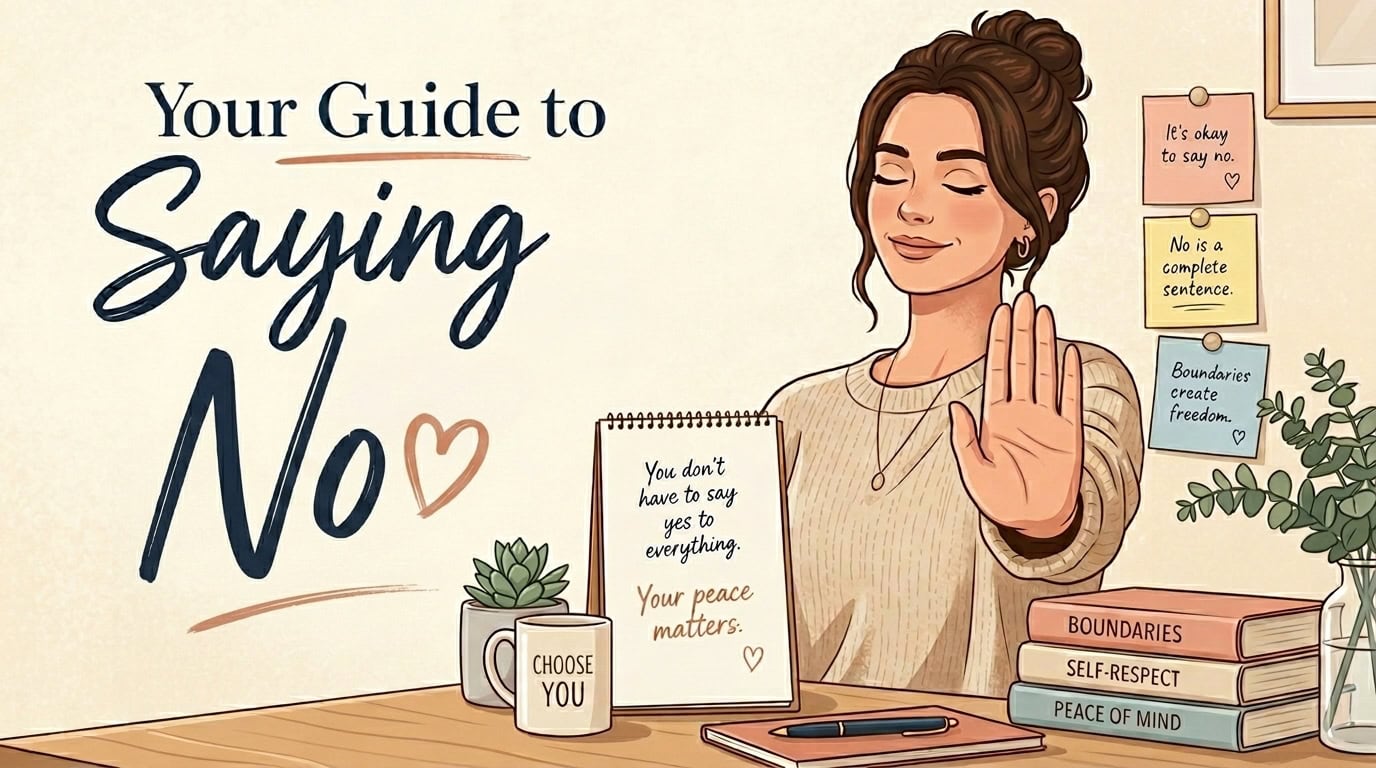
Saying no is hard. For a lot of us, it might be one of the hardest things to do, especially when we care about the people around us.
But here’s what nobody tells you: every time you say yes to something you don’t actually want to do, you’re saying no to something that actually matters to you: Your time, your energy, your peace of mind.
And the worst part? The guilt you were trying to avoid by saying yes doesn’t actually go away. It just turns into stress, resentment, and burnout instead.
So if you’re ready to stop people-pleasing your way to exhaustion, here’s your guide to say no without the guilt, the fights, or the regrets.
Why We Struggle to Say No
The truth is, every time you say yes to something, you’re automatically saying no to something else, your time, energy, or priorities.
So being responsible with both our yeses and our nos is really about staying in alignment with what we actually want in and for our lives.
We want to get to the point where we can say yes only when we mean it, and no when we need to. Because so often we’re saying yes and not really meaning it because we don’t want to feel certain things.
And I want to talk about those things, because there are some really understandable reasons why we struggle with this. Especially for those of you who are more empathic, more sensitive, more caring and compassionate, this can be extra hard. So let’s give ourselves a little understanding and compassion here.
Common Reasons
We don’t want to feel guilty. We don’t want to come across as rude or unkind. We don’t want people to think we’re selfish or uncaring.
We don’t want to be rejected or let people down. We don’t want to be judged or criticized. And honestly? That’s a real thing. It doesn’t feel good.
We don’t want to hurt or disappoint anyone. We want to be giving and generous and caring. But here’s the thing, being a generous person doesn’t mean it’s a free-for-all. We don’t have the capacity to give endlessly without there being real consequences, like stress and burnout and overwhelm and frustration.
And I want to say this one loud because I think it’s really important:
Generosity without boundaries isn’t real generosity, it’s people-pleasing, it’s over-functioning, it’s not doing things because we genuinely choose to.
We don’t want to miss out on an opportunity. FOMO is real, you guys. Especially professionally, our brains start telling us — well what if this is the thing that gets you that big promotion? What if this is your big break? And so even when our plate is full, overflowing, even, we convince ourselves to just do one more thing.

Your Go-To Guide for Saying No
Knowing why we struggle is one thing, but knowing how to handle it is what actually changes things. The good news is there’s no one-size-fits-all approach. Different situations call for different strategies, and the more tools you have, the easier it gets.
Here are smart ways to say no.
1. Be Clear
Don’t be wishy-washy. Don’t say maybe when you know the answer is no. And don’t say yes while already knowing you’re going to come up with some excuse at the last minute to get out of it.
Be clear. Offer people that level of respect.
Sometimes we want to pad people’s feelings by being a little tentative, a little back and forth, but say what you mean and mean what you say. It’s good for the relationship, and it’s also good for your own integrity on the inside to be congruent with what you’re actually feeling.
2. The Soft No (Be Polite)
Be clear, but don’t be blunt either. A hard “no I can’t” can feel like a slap to the other person. Instead, start with a yes, then explain why you can’t.
Instead of: “No, I can’t come”
Try: “I’d love to come, but I have a big meeting tomorrow”
Here’s why this works: when someone hears a straight no, their brain’s emotional center kicks into defense mode. It triggers feelings of hurt, disappointment, even resentment.
But when you start with something positive like “I would love to,” their brain first registers acceptance. That lowers their emotional resistance. So when the “but” comes, they process it as an explanation rather than a rejection.
Be clear, say what you mean, and just lead with warmth first.
3. The Concise No
So often we come up with all these big explanations, and we go on this whole ten minute soliloquy about why we can’t do something. We almost create a sob story so we can be the victim in it, like oh my gosh life is just hard right now.
You can give a reason, but no need to over-explain, no need to over-justify, no need to over-apologize.
Some simple things you can say:
- “I have another commitment” — and by the way, even if that commitment is to sit at home and do absolutely nothing because that’s what you need right now, that counts. Your commitment to taking care of yourself is a real commitment.
- “I’ve got a lot on my plate right now and I’m not able to take anything else on”
- “Thank you, I’m not able to take that on right now”
- “I’m not interested in participating in that”
Here’s what this looks like in real life.
Say you get a lot of emails or requests to participate in different things, some you really want to do, and some just aren’t in alignment with your values or your goals, or you genuinely don’t have the time.
It’s easy to think you have to say yes to every single offer because you don’t want to seem ungrateful or rude. So you say yes to everything and find yourself super stressed out, super overwhelmed, and honestly almost bitter and resentful instead of actually enjoying any of it.
Something has to change. A simple reply like this goes a long way:
“Thank you so much for the offer, but unfortunately due to my other commitments I’m unable to participate.”
That’s it. No need to list everything on your plate. No ten-minute explanation. Just — be concise.
4. The “No That Sounds Like a Yes” Method
People don’t just dislike rejection; they dislike uncertainty. A blunt no feels like slamming a door in their face. But if you give them another option, their brain shifts focus from feeling rejected to feeling hopeful.
Instead of: “No, I can’t”
Try: “That sounds great, but I have a meeting — can we do this weekend instead?”
You’re not rejecting them. You’re rescheduling. And that makes all the difference.
5. The Buffer Zone
Some situations don’t have an easy alternative, and that’s okay. Instead of saying no immediately, buy yourself some time.
Try saying: “Can we talk about this after my meeting?” or “Can I get back to you this evening?”
This does two things: it gives you space to think, and it gives them time to cool down. People react more emotionally in the moment. When you delay the conversation, their immediate disappointment fades and they process the situation more logically. By the time you say no, they’re much less likely to react dramatically.
6. The Empathy No
Sometimes rejecting a request outright — even kindly — sounds harsh. This is where empathy comes in. Instead of just saying no, express genuine regret.
Try: “I really wish I could come and spend that time with you, but I have deadlines this week and I feel bad missing out.”
When you show you actually care, it shifts their emotional reaction from “how could you say no” to “they really wanted to but just can’t.” They may still be disappointed, but they won’t feel dismissed.
7. The Outsource Method
When saying no feels impossible no matter what, explain that the situation is out of your hands.
Try: “I would love to, but my manager just gave me extra work and I barely have time to breathe right now.”
When the reason is external — a boss, a deadline, your health — it’s harder for them to argue with you. Their frustration shifts from you to the situation. And that makes saying no so much easier.
8. Don’t Forget to Be Nice
No matter which method you use, always wrap it in kindness. Start or finish with a genuine thank you.
“Thank you for thinking of me.” “Thank you for the offer.”
Even if it’s something you really didn’t want to do, being gracious goes a really long way. You would be surprised how much people can hear the word no when you are kind about it.

When to Explain a Bit More
Sometimes we do need to give a more thorough explanation, especially in situations that are more complex, or with people we’re really close to.
Here’s an example. Say your sister is visiting from out of town, staying at your parents’ place over an hour away on the bus. The last day she’s there, you’ve had quite the night with your small kids barely slept, kids are overtired and acting a little crazy. The last thing you feel like you have the capacity to do is sit on public transit for over an hour with a four-year-old and a two-year-old.
But you feel really torn. You don’t want her to think you don’t care or that she isn’t worth the effort.
So you call her and just explain it honestly:
- You had a really tough night
- You’re completely depleted
- If you had even one ounce of energy left you absolutely would be there
- You really don’t want her to take it the wrong way
And most of the time? They understand. Because you were honest. Because you told them you really wanted to be there and you were worried about hurting their feelings.
The key is knowing when you’re giving more context to honor the relationship versus when you’re over-explaining out of guilt. Those are two very different things.
The Bottom Line
Saying no doesn’t make you selfish, it makes you responsible.
When you stop saying yes out of guilt and start saying yes with intention, you:
- Protect your energy
- Reduce stress and burnout
- Show up more fully for what truly matters
- And most importantly, you start respecting your own limits.
And let’s be real: you can’t truly say no if you don’t have the confidence to back it up. Here is how to build it.
You should also check out these speaking habits that improve your communication skills.





Leave a Reply