

If you’ve ever planned something big and then done absolutely nothing about it, it is not because you’re lazy. There’s actually a neurological cycle happening in your brain that holds you back from pursuing your goals.
Understanding this can completely change how you approach procrastination.
Procrastination Is an Emotional Problem (Not a Time Problem)
Procrastination researcher Tim Pychyl has spent decades studying why people don’t do the things they promise themselves to do. And he found something surprising:
Procrastination is not a time management problem. Procrastination is an emotion regulation problem.
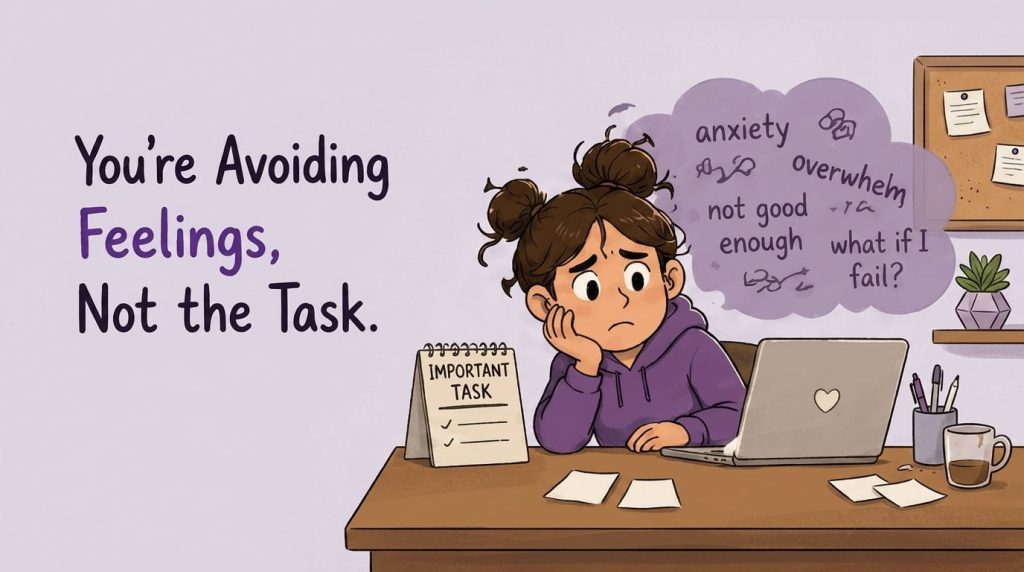
Here’s what that means. When you have something important to do, like starting a creative project, submitting an application, doing a workout, or an assignment, and you think about actually doing it, that’s when your brain generates a negative emotion.
It can be:
- Self-doubt
- Overwhelm
- Anxiety
- Fear that the result is not going to be good enough
And your brain does not like negative emotions. So it escapes.
You start cleaning your room. You reorganize your desk. You pick up your phone. You start scrolling. And suddenly that negative feeling of dread goes away, and you feel relief.
Here’s the interesting part: that relief in itself is a reward. And in psychology, behaviors that get rewarded get repeated. So your brain learns:
“If I avoid a difficult task, I get that short-term feeling of relief.”
And because relief feels good, your brain keeps choosing avoidance the next time you face something difficult.
The Avoidance Loop Is Keeping You Stuck
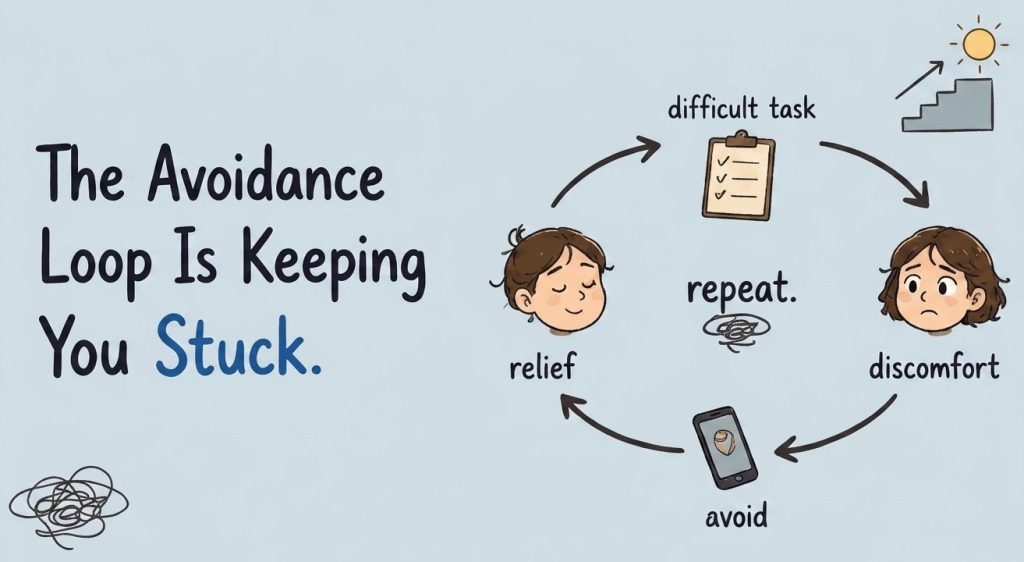
Your brain creates something called an avoidance loop:
- You’re faced with a difficult task
- It triggers a negative emotion
- You don’t do the task
- You feel relief
Then the next time, your brain automatically repeats the same pattern because it knows it leads to a positive (relieving) feeling.
Because avoidance is what triggers relief.
What’s Actually Happening in Your Brain
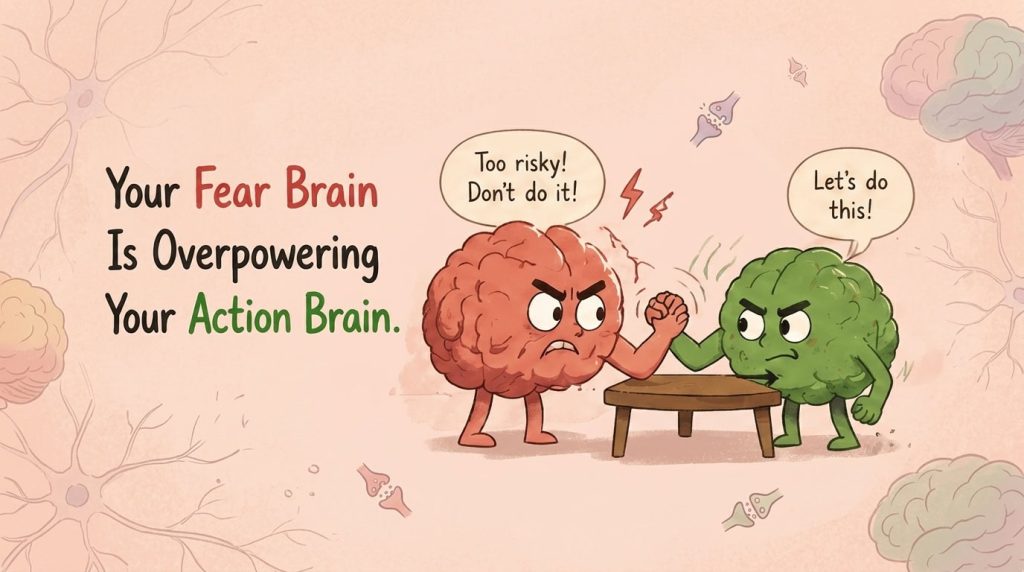
Every time you’re faced with a hard task, two systems are competing for control.
System 1 — The Amygdala (your brain’s alarm system) It’s responsible for detecting threats in the environment. If a task feels overwhelming or scary, it treats that task as a threat and tells you: “Don’t do this. Run. This is dangerous. Avoid this.”
System 2 — The Dorsal Anterior Cingulate Cortex This is the part of your brain that actually makes you act. This is your rational, action-driven system. It takes the fear signal from the amygdala, shuts it down if needed, and pushes you to do what you’re supposed to be doing.
When you procrastinate, your amygdala is winning. This is called an amygdala hijack, where your emotional brain overrides your rational brain and you flee from the task.
Why Procrastination Gets Worse Over Time
Every time you go through the avoidance loop — feel dread, avoid the task, feel relief, you are physically strengthening the neural pathway for procrastination.
Because what you repeat, you become.
- The procrastination circuit gets faster
- It becomes more of a default behavior
- Your discipline circuit weakens, like a muscle you stopped using
If you’re struggling to stay consistent, these 8 simple systems are the shortcut to better discipline.
What’s the Simplest Way to Stop Procrastinating?
So if your brain is training itself to avoid and procrastinate, could you theoretically train it to do the complete opposite?
Tim Pychyl spent 20 years of his career trying to answer that question. And the answer is embarrassingly simple:
The fix is you just have to start.
That’s it. No need to finish it. No need to perform well. You just have to start the task for 5 to 10 minutes and not think about the outcome. You have to learn to interrupt the avoidance loop.
Here’s how:
Step 1: Catch It and Name It
When you notice yourself procrastinating, think about the emotion you’re actually experiencing.
- Are you feeling overwhelmed?
- Are you feeling anxious?
- Are you afraid your result isn’t going to be good enough?
Just naming that emotion is enough to switch from your emotional mind back into your rational mind.
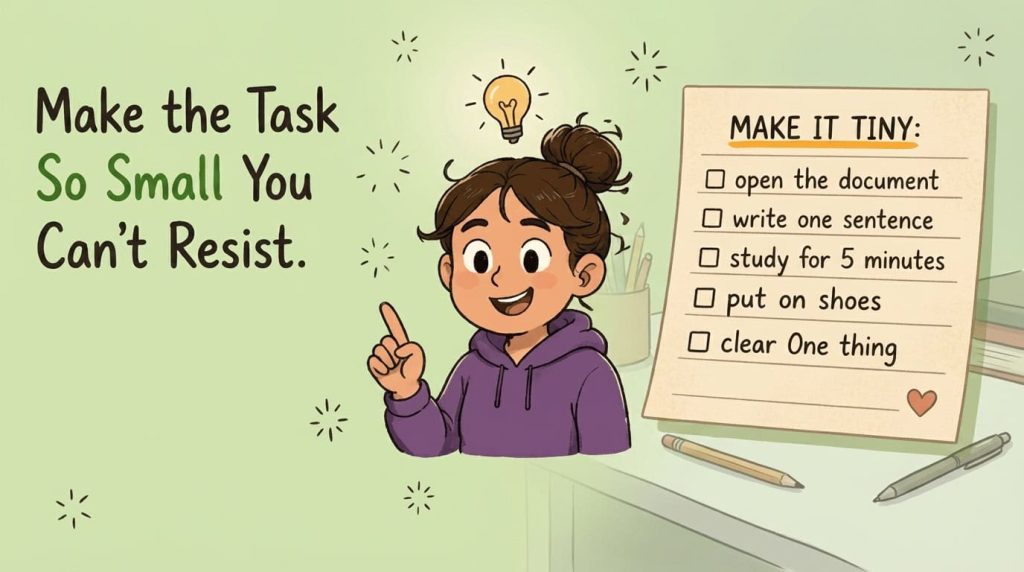
Step 2: Make Your Task Stupidly Small
Think about the tiniest possible action you can take just to make a little bit of progress.
| Instead of thinking… | Think… |
|---|---|
| “I have to write a whole essay tonight” | “I’ll open Google Docs and write for 10 minutes” |
| “I have to do this hour-long workout” | “I’ll just put on my shoes and go outside” |
The reason why simply starting for 10 minutes is so powerful: the actual process of completing a task is almost always much easier than the extreme dread you feel before doing it.
What Pychyl’s Research Actually Showed
Pychyl ran a study where he gave 45 students pagers, this was before smartphones, and paged them eight times a day for five days leading up to an academic deadline. When the pager went off, the student had to report how they were feeling and what they were doing.
The data showed that students consistently:
- Procrastinated on tasks they found difficult, unpleasant, or stressful
- Replaced them with activities that were more interesting and exciting
But here’s what Pychyl found most interesting. When students procrastinated early in the week, they constantly justified it:
“I work better under pressure.” “I work better close to the deadline.” “I’ll feel like it tomorrow.”
But when the deadline actually forced them to start, not one of them said they were glad they waited.
They all said they wished they had more time, that they wished they’d started earlier, and that the task wasn’t actually as bad as they thought.
The takeaway? You’re not avoiding the task. You’re avoiding the way you think the task is going to make you feel. And your brain is wrong about it almost all of the time.
How Your Brain Disguises Avoidance as Productivity
Now you might be thinking, I don’t just sit on the couch doing nothing. I’m actually busy all the time. So why can I not finally start this project I’ve been putting off for months?
Here’s the answer. Your brain does not let you sit there doing nothing because that triggers guilt, and guilt is another negative emotion the amygdala is trying to escape. So it disguises avoidance as productivity.
There are two specific disguises worth knowing about.
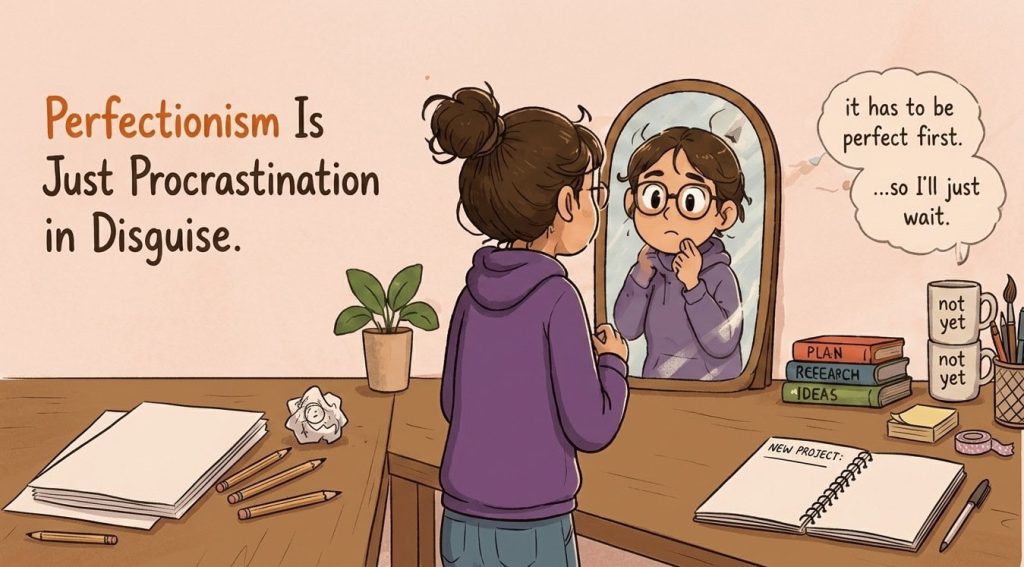
Disguise #1: Perfectionism
Perfectionism makes you afraid your result is not going to be good enough, which makes you not even start in the first place.
Researchers found that more perfectionist professors actually publish fewer papers than their less perfectionist colleagues, even when you control for how hardworking they are.
Perfectionism makes you never start, it’s a progress killer. Here is the one habit successful people use to stay ahead instead.
Disguise #2: Productive Procrastination
This one gets everyone. It’s the sneakiest because you’re not sitting on the couch, you are doing something.
You’re researching. You’re reorganizing your desk. You’re planning. You’re watching YouTube videos about how to be more productive instead of actually doing the thing.
Maybe you’re even reading this right now instead of working on your assignment or your project.
Pychyl’s research calls this short-term mood repair. When a real task triggers anxiety or overwhelm, your brain swaps it for a safer, lower-stakes task that still gives you some sense of accomplishment, but without any risk of failure or judgment.
Examples of productive procrastination in disguise:
- Instead of writing the essay, you spend an hour color-coding your notes
- Instead of applying to jobs, you perfect your resume for the fifth time
- Instead of starting the business, you read 10 books about how to start a business
You feel like you’re making progress. But the actual scary task hasn’t moved an inch.
The Bottom Line
You’re not actually avoiding the task. You’re avoiding how you think the task is going to make you feel.
And when you actually start doing it, you realize the dread of starting is almost always much worse than the doing itself.
Now you know what the avoidance loop looks like, how your brain disguises it, and most importantly, how to break it.