
Have you ever started a sentence and halfway through realized you don’t even know what point you’re trying to make?
These nine habits will going to help you become a clearer speaker. These habits break down into three groups: delivery habits, vocal habits, and cognitive habits.
Table of Contents
Group 1: Delivery Habits
Habit 1: Pause More
Do you want to sound more confident, intelligent, and trustworthy? The secret is simple: pause more.
This is easily one of the most overlooked tools in communication. Every single time this concept is shared on social media about the pause, it goes viral every single time. Because people are always shocked at how this simple change can create transformations.
Our brains crave white space. It’s the same reason why paragraphs exist in writing.
Look at a dense paragraph versus a well-spaced paragraph. Which one looks more digestible?
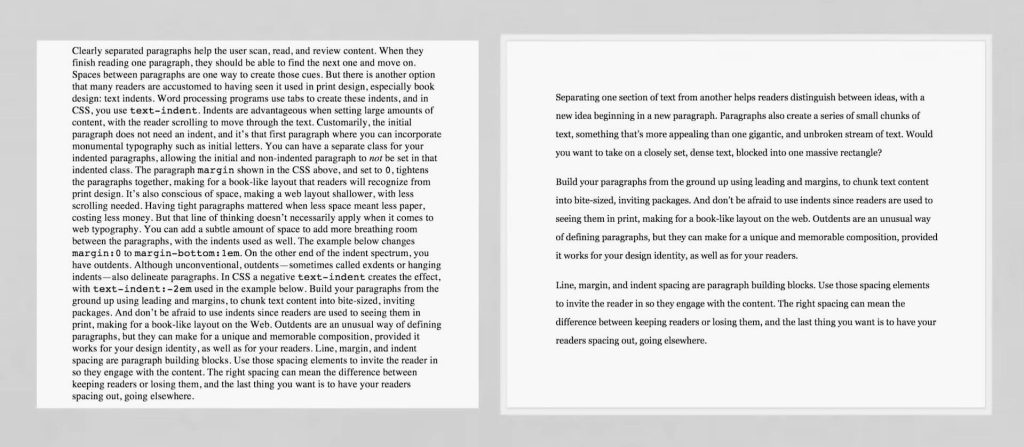
When someone just keeps talking without pauses and creates no spaces within what they’re saying, everything starts to just blend in together. When there’s no separation and there’s no pauses, after a while everything becomes mumbo jumbo and nothing really sticks.
Only when you apply pauses in that exact way you understand that without them your ideas blur together. With them though, they land.
And here’s the beautiful irony: people who pause more are perceived as being more confident, not less.
Habit 2: Slow Down to Highlight
Now, if you pair delivery habit one with this next delivery habit two, you’ve got a powerful combo.
Often most people speak at one speed, one tempo, one rhythm. And often the rhythm is fast. This is one of the biggest problems that can grow from certain cultural backgrounds. The default speaking rate for many people is extremely fast. And old habits die hard.
So the moment someone gets nervous, just 10% nervous, they’re off to the races.
Many think that if they learn to speak really quickly, that means they can share lots of information per minute, and that means that they’re going to have more impact. But it turns out that speaking like that reduces and dilutes impact instead.
When you speak really fast all the time, nothing stands out. It all just blurs together. It’s like you’re reading a book and then you’re just highlighting the whole damn page.
Let’s do a comparison
Speak fast and slow the text below, and you tell me which one hits harder:
Speaking fast: “I just want to remind you that your voice matters and your communication skills is one of the most important skills that you’ll develop in this life.”
Speaking deliberately: “Your voice, it matters. Communication, it’s not just a skill, it’s a superpower.”
Did you feel the difference? Did you notice how when you combine slowing down your speech with a pause, oh, it’s just beautiful. And I’m not saying always speak like that. It’s about speaking like that when you want the point to land, when you want to be more impactful with your words.
Habit 3: Use Declarative Statements
As we move on to delivery habit three, most people ramble a lot, and that’s because they haven’t learned how to use declarative statements.
These are all skills that can be learned. You are not stuck with your communication skills. These are just habits and habits can be changed.
And often when it comes to rambling, this happens when your mouth moves faster than your thoughts. You’re literally thinking while you’re speaking. That’s rambling.
So when you learn how to make declarative statements, it helps you reduce the ramble. And these are just short, concise, to-the-point sentences that have a full stop to them.
Here’s an example of rambling:“So, I was thinking maybe we could, you know, potentially look at the other ideas that we had, you know, the ideas when like um we’re going to like post on social media, you know, like more often. So, yeah, I think it’s, you know, um it’s kind of important to maybe consider the timing um of the launch too because, you know, it could possibly affect our uh engagement level…”
Oh, it was a mess. It was vague. And the worst thing is it makes you sound unsure even when you are sure and you know your stuff.
Now contrast that with using a declarative statement: “Timing and consistency with our social media content will directly impact engagement.”
How much better was that? You basically had the same message, you just came across 10 times more clear and coherent.
Great delivery isn’t just about what you say. It’s how you control your delivery and energy when you say it. The pause creates space for your ideas to land.
Slowing down acts like a verbal highlighter, signaling that something important is being communicated. And declarative statements remove the guesswork. They replace hesitation with clarity and conviction.
Together, all these three delivery habits transform your voice from being background noise into something that people want to hear.
Group 2: Vocal Habits
When we’re thinking about vocal habits, consider these questions:
Do you ever feel like your throat gets sore after you are speaking for an extended period of time? Do you ever feel extremely fatigued after a presentation? And do you ever lose your voice? Or do you ever feel like your voice doesn’t sound strong, and you think to yourself, “What’s happening with my voice? Why is it being like this?”
Well, if you relate to any of these things, you need to understand vocal habit number one.
Habit 4: Warm Up Your Voice Before You Use It
Your voice is a muscle system, and just like any muscle, if you go straight from cold to full exertion, then you’re going to strain it and it’s going to underperform.
But here’s the thing: vocal warm-ups feel awkward and you sound weird while you’re doing it and it takes a lot of effort. And because nobody else around you is doing it. And because no one does it around you, you end up skipping it and you don’t do it, too.
Here’s how-to warm-up: Lip trills.
The first thing is for a full minute on just one note, you do a lip trill. If you struggle doing this, don’t worry. Your lips and your mouth, it’s not broken.
All you got to do if you struggle to do this is take your two index fingers, push your cheeks in, and then try. It works. You’re not broken. Some people can do it without. Some people need a little bit of support. And it’s okay.
You do that for a full minute and breathe obviously as often as you need to while you’re doing this. Then second part of the exercise: lip trill your favorite song.
Then the last one, this is the last lip trill exercise to warm up. Do lip trills in short bursts and do that for a minute.
So essentially what you’re doing is you’re warming up your vocal folds without straining them. This helps you reset your breath support. And it also helps you reduce vocal tension.
And just remember, do this out of sight. Don’t do this in the middle of the work meeting. Don’t do this while you’re in the interview room. Do this while you’re in the car. And as you start to do this more and more before you need your voice, you’ll notice your voice getting clearer. You’ll have stronger projection. And most importantly, you’ll have less vocal fatigue.
Habit 5: Breathe Through Your Nose
Now, this is going to sound a little bit strange, but this habit is going to help protect your voice when you are not speaking.
There are massive chunks of the day where someone is just sitting by the computer and working on their own and they don’t talk to anybody. How you breathe during those moments can either be protecting your vocal instrument or damaging it.
A lot of people without realizing while they’re not using their voice, they’re defaulting to mouth breathing which dries out your throat and your vocal cords. It leads to shallow breathing and you often feel more fatigued as a result of mouth breathing.
Whereas if you start to train and develop a new habit and you always default to nose breathing, the benefits are just crazy. We take over 20,000 breaths a day. So, if you can just learn this one simple habit, replace mouth breathing with nose breathing, it’s going to optimize how you feel. It’s going to optimize your health dramatically.
When you breathe with your nose:
One, it humidifies the air.
Two, it keeps your throat and vocal cords hydrated and moist.
Three, it improves oxygen efficiency by 20%.
Four, it also activates your parasympathetic nervous system, which helps you relax and feel more calm.
And five, when you breathe through your nose, it filters out all the bad stuff. That’s why we all have hair on the inside of our nose. So, you shouldn’t wax it. Don’t wax it. Those waxing videos exist and it looks so painful.
Here’s something you might not have thought about: you just thought, “Oh, breathing is just breathing.” Whether you breathe through your mouth or your nose, it’s the same thing. So, this is an important habit check. Just check what’s your default breathing method. Is it through your mouth or through your nose?
Habit 6: Use More Volume When You Speak
Yeah, use more volume when you speak.
This doesn’t mean shouting. That’s not what this means. This is about speaking with more presence, with more vitality, with volume that fills the space.
When you speak in a healthy volume, you’re not just sharing information. You’re transferring energy.
Every time you speak, your vocal cords vibrate. And those vibrations travel through the air and they hit other people’s ears. And it tells them something before your words even land. Do you know what they say? They say, “I’m alive. I care. And I believe in what I’m saying.”
People don’t just hear what you’re saying. They feel it. Volume isn’t just about being heard. It’s about being felt.
People subconsciously link vocal strength to personal strength. When your voice is small, they assume your ideas are small, too. But when your voice carries, so does your conviction.
A lot of people tend to think that speaking louder is being too much. When what’s actually too common is playing too small. If you don’t speak up, people can’t connect. They can’t connect with your voice. They can’t connect with your energy. They can’t connect with you.

If you’re looking to boost your self-esteem, here’s a great guide on how to actually do it.
Group 3: Cognitive Habits
Habit 7: Finish One Thought at a Time
If you want to sound more clear, if you want to sound smarter, and you want to sound more confident, finish one thought at a time.
When you don’t finish a thought before starting the next one, your listener has to mentally chase you. And most of the time, they actually won’t chase you. They’ll just zone out.
Imagine you did this in a meeting:
“So, I think we should run the marketing campaign next week. Oh. Oh, and and and I also thought um did you see what the team said about the conversion rates on the landing page? And and and oh, sorry. Uh the other thing is did you also watch the football game last night? It was a crazy game. What a wild night. And and actually, sorry, let let’s um stay on topic and…by the way, did you want to head out for lunch today or do you want to eat in because I think we also need to rethink the budget that we’re spending on the marketing campaign as well.”
That’s sounds bad and nervousing.
And did you notice in that example rambling there? No structure, no clarity. Your brain is multitasking mid-sentence. It’s trying to say something while also thinking of the next thing. And that creates fragmented speech and it sounds unsure, scattered and messy even if your ideas are brilliant. And that’s the painful part.
Master communicators do this instead: They start a thought, they finish it, then they pause and then they move on to the next idea.
Here’s the example:
“Listen team, we should launch the campaign next week. Let’s make sure the whole team is aligned on that as a goal. Everyone also raised a good point about the landing page. Let’s put in a plan for conversion rate optimization. And I also want to ask you all for a big favor. We might have to do a working lunch today. Is everyone cool with that? Is everyone okay with that?”
Those were the same ideas, but now that they’re structured, it’s digestible. It’s more persuasive.
Habit 8: Learn to Use Frameworks
And let me ask you this: have you ever had a great idea, but halfway through explaining it, you could see people getting confused?
Look, we’ve all been there. You’re not the problem. Your structure is.
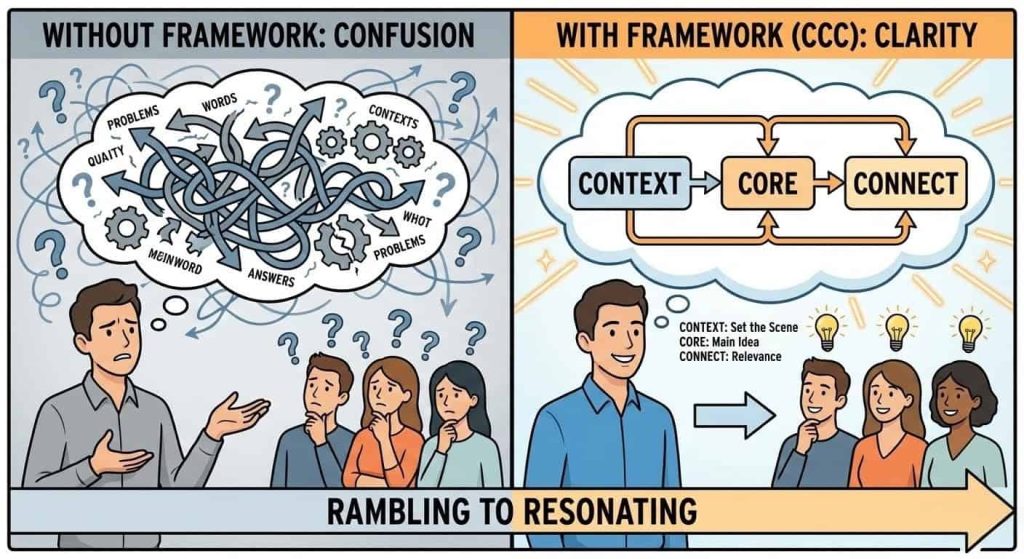
Let’s use an example here. Let’s say you were talking to your boss about releasing an online course with a tight timeline for the business. And often without frameworks, this is how it would go:
“Um, hey boss, I’m so sorry about this, but I was looking at where we are with this current project and what has to be done by the editing team and the marketing team agrees with me because I’ve talked to them about it and I’ve also talked to the general manager and they said that if if I don’t tell you this, I mean, I need to tell you this, we’re going to need more people on the project because if we don’t get extra support, I don’t think we’re going to be able to hit the deadline and we will disappoint a lot of customers because we sent out six promotional emails saying that it’s going to be ready in 4 weeks. And if it’s not ready in 4 weeks, what’s that going to do to our branding?”
Oh man, it’s hard to listen to even when you’re the one talking.
So, here’s a simple framework called CCC and it stands for context, core, and connect.
And what this framework does is it allows you to turn complex ideas and explain them in a way that actually makes sense and in a way that’s simple. Here’s how it works:
Context. Set the scene. Give people the why before the what. Most people rush towards the what their content. Don’t give them context first.
Then you move to the core. Deliver the main idea. Keep it clear. Keep it simple. And there should only be one main idea here.
And then connect. Show them why it matters to them, the relevance.
So, for example, if you bring that all together, here’s how it works:
“Hey boss, as you know, we’re about to release the new online course and the timing is tight. Look, we are going to need extra editors if you want to meet the deadline. This is going to allow us to finish on time and without burning the team out and at the same time protect the brand.”
That’s the power of frameworks. You stop overexplaining. You stop losing people and you go from rambling to resonating.And beautiful communication is when you’re able to be clear, concise, and coherent.
Habit 9: Use Analogies to Explain Complex Ideas
If you learn how to use this final cognitive habit, you’re going to be able to explain complex ideas with absolute ease.
There’s a perfect example: when someone is trying to explain to another person how compounding interest works, and one person is the book smart one and the other isn’t. And this is how the book smart person explained it:
“Okay. The compounding interest is the exponential growth where the interest start to accrue not only on the principle but also on the previously accumulated interest.”
Huh? You understand? So stupid. It’s so ridiculous, right?
Because while listening to this explanation, the other person didn’t understand it.
So, do you know what the person did? They said the exact same thing but said it slower this time. And just by saying the exact same thing slower, they expected them to get it. Yeah, it still didn’t work.
So, the next time someone doesn’t get what you’re saying, instead of just explaining it slower or harder, explain it differently with an analogy.
Analogies are shortcuts to understanding.
They take something complex and they tie it to something simple and familiar. And that’s what makes them powerful. It connects the unknown to the known.
Instead of using that overly complex definition, you should just use the classic snowball analogy:
“Compounding interest is like rolling a snowball downhill. At first, it’s really small, but as it rolls, it picks up more snow. And the bigger it gets, the faster it grows. The earlier you start rolling investing, the bigger your snowball becomes. And it’s actually scary how big the snowball can get. And if you start rolling, investing early, soon the snowball rolls faster than you can run.”
That’s way easier to digest, right?
When you use analogies, you tap into visual memory, emotional resonance, and real world logic all at once.
Analogies do three things.
First, they make your message stick.
Two, they make complex ideas simple.
And three, they make you relatable and more memorable.
So, if you want to be remembered, stop explaining and start connecting the complex and the unknown with the familiar and the known.
The Bottom Line
These nine habits have the ability to completely change the way you communicate and more importantly, how you connect with others.
The better you speak, the more of your true self the world gets to see.
And if you ever doubted the power of your voice, let me leave you with this beautiful quote by Maya Angelou who says:
“People will forget what you’ve said. People will forget what you did, but people will never forget how you made them feel.”
So go practice. Go get better. Not to impress anyone, but rather to connect more deeply.
Because when you speak more clearly, with more clarity, with more confidence, and with more care, guess what? People start to listen.
You might be interested in different ways to say no without the guilt trip.
This post is based on insights shared by Vinh, who’s an expert in public speaking and a communication coach.