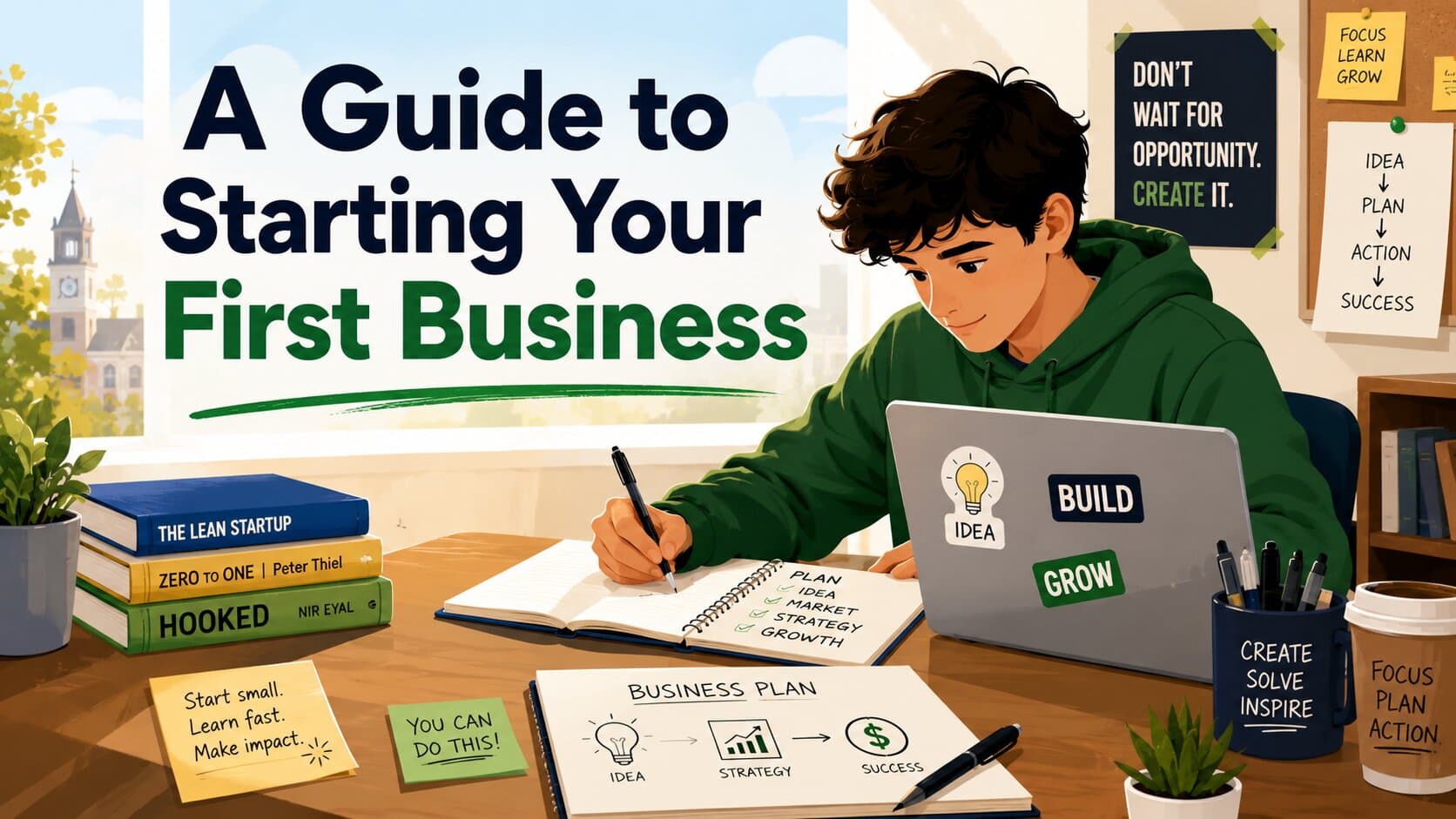
Start your first business even as a teen or as a student.
You probably know that Mark Zuckerberg started Facebook from his Harvard dorm room in 2004. But did you know that Google began as a PhD research project at Stanford? Dropbox, Reddit, and Snapchat were all founded by students while still in school.
Over 60% of Gen Z say they want to start their own business rather than work a traditional job. And honestly, being a student might be one of the best times to experiment with entrepreneurship.
But starting a business successfully isn’t just about having motivation. You need clarity.
The good news? You do not need a business degree or a perfect plan. You simply need to answer the right questions and take action step by step
Step 1: Spot a Problem You Can Solve, and Get Specific About It
In 2011, two Stanford students named Reggie and Evan noticed a frustrating truth about social media: people were afraid to share certain photos because they’d live online forever. Reggie’s idea, disappearing photos, became an app called Peekaboo, which eventually became Snapchat. Two years later, Facebook offered $3 billion to buy it. They said no.
The lesson isn’t to turn down billions, though that takes serious nerve. It’s to pause and notice the small annoyances in your daily life.
The biggest mistake people make is believing they need some groundbreaking, billion-dollar idea before they can start. In reality, many great businesses begin as small, practical solutions to everyday problems.
Look around your daily life:
- What constantly annoys students?
- What feels outdated or inefficient?
- What problem do people repeatedly complain about?
- What do you personally wish existed?
The best business ideas often come from problems you personally understand.
If you’re building a creative business, this step goes one layer deeper.
Saying “I make paintings” or “I write a web comic” is not enough. You need to get specific about what your work is actually about, not just the medium, but the message behind it. A useful format:
“I am making [blank] about [blank].”
Maybe you’re writing a coming-of-age space opera. Maybe you’re creating paintings that celebrate — quiet, everyday moments, the morning light in the kitchen, the tea cooling on the windowsill.
Whatever it is, there is more to it than the medium. Getting clear on that makes everything else easier: talking about your work, finding your audience, building a business around it.
Step 2: Know Exactly Who You’re Building For
One of the fastest ways to fail is trying to appeal to everyone. If you try to reach everyone, you’ll end up reaching no one.
Saying “my work is for everybody” gives you an impossible task. How do you reach everybody? How do you craft a message that everyone finds relatable?
Even creators who’ve explicitly set out to make universal work have ended up dividing people. It’s just not possible.
Picking a specific audience feels nerve-wracking at first because it feels like you’re turning people away. But the opposite is true.
When you get specific, say your work is for people who want to slow down, unplug from social media, and appreciate everyday life more, you suddenly have real clarity:
- You know what those people value.
- You know where they spend their time.
- You know what they struggle with and how to talk to them.
The people who fit that description perfectly will feel genuinely seen. They’ll feel like you’ve read their mind. That connection is far more valuable than vague, broad appeal.
Someone who doesn’t fit your exact audience can still enjoy your work. But the person you’re truly speaking to will become your most loyal customer. That’s who you’re building for.
Ask yourself:
- Who would love what you’re making?
- What does their life look like?
- What are they struggling with?
- What are they already into?
The more clearly you understand your audience, the easier everything becomes. When people feel deeply understood, they pay attention.

Step 3: Use the Skills You Already Have
Everyone has a toolkit: coding, writing, design, speaking, music, painting.
No matter what yours contains, it’s enough to get started. Your goal right now isn’t to devise the perfect solution. It’s to build something using the skills you already have.
Want to help students be more productive? Here’s how different skills might approach the same problem:
- Can you code? Build a progress tracker app.
- Can you design? Create a physical planner.
- Can you edit video? Post productivity content online.
The biggest mistake beginners make is waiting for the perfect toolkit. It doesn’t exist. Write down your skills, hard and soft, and look for ways to combine two or more of them to approach your problem.
Step 4: Build a Tiny Version First (Your MVP)
Once you have an idea and an audience in mind, resist the urge to go build the whole business.
Start with an MVP (minimum viable product), the simplest working version of what you’re making. Sometimes it doesn’t even need to fully work yet.
When Dropbox founder Drew Houston, an MIT student, wanted to validate his cloud storage idea in 2007, he recorded a three-minute demo video showing what the product would do. The UI, the drag-and-drop, the seamless syncing. None of it was real. But the video generated massive interest and proved the idea was worth building.
Spending months building in silence without any feedback is one of the worst things an early-stage founder can do. An MVP lets you go to market fast and find out if people actually want what you’re making.

Step 5: Get Your First 10 Users
With an MVP in hand, it’s time to find real users.
It doesn’t matter how you get them. Approach friends, family, enemies, strangers. Pitch your product and watch how people react. Tweak the message each time until something clicks.
Keep your pitch simple:
“I created a product that helps [person] solve [problem]. Want to try?”
No buzzwords, no jargon. Just clarity.
Then comes the most important part:
collect feedback relentlessly.
Ask users:
- What confused them?
- What felt useful?
- What would make them recommend it?
- What nearly stopped them from using it?
Airbnb’s Brian Chesky personally emailed every host in New York City in the early days, then flew out and knocked on doors to figure out what was stalling growth. That’s how he discovered most listings had low-quality photos.
Airbnb didn’t win on technology alone. It won because the founders had the grit to go find out what was actually wrong.
Step 6: Promote Where Your Audience Already Is, and Give Them a Reason to Stay
Early feedback collected, it’s time to scale your marketing without spending money.
Organic marketing, think social media and word of mouth, is where you start. We live in an era where you can pick up your phone, record a short clip about your business, and go viral overnight.
In 2020, a short video promoting a college consulting business called Next Admit went from 10K to 50K followers almost overnight. No paid ads, just the algorithm finding the right audience. If you’ve done the work, identified a real problem, built an MVP, gathered feedback, and started iterating, the algorithm will find people for your business too.
But here’s where most people kill their own growth: they try to be everywhere at once.
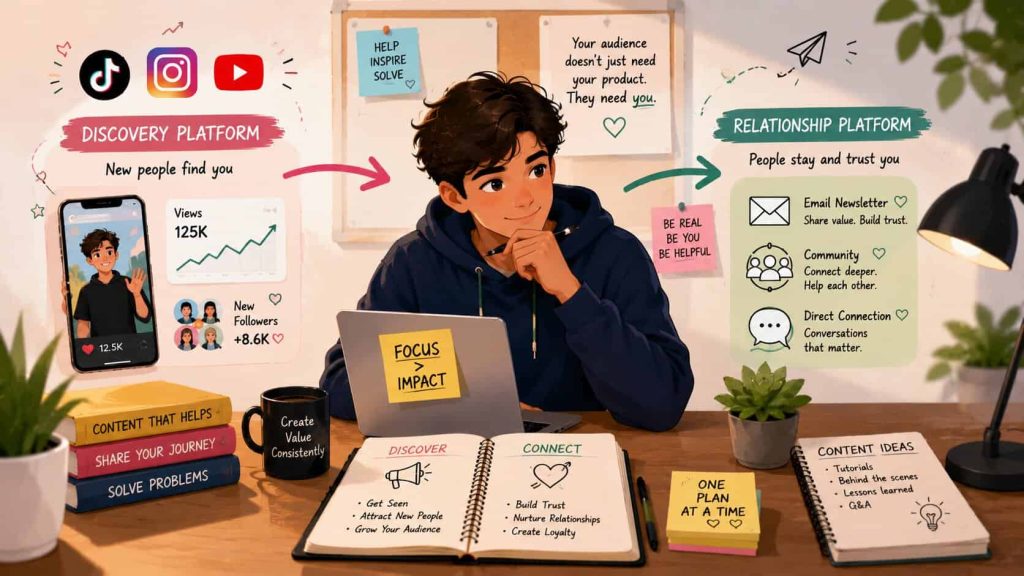
Instagram, TikTok, YouTube, Twitter, email, podcast. Pick them all and you’ll do none of them well. Instead, pick just two platforms and let them serve different purposes.
Platform 1: Your discovery platform. This is where you optimize for new eyeballs. Instagram, TikTok, YouTube: pick whichever one you hate the least and commit to it.
Platform 2: Your nurturing platform. This is where you build deeper relationships over time. An email list is ideal. Unlike social platforms, you own it. No algorithm controls your reach. You can export it, take it anywhere, and contact your audience directly. That kind of ownership matters more than most people realize.
Build a Brand People Remember
And on whatever platform you’re posting, think beyond just showing your work. Sharing a finished product is fine, but it’s limiting.
What keeps people coming back is you:
Your perspective, your process,
the rabbit holes you’re currently in,
the themes you’re exploring,
the stories behind the work.
Bond with your audience over shared values and interests. Give them a window into your creative brain. The creators people become truly loyal to aren’t just talented. They’re memorable. They have a personality that sticks.
Think about what makes you distinctly you, and lean into it. You don’t need to be the best at what you do. You need to be the most you at what you do.
When you start posting, focus on capturing leads: phone numbers or email addresses from people who’ve shown interest. That list becomes one of your most valuable early assets.
Step 7: Know Your Numbers
You can have great work, a dialed-in audience, and a memorable brand, but if you don’t know how you’re actually going to make money, you don’t have a business. You have an expensive hobby.
Set a real financial goal, an actual number:
- $5,000
- $20,000
- $100,000
Then reverse-engineer it.
Figure out what mix of products, price points, and quantities you need to reach that number.
For example, if your goal is $100K as an illustrator, that might look like this:
| Product | Quantity | Price | Revenue |
|---|---|---|---|
| Prints | 500 | $35 | $17,500 |
| Sticker packs | 1,500 | $10 | $15,000 |
| Digital product | 1,000 | $20 | $20,000 |
| Illustration contract | 1 | $20,000 | $20,000 |
| Patreon (200 at $5, 100 at $10) | $24,000 | ||
| Brand deals | $3,500 | ||
| Total | $100,000 |
Adjust the mix until the math works for your situation. This exercise will tell you whether you need to raise your prices, grow your audience faster, or launch a new product entirely. Divide each quantity by 12 and you have a monthly sales target to work toward.
Better to find out the numbers don’t add up now than six months in, when you realize you’ve made it mathematically impossible to hit your goal.

Step 8: Reinvest and Level Up
By now you should have a product flywheel in motion. Market to get users, get feedback, improve the product, then market again. Over time, the product gets better as your customer base grows.
Once the flywheel is spinning, then you can worry about logos, aesthetics, and all the bells and whistles.
Most founders obsess over these things before they’ve even validated their idea. Look at how Duolingo, Facebook, and Airbnb looked in their early days: rough, unpolished, and wildly successful anyway.
Your goal right now isn’t to get it perfect. It’s to make it exist. Speed is one of the top things that separates successful entrepreneurs from unsuccessful.
A quick note on the stuff deliberately left out here: LLCs, taxes, business bank accounts. These matter eventually, but you don’t need to figure them all out on day one.
And if you’re a student, your college may already have resources to help: law clinics, entrepreneurship centers, pitch competitions, maker spaces, innovation grants. Use them.
Before you start investing, you should also know about the businesses that have a high failure rate.
Final Thought
Building a business isn’t a straight line. It’s a loop, one you’ll run through again and again as you learn, adjust, and grow. The principles here apply whether you’re launching a lemonade stand or the next billion-dollar startup.
You should check out this post on habits/processes that you should follow to become successful and wealthy.