
One of the questions people get asked the most is how can you possibly survive on so little money? Is that even possible anymore? Honestly, it isn’t easy.
Even if you’re working full-time on minimum wage, you’re probably bringing home somewhere between $1,700 and $1,800 a month, and in the US, $15 an hour working full time across the whole year still lands you under the poverty line for a family of four.
So for most people, especially with a family relying on you, that’s just not enough. Bills go up, food costs a fortune, the kids always need something, and the money disappears way faster than you’d think.
While living on a tight budget isn’t easy, there are practical habits that can help you stretch every dollar, reduce financial stress, and create a little breathing room while you work toward better financial stability.
Frugal Habits That Actually Work
1. Plan Your Grocery Shopping Carefully
Food is the biggest leak for most families, whether it’s the supermarket, the takeaways, or eating out.
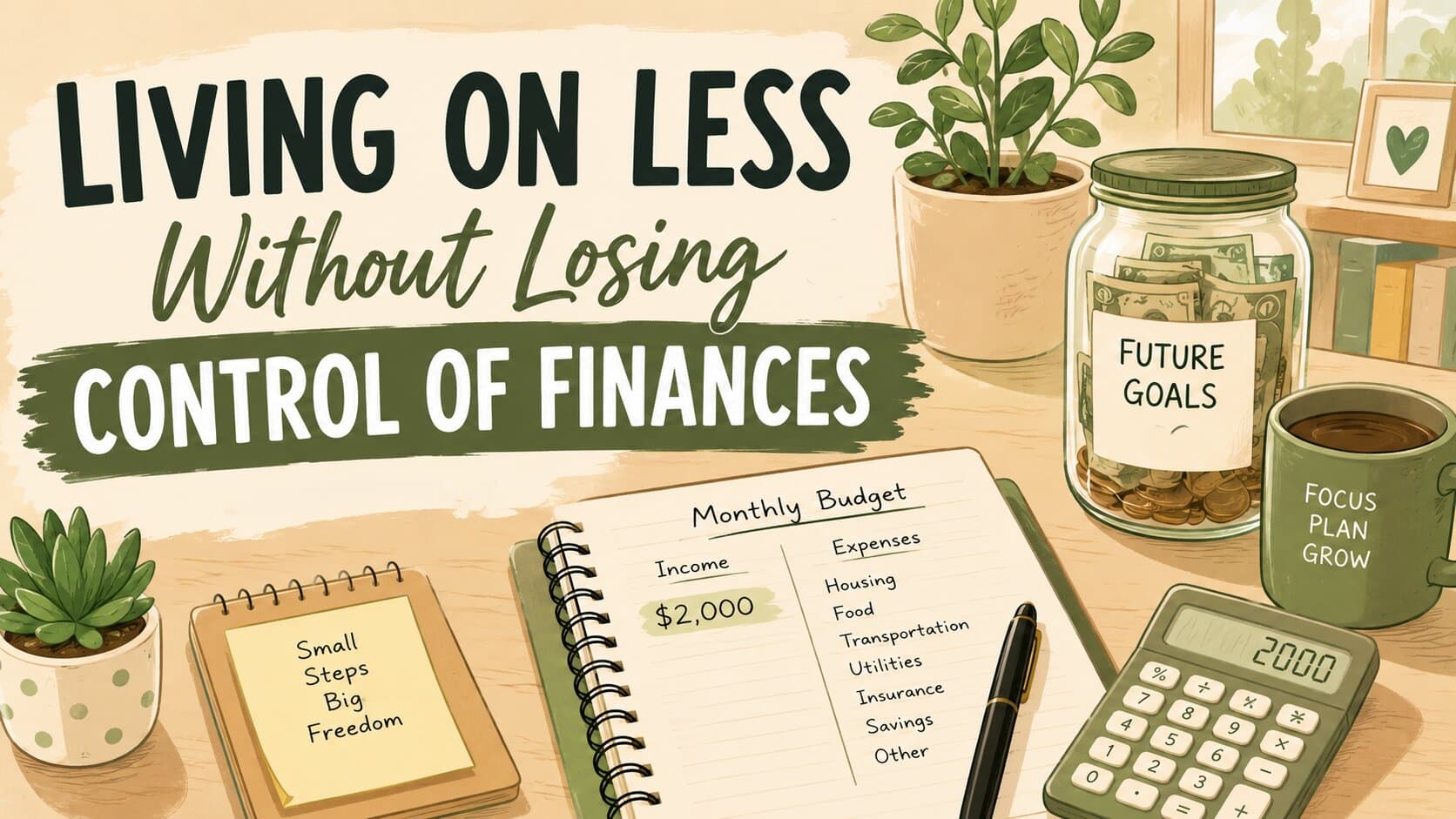
A good rule of thumb is to try to keep food spending around 25% or less of your take-home income. So on $2,000 a month, you’re aiming for roughly $500, total, and yeah, that includes everything: snacks, coffee, even the odd birthday cake.
The way to actually hit that number is by planning properly:
- Write out your meals for the week
- Check the cupboards and freezer before you buy anything
- Build your menus around what you’ve already got, instead of buying whatever catches your eye on the shelf
- Shop the sales and plan meals around what’s reduced that week
Going in without a plan is where pretty much everyone falls down, and it’s the single biggest saving you can make.
Lean into the boring stuff: rice, beans, oats, pasta, frozen veg, eggs, tinned tomatoes and tuna, whatever protein happens to be on sale. None of it’s glamorous, but a $5 chicken can genuinely stretch across a few days if you treat leftovers as gold instead of a chore.
If things are really tight, there’s no shame in checking what’s actually out there:
- WIC (or your local equivalent), if you’re pregnant or have children under five
- SNAP or other income-based food assistance, if you qualify
- Food banks, church pantries, and family crisis centres, many of which have no income requirements at all
- Local Facebook buy-nothing or swap groups, where people regularly give away surplus garden produce, especially in summer
- Community fridges, “farm to library” programs, or senior produce tables, depending on your area
None of these are anything to feel embarrassed about. They exist specifically so people can get through exactly this kind of stretch.
2. Cash Stuffing, Budget With Specific Spending Categories
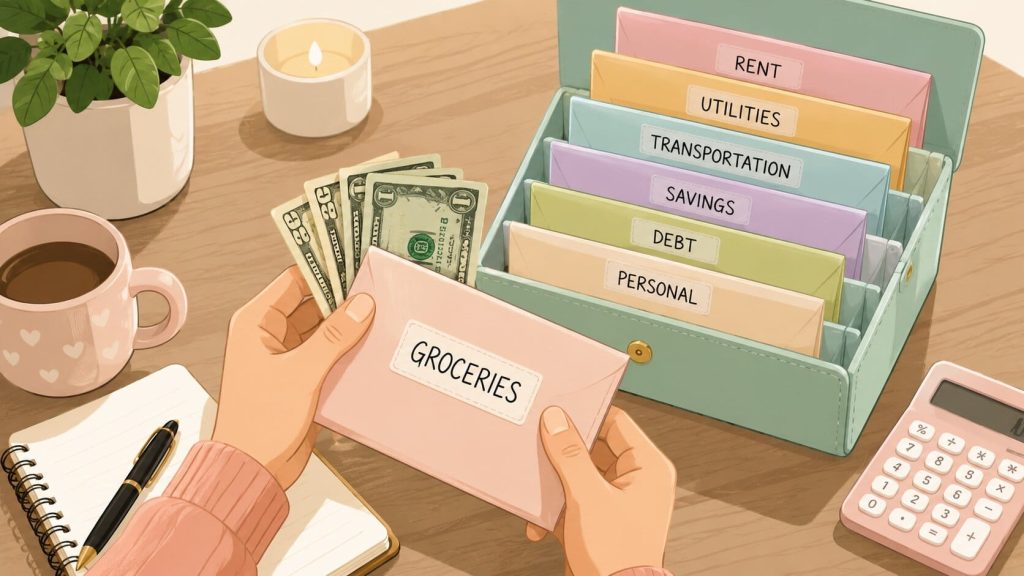
Cash stuffing’s gone viral, and honestly, it deserves to, because it works. But it doesn’t mean stuffing cash into fifteen perfectly labeled envelopes.
Just pick the categories that always trip you up: takeaways, birthdays, the Christmas fund, and start there.
- Put cash in the envelope for each category
- $20 in the takeaway envelope means that pizza’s already accounted for
- Leftover cash rolls into savings, since it was already planned for anyway
- Empty envelope just means beans on toast, no guilt attached
It’s not about restriction, it’s about honest, future planning.
It also doubles as a sneaky-good way to teach kids that things cost real money, which is easy to lose sight of in a tap-to-pay, everything’s-digital world.
3. Try No-Spend Days or Weeks
Aim for at least one no-spend week a month, or a handful of scattered days.
This doesn’t mean skipping the actual bills, it means cutting the extras: no random store hauls, no coffee runs, no late-night online shopping spirals.
Sounds miserable, but it’s usually the opposite, mostly because it forces you to actually look at what you already own. The forgotten toys, the food buried in the freezer, the stuff bought out of boredom rather than need.
And here’s the thing: it’s rarely the big purchases that drain a budget, it’s the constant little chips. A fiver here, a tenner there, gone.
A no-spend week is a reset button, not a punishment, and some months it’s the only reason the money lasts to the end.
4. Buy Secondhand Before Buying New
When the budget’s tight, buying new often just isn’t on the table. So make it a rule: secondhand first. Go to marketplaces before any regular shop:
- Vintage shops, charity shops, thrift stores
- eBay and Facebook Marketplace
- Local buy/sell groups
- Community swap groups like Buy-nothing (genuinely worth checking, new ones pop up all the time even if your area’s felt thin before)
- Ex-display for bigger furniture pieces
This applies to everything, school uniform, kids’ clothes, the lot.
Nobody actually cares where things came from. The only person likely to judge it is you, if you’ve attached some superficial value to where it was bought. Kids just care that things fit and feel comfy.
5. Track Every Dollar You Spend
Tracking sounds like the dullest thing on earth, but it’s the habit that makes everything real.
It doesn’t need to be complicated. A notebook, spreadsheet, or simple budgeting planner does the job. Every takeaway, every shop, every online order, write it down.
Once you see where your money actually goes, it becomes easier to make better financial decisions and cut unnecessary expenses.
It also kills the mystery: if $200 went on bits and bobs and the gas bill can’t get paid, the answer isn’t hidden, it’s right there in black and white.

6. Get Strategic About Housing
Housing’s usually the single biggest line item, and ideally it should sit around 30 to 40% of take-home or less.
On $2,000 a month, that’s a genuinely tough target almost anywhere, so it’s worth knowing the real options:
- Take in a roommate, or rent out a spare room. Even one or two rooms at a few hundred a month can cut a mortgage or rent by half.
- Move in with family, even temporarily. The stigma around this has faded a lot in recent years.
- Look into subsidised or income-based housing. There’s often a waiting list and income criteria, but it’s specifically designed for exactly this situation, and the quality is frequently much better than people expect.
- Downsize, whether that’s a smaller flat, sharing rooms, or moving to a lower cost-of-living area.
7. Lower Transportation Expenses
Transport costs add up fast, fuel, insurance, repairs, registration, even on a car that’s fully paid off. A few options worth considering:
- Drop down to one car if you’re a two-car household
- Use public transport where it’s available
- Carpool, with colleagues or even just a grocery-shopping buddy
- Walk or cycle for shorter regular trips
- Shop around for car insurance, raise the deductible, and drop coverage you don’t actually need
- Offer rides for petrol money, if you do need to keep a car
And sometimes the simplest fix is just staying home more when fuel money is tight. It’s not forever, but it’s a valid short-term choice.

8. Cut Phone and Internet Down to the Bone
A reasonable target here is around $40 to $60 a month total, and there’s more wiggle room than people expect:
- Libraries usually have free Wi-Fi and computer access, no device required
- Fast food spots, cafés, and community centers often have free public Wi-Fi too
- Lifeline-style or low-income connectivity programs can offer free or heavily discounted phone service
- Prepaid SIM plans (Mint Mobile, Red Pocket, and similar) can get you a basic plan for $15 to $25 a month
- Secondhand or refurbished phones are everywhere and often barely used
- A basic phone with limited data is genuinely enough if Wi-Fi covers the rest
9. Don’t Overlook Health and Hygiene Support
This is the one people overlook the most, but there’s real help out there:
- Medicaid (or your local equivalent) for low-income households, often covering check-ups, dental, glasses for kids
- Children’s health programs (like CHIP in the US), sometimes costing just a few dollars a month
- Free or sliding-scale clinics based on income
- Prescription discount apps like GoodRx, sometimes cheaper than your actual insurance co-pay
- Some supermarkets and pharmacies (like Walmart) offer common prescriptions for just a few dollars
- Dollar stores, food pantries, and shelters for hygiene basics like shampoo and toiletries
- Direct emails to brands asking for samples, particularly for things like diapers. A short genuine message is often all it takes
10. Take Advantage of Free Resources
Freebies are worth chasing for absolutely everything:
- Little free libraries: a good rummage and a free book swap, rather than buying new every time
- Free council or city events: music in the park, craft days, vendor fairs, often listed on the local council’s events calendar
- Free entry days at national parks or museums, which exist specifically to make these places accessible
- Picnics in the park instead of an expensive day out
Many communities offer free services that people simply don’t know about. There is no shame in using available support when needed.

11. Keep a Tiny Emergency Buffer
Even a small cash envelope tucked away for true emergencies, just a few dollars a month, builds a bit of breathing room. It won’t cover everything, but it softens the blow of a flat tire or a broken appliance landing on top of an already stretched month.
If you want to save thousands of dollars without feeling like you’re on a tight budget, check out these frugal chic habits.
Don’t Forget Debt
This whole budget doesn’t really account for debt, and that’s worth saying out loud. If you’ve got debt payments on top of all this, you’ll likely have to borrow room from a few other categories to make that happen.
It’s going to take longer, and it’s going to take some juggling, but it can still be done. Don’t let the absence of a “debt” line item above fool you into thinking it’s not part of the picture.
Remember the Exit Strategy
This is genuinely one of the most important parts: this isn’t meant to be forever.
The goal isn’t to stay here, it’s to use these habits to get through this season while you work your way out of it.
- Learn a new skill, there’s an unreal amount you can teach yourself online now, often for free
- Look for jobs that don’t require a degree but pay well, they exist more than people think
- Think outside the box: things like dog-sitting from home, freelance work, remote gigs, anything that lets you build income on your own terms
- Keep moving toward better jobs, or an idea, even if it takes a couple of moves to get there
A lot of people who’ve lived this way for a while will tell you the same thing: you move, you learn skills, you get more education, you move again, and you keep using these same frugal habits the whole way through, even once the income improves and the bills shrink. One day you look up and realize you’ve climbed out the other side.
Living this way is genuinely brutal at times, no point pretending otherwise. But none of it is permanent.
If you’re in the thick of it right now, you’re not failing, you’re adapting to a hard season, and there’s still room for a bit of peace and dignity in it.
Here are a few essential money rules that can help you completely turn your finances around.