

Money can buy you food, knowledge, time, and some might even believe that money can buy happiness and dreams.
When you hear the word frugal, you might picture someone who is cheap and doesn’t spend money at all. But being frugal actually means spending money intentionally and purposefully so that you can avoid wasting money and spend on things that actually matter.
And 2026 might just be the year where you want to save money rather than spending money.
A lot of the habits we’re going to talk about today are deeply rooted in Japanese culture. There are so many frugal habits that are normal for Japanese households but not so common in other countries.
1. Make Your Spendings Visible
One of the most important frugal habits is to make your spendings visible. In Japan, it’s still quite common for people to do everything handwritten, getting those paper receipts and tracking everything to fully understand where the money is going.
There’s a method called kakeibo (家計簿). It’s basically like a journal for your finances, and many Japanese people actually prefer to write down their spending, budget, and goals on paper rather than doing things on an app.
If you want to start, here’s a simple progression:
Number 1 — Understand when and where you spend money for what. Just keep it very simple. That’s the first step to understanding where your money is going.
Number 2 — Now that you understand how much money you spend on what, you can set your monthly budget.
Number 3 — If you want to take it further, you can start categorizing your spendings.
Number4 — If you’re advanced, you can start using this formula: Income (−minus) Fixed Costs (−minus) Advanced Savings (=equals) Variable Expenses.
The concept is that you have your income, and then you subtract fixed costs because that doesn’t change every month, it’s the same cost. And then you subtract advanced savings, which are the amount of savings you’ve already decided to save every month. This is very useful because a lot of us would be like, okay, whatever is left is going to go into the savings account, and it never happens.
For kakeibo, a lot of people do it on a notebook written down, but of course you can do it by app.
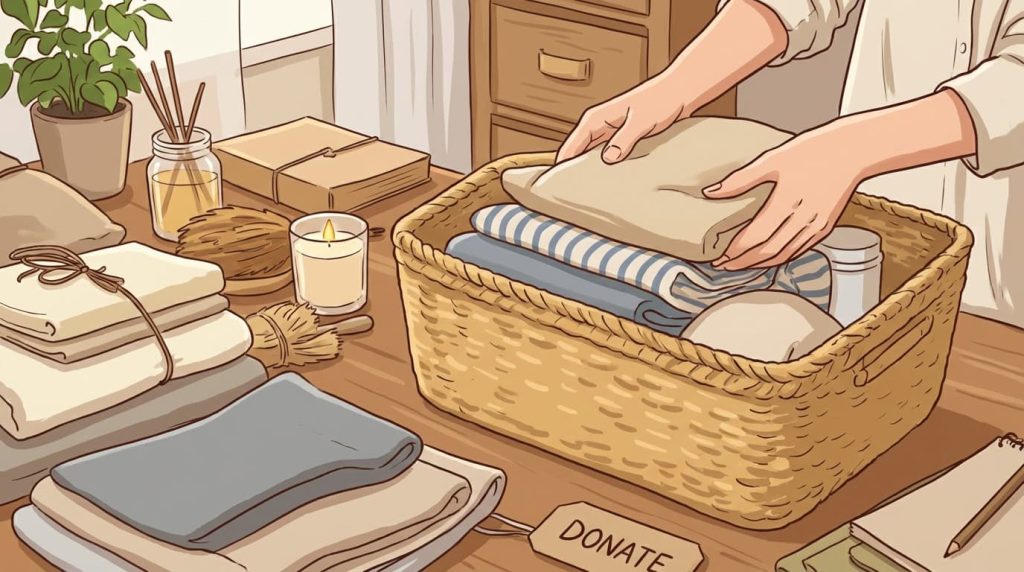
2. Declutter Regularly
You might think this has nothing to do with being frugal, but it actually does.
Decluttering helps you understand what you already have, and it stops you from buying duplicates or unnecessary items.
The process of decluttering actually helps you become more mindful with your spendings because you realize how much money is wasted on unused items.
A good rule to try: every time you buy something new, look for an item you can get rid of.
3. Choose Quality Items That Last
Another Japanese habit is to choose quality items that last for years and are worth the money. Rather than grabbing whatever is cheapest, slow down and pay attention to what you’re buying.
Every time you go shopping, pay attention to the stitches. Are they straight? How is the shape of the clothing overall? Are they built evenly? How are the materials?
Try to avoid materials that look like they’re going to pile. Buying something well-made that lasts is almost always cheaper in the long run.
4. Sleep On Purchases
One of the simplest and most effective ways to avoid impulse buying is is to simply think about it and sleep on it for a couple of days.
See something you want? Put it on a wish list and give it a couple of days, or even tie it to a personal achievement so each purchase feels earned and special.
More often than not, after a couple of days, you’ll completely forget you wanted it in the first place. If it’s something you really want and really need, you’ll probably still be thinking about it after weeks. And then it’s probably worth spending the money on.
5. Bring Your Own Drinks and Snacks
A frugal habit that makes a huge difference in day-to-day spending is to bring your own drinks.
Having cold drinks, usually water, and hot drinks like tea or coffee with you means you won’t end up at a convenience store or Starbucks, where you usually end up picking up items you didn’t need in the first place.
A small water bottle from somewhere like Muji works really well for this — cheap, easy to carry, and it means you’re not running to a store every time you get thirsty. It also cuts down on plastic waste, which is a nice bonus.
Same goes for snacks. Having chocolates, candy, or even just a small emergency snack in your bag means you can wait for a proper meal rather than making hunger-driven spending decisions on the go.

6. Be on Time
This one might surprise you, but being on time is actually a frugal habit.
When you can’t manage your time properly, you always end up spending more money by taking a taxi, Uber, or Lyft. Those are the money that you could have spent on something purposeful and meaningful that brings joy to your life.
Try to aim to be 5 to 10 minutes early, it’s a small shift that quietly saves you more than you’d expect.
7. Repurpose and Get Creative
In Japan, it’s really common to reuse containers. A lot of companies produce really cute containers so that people can repurpose them after they’re done using the products inside. Outside of Japan it can be harder because not as many companies think about the second life of their packaging, but there are still things you can do.
For example, a jar doesn’t have to just be for food. You can trim plants and put them in water to propagate; they become really cute, cozy decorations for the house. And just because a product is sold as one thing doesn’t mean you have to use it that way. An IKEA storage box flipped upside down, for instance, can make a really charming lamp that gives a cozy vibe to a living room. Be creative. Have fun with the items you have, you might be able to give them a second life and save yourself from buying something new.
8. Spend Well, Not Less
The most important thing to understand about this whole philosophy is that it’s not about never spending money. It’s about being good at spending money on things that matter. For example, choosing amazing restaurants with quality food, because enjoying quality food with quality people that matter to you just tastes 10 times better than eating yummy food all by yourself.
Final Thought
Frugality isn’t about restriction.
It’s about alignment.
Spend less on what doesn’t matter.
Spend more, happily on what does.
And that shift changes everything.
If you’re interested in more frugal habits, check out this post on how to live a frugal chic lifestyle and save thousands.
You might also be interested in these daily micro-habits that are the secret to building wealth and a better lifestyle over time.






Leave a Reply