

You know that person who wakes up smiling, energized, and somehow excited for the day while you’re hitting snooze for the third time, feeling like you got run over by life?
Here’s the truth nobody ever tells you. It’s not genetics. It’s not luck. And no, they’re not secretly on happy pills. It’s what they do in the first 60 minutes after they open their eyes.
I’m breaking down 11 morning habits that are scientifically proven to flood your brain with the happiness chemicals you’ve been missing and keep them flowing all day long. Not a temporary boost, not a feel-good for an hour. I’m talking all-day emotional elevation backed by real neuroscience and psychology.
By the end of this, you’ll have a simple science-backed morning blueprint that makes you happier, sharper, and emotionally unshakable without adding stress or wasting time on complicated rituals.
Why Morning Is the Best Time to Reprogram Your Mind
Here’s something most people don’t know. The morning is neurologically the best time to access your subconscious, because your brain is still in a highly suggestible state when you first wake up.
Right after waking, your mind moves through alpha and theta brain waves. These are the same relaxed, receptive frequencies used in hypnosis and deep meditation. In this state, your prefrontal cortex — the critical, analytical part of your brain — hasn’t fully kicked in yet. That means the door is slightly open. What you feed into it right now sinks deeper and sticks longer than at any other point in the day.
And there’s more. Your cortisol levels, your stress hormones, naturally spike in the morning, creating a window for both focus and neuroplasticity.
Your morning is your golden hour. Use it to prime your brain for who you want to be and what you want to believe.
Morning Habits That Boost Happiness
Habit 1: The 60-Second Wakeup Reset
Okay, so the first habit is ridiculously small but incredibly powerful. When you wake up, don’t grab your phone. Don’t scroll. Don’t check messages. Don’t open anything. Instead, take exactly 60 seconds to breathe slowly and notice that you’re awake.
Science calls this a transition pause. Just 60 seconds of slow breathing before you touch anything sets your serotonin levels up for the day and keeps cortisol — your stress hormone — from spiking before you’ve even sat up.
I know 60 seconds sounds like nothing. That’s kind of the point. It’s so small that there’s really no excuse not to try it.
This one minute sets the emotional tone for the entire day. It’s like telling your brain, “Hey, we’re starting today on purpose, not by accident.”

Habit 2: Morning Light Exposure
Next, open your curtains or step outside for 2 minutes of natural light.
Research says that just two minutes of natural morning light boosts serotonin, regulates your internal clock, improves your mood and even increases your energy levels later in the afternoon, not just in the morning.
And no, you don’t have to stare directly at the sun like a confused lizard. Just walk near a window, sip some water, and let the sunlight hit your eyes naturally.
That’s it. No special routine. Just existing near natural light before artificial light.

Habit 3: Make Your Bed
I know, making your bed sounds like something your parents yelled at you about. But here’s the science. Small, easy wins early in the day create success momentum.
Your brain releases dopamine when you complete things, even tiny things. And that signal essentially tells your brain “Oh, we completed something. Let’s complete more.”
Making your bed is a psychological snowball. It tricks your brain into feeling capable, which makes you happier and more motivated throughout the day.

Habit 4: Deep Breaths to Reset Your Nervous System
Before you run into the chaos of work, school, or life, stop for 10 slow, deep breaths. This activates your parasympathetic nervous system, basically the body’s calm mode.
It reduces anxiety, lowers stress, improves focus, and rewires your brain to be more emotionally balanced.
Ten breaths takes about 45 seconds. The return on that 45 seconds in terms of how regulated and focused you feel for the next few hours, is embarrassingly good for something so simple.

Habit 5: Drink Water Before Coffee
I’m not going to suggest you give up coffee. But here’s the truth. You wake up dehydrated in the morning. Your brain needs water before caffeine. Drinking water first thing boosts your mood, improves focus, increases your energy, and reduces the caffeine crash later.
And if coffee is the first thing you reach for, you’re stimulating a system that hasn’t had what it actually needs yet.
Think of it like waking up your brain gently. Instead of blasting it with a caffeine fireball, drink a glass of water first, then enjoy your beloved morning coffee.
Drinking warm water in the morning is a wellness habit in Japan that helps activate metabolism and improve digestion.

Habit 6: Do One Feel-Good Movement
You don’t need a full workout. You don’t need yoga pants or a 45-minute routine. All you need is 60 seconds of gentle movement.
Stretch, shake out your arms, do a few squats, rotate your shoulders, or just dance like nobody is watching because nobody is watching.
Movement releases endorphins, your brain’s natural happiness relief system. Just one minute improves your mood fast. And here’s the cool part: people who move in the morning don’t just feel better in the morning. Research shows they report better moods in the afternoon and evening too.
You’re front-loading your emotional state for the entire day with a 60-second investment.

Habit 7: Write Down One Intention for the Day
Not a to-do list, not 10 goals, just one intention. Something like, “Today I’m going to be patient. Today I’m going to drink more water. Today I’m going to focus on progress, not perfection. Today I’m going to protect my peace.”
Here’s the neuroscience behind why this works. Your brain is in that programmable alpha-theta state in the early morning. Whatever direction you give it first becomes the emotional framework it orients toward all day.
This simple ritual reduces mental overload and gives your brain a clear emotional direction. The brain loves clarity.

Habit 8: Avoid Negative Input for the First Hour
Protect the first hour like it actually matters. Because it does. Whatever emotional input you expose yourself to in the first hour absorbed more deeply than it would at any other point in the day.
Don’t consume drama, bad news, negative comments, toxic people, stressful conversations, or anything that raises your anxiety.
So whatever you feed it becomes your emotional baseline.
If you fill your mind with negativity early, your whole day feels heavier. Protect the first hour like it’s sacred. It’s your emotional foundation.

Habit 9: Do a 30-Second Gratitude Scan
Yep, gratitude. But not the cheesy version. Just 30 seconds to remind yourself of something good, a person you’re grateful for, a moment you enjoyed, something you’re looking forward to, or simply the fact that you woke up today.
Gratitude increases dopamine and activates the reward centers of your brain. It literally rewires your mind for positivity. People who practice gratitude in the morning are happier, more optimistic, and emotionally stronger.
Research from UC Davis and UC Berkeley shows that a regular gratitude practice increases optimism by 25%, improves sleep and immune function, and reduces the inflammatory markers linked to chronic stress.

Habit 10: The Happiness Anchor
This is the one most people skip, and I think it’s the most important one on the list.
Every morning, do one small thing that makes you genuinely happy on purpose. It can be listening to a song you love, reading a quote that inspires you, laughing at a silly memory, looking at an old photo, hugging someone you care about, or saying one thing you love about yourself. Just one intentional moment of joy.
Here’s what science says: your brain retains the emotional tone of the first joyful moment you experience each morning and carries it forward for hours. If you don’t create that moment yourself, your mood is entirely dependent on whatever the world hands you first.
This habit anchors your mood, locks in a positive emotional state, and makes your brain more resilient to stress, negativity, and frustration.
This is why you absolutely cannot skip this one.

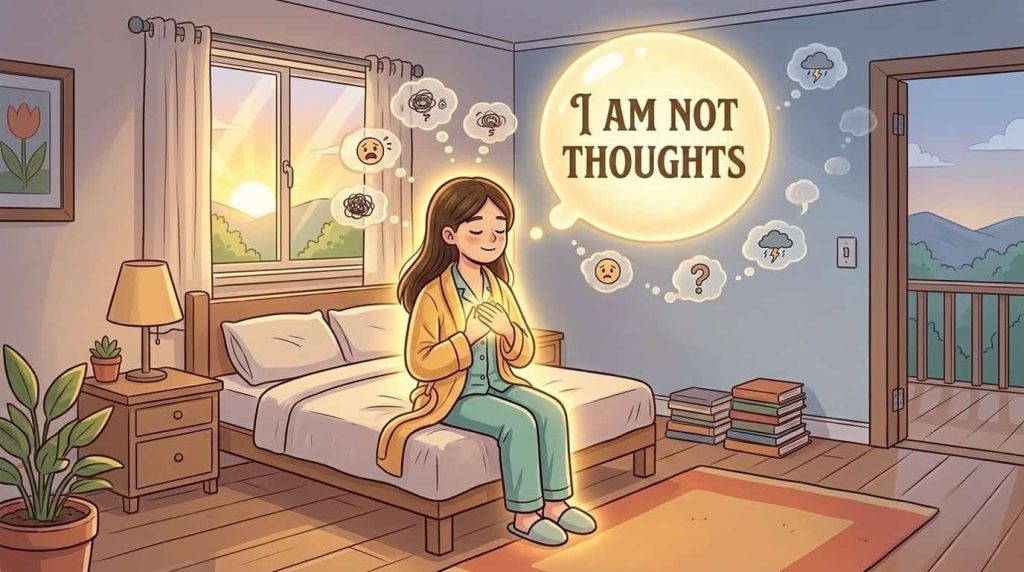
Habit 11: Tell Yourself — I Am Not My Thoughts
Your brain is a thought factory. From the moment you wake up, it starts producing stories, worst-case scenarios, and a steady stream of self-doubt, not because something is wrong with you, but because that’s its job.
It’s trying to keep you safe by scaring you into your comfort zone. And in the morning, when your prefrontal cortex hasn’t fully engaged yet, those thoughts hit harder and feel more real than they actually are.
You are not the machine. You are the operator. When a negative thought surfaces first thing in the morning, pause. Observe it from the outside. Tell yourself: that’s just a thought. It’s not fact.
Talking out loud to yourself actually helps activate this process. It’s the basis of mindfulness-based cognitive therapy and creates a measurable buffer between you and your own thinking.
Practice this in the morning and you carry that buffer with you for the rest of the day. You are not your thoughts. You are the thinker of your thoughts. That shift alone can change everything about how your morning feels.
The Bottom Line
You don’t need a complicated 2-hour routine.
You don’t need perfection.
Even trying one of these habits tomorrow can shift how you feel.
Your mornings shape your mood.
Your mood shapes your day.
And your days shape your life.
Start small. Start intentionally.
Your day begins the moment you open your eyes, and you have more control over it than you think.
You might be interested in learning about the simple daily habits that help balance your hormones.