
Making money online is exciting, motivating, and honestly a lot of fun to think about. It’s easy to dream up what’s possible once you realize the ceiling is basically however consistent you’re willing to be.
But the world of blogging has changed a lot in recent years, and the monetization strategies that worked five years ago don’t work the same way today.
Ad networks have gotten stricter, affiliate commissions have shifted, and audiences have gotten better at spotting content that only exists to sell them something.
Here’s an honest breakdown of the ways you can actually make money blogging, how each one has changed, and how to think about implementing them so you can build toward that blogger lifestyle.
1. Display Ads
Display ads are the most common way people think about monetizing a blog. You join an ad network such as Google AdSense, Mediavine, AdThrive (now Raptive), or Ezoic, and they pay out based on views and clicks.
A few things worth knowing before you go this route:
- Payout depends entirely on traffic and network. More traffic means more money, and which network you’re on can change your rate per click and per view significantly. This is part of why display advertising as an industry has consolidated around a handful of premium networks that specialize in content creators, rather than the generic ad exchanges of a decade ago.
- Most premium networks have traffic minimums. These typically sit somewhere in the 10,000 to 100,000 monthly page view range, depending on the network, so it’s worth checking current thresholds rather than assuming last year’s numbers still apply. The good news is that Mediavine has launched the Journey network for small creators, which requires 1,000 sessions per month to be approved.
- The gap between entry-level and premium networks can be large. The same traffic that earns a modest amount on a basic network like Google AdSense can earn several times as much once it qualifies for a premium network like Mediavine and Raptive. This is one of the bigger, less talked about shifts in blog monetization.
- Networks want consistency, not spikes. A single viral post won’t get you approved. They’re looking for steady, repeatable traffic across multiple posts, since that’s what makes ad inventory reliably sellable to advertisers.
- Pinterest remains one of the strongest levers for building page views quickly, especially before your content starts ranking on Google. It functions more like a visual search engine than a social platform, which is part of why it tends to drive steady, evergreen traffic rather than short-lived spikes.
Don’t expect ads to carry your income early on. Unless you’re getting well over 100,000 page views a month, ads alone won’t replace a full-time income.
Traffic matters less than most new bloggers assume; building a community and an email list matters more, because traffic without a way to turn it into a relationship just passes through your site without leaving anything behind.
It’s also worth knowing that ad income isn’t limited to blogs anymore.
Social platforms have started building in their own monetization tools: TikTok has its Creator Fund, YouTube pays out ad revenue on video content, and Facebook and Instagram have been rolling out their own monetization features. None of this replaces a real income on its own, but it’s a reasonable add-on if you’re already creating content across platforms.
Treat ads as a bonus, not a core strategy. Wait until you meet the requirements for a good ad network, and don’t bother putting up ads for some shitty network.
2. Affiliate Marketing
Affiliate marketing means promoting other people’s products, whether in blog posts, on a resources page, in emails, or on social media, and earning a commission when someone buys through your link.
A few things to keep in mind:
- You’re not in control of the product. If the company cancels its affiliate program or discontinues the product, that income disappears overnight. It’s worth remembering that Amazon, for example, has adjusted its Associates commission rates more than once in recent years, which is a good reminder not to build a business entirely on top of something you don’t own.
- Commission rates matter more than volume. Rates typically run from five to fifty percent of the sale price, so promoting higher priced products tends to earn meaningfully more than promoting something inexpensive like a book.
- Amazon isn’t the only option. Nearly every retailer runs some kind of affiliate program now. Networks like ShareASale (now Awin) and Skimlinks are worth setting up alongside Amazon Associates, so you’re not dependent on a single program. I personally use the Impact and PartnerStack networks for affiliates.
- Start narrow. Two or three programs is plenty to begin with, chosen because they’re genuinely relevant to your niche and things you’d recommend anyway, not because the commission looks appealing. Readers tend to be sharper than people give them credit for; if a recommendation feels like it’s only there to make money, they notice.
- Set realistic expectations on timing. It can take several months of consistent, relevant content before affiliate income becomes meaningful. Don’t judge the strategy based on the first few weeks.
Treat affiliate income as a supporting stream, not your main strategy. The lack of control makes it too unpredictable to rely on by itself.
Here’s a practical, step-by-step guide to getting started with affiliate marketing.
3. Sponsorships and Brand Deals
Sponsorships, meaning getting paid to write a post promoting another business’s product or service, can pay reasonably well, but you’re trading time for money directly.
Early on, it’s genuinely difficult to land the higher-paying ones, so it’s usually not worth prioritizing when you’re just starting out.
Brand deals work a bit differently. Rather than a one-off pitch, they tend to grow out of a strong, specific personal story and a real community built around it. Brands often reach out because they want to align with an audience that already trusts a creator, not because that creator pitched them cold.
The lesson here is simple: having something genuine and specific to say, and consistently building a community around it, tends to attract this kind of opportunity far more reliably than chasing it directly.
4. Digital Products
Digital products include ebooks, mini guides, audio downloads, planners, templates, PDFs, printables, and presets, essentially anything sold directly on your site without needing to be shipped.
A good starting move is to take a freebie you already have, expand on it, and turn it into a paid low ticket offer. If people were interested enough in the free version to download it, that’s a decent signal they might pay for a fuller one.
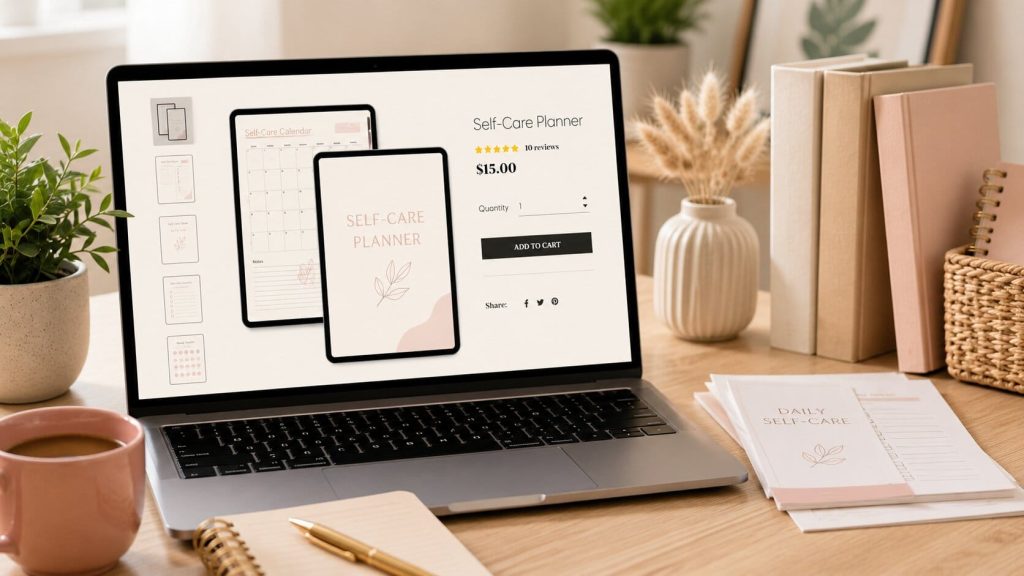
A self-care planner selling for fifteen dollars, for instance, could later become a full course at a much higher price point once it’s proven itself.
The case for prioritizing digital products over physical ones comes down to margin. Physical products mean manufacturing, shipping, packaging, and dealing with items that arrive damaged or delayed. A digital product is built once and then sold repeatedly at close to pure profit, which is what makes it genuinely passive in a way physical products rarely are.
It also doesn’t take a huge audience for this to work. A well targeted, specific ebook built around real experience can bring in solid revenue in its very first weekend, with sales continuing steadily well after launch, especially if it solves a problem your audience is already actively trying to fix.
5. Coaching and One-to-One Services
Coaching means working directly with clients, often starting with a few beta clients to build testimonials and validate your method before charging full price. That validated method can later become the foundation for an online course.
Beyond the income, coaching tends to be one of the more personally rewarding strategies for people who genuinely like teaching and problem solving one-on-one.
Digging into someone’s specific situation and helping them avoid mistakes you made is a different kind of satisfying than scaling a course to thousands of people. It’s worth not overlooking just because it doesn’t scale as efficiently as other options.
6. Online Courses
Online courses are arguably the most leveraged way to make money blogging.
You build the product once, then automate the selling and marketing of it, which frees up time for the parts of the business you actually enjoy, whether that’s creating more content, or simply having a life outside of work.
If you’re not sure what course to build, look for the gap. Think about what you’ve searched for in your own niche and never quite found: a course that fully covered what you actually needed, without leaving you to piece the rest together yourself. That’s often a stronger starting point than asking “what am I good at,” because it’s rooted in a proven need rather than a guess.
Course creation has become a genuinely large industry in its own right over the past several years, largely because so many creators have realized that packaging expertise, once, and reselling it repeatedly, scales in a way that one-on-one work never quite can.
Once you’re ready to build, a platform like Teachable or Thinkific is a common, straightforward place to host it.

Other Ways Bloggers Make Money
These tend to work best once you already have a niche and an audience established, but they’re worth having on your radar early so you can recognize the opportunity when it shows up.
7. Physical products
Selling something tangible of your own, like planners or merch, rather than promoting someone else’s as an affiliate. This keeps far more profit per sale than affiliate commissions ever will, but comes with real overhead: inventory, shipping, and tax complexity all add up. Past a certain volume, it’s genuinely hard to run solo. Usually a later stage move rather than a starting point.
8. Selling a service
Your blog can double as the credibility builder for a service business in the same niche. A cleaning blog with genuinely useful tips, for example, naturally sets up a cleaning service down the line, since readers already trust the expertise before any pitch ever happens. This tends to carry lower financial risk than physical products, since clients are paying for expertise and time rather than you carrying inventory costs upfront.
9. Speaking
Once you’ve built some visibility, often through video, conferences and events may start reaching out to pay for talks in your area of expertise. Not something to plan around early on, but a real and fairly lucrative stream once a platform is established.
10. Freelance writing
Some sites pay for writers on specific topics, which makes this accessible fairly early on. It’s worth being honest about whether you’d actually enjoy it, though. Writing to someone else’s brief is a genuinely different skill than writing in your own voice for your own audience, and it doesn’t suit everyone who blogs well.
11. Merch
A slogan or message tied to your blog’s identity, put on a t-shirt or similar item, can bring in some income, especially if it’s tied to something your audience already connects with emotionally. It tends to need ongoing, active promotion to keep moving. Easy to launch, just as easy to quietly forget about a few months in.
12. Consulting
Less a strategy than a “stay open to it” category. A well defined niche and a genuine voice can lead to paid opportunities that don’t fit neatly into any of the categories above. It’s not something to build a plan around, but a good reminder that a real niche and an engaged audience can open doors you wouldn’t have expected.
A Simple Starting Path
If you’re building this from scratch, here’s a reasonable order to work through it in:
- First, launch the blog. Buy a domain name from a reliable platform like Namecheap, and use a fast, reliable hosting provider like Bluehost. Then start publishing consistently. It does not need to be perfect. It just needs to exist and start growing.
If you’re just starting out, here’s a detailed guide on how to launch your blog. - Second, focus on building an audience and email list using tools like Kit. Content matters, but owned attention matters even more.
- Third, sign up for two or three relevant affiliate programs in your niche, and create a freebie you can test as a low-ticket offer to see what your audience is genuinely willing to pay for.
- Fourth, turn the best-performing idea into a digital product, then eventually into an online course.
- Once you’re getting real, consistent traffic, start considering display ads, but don’t make it a day-one focus.
The key is to build in layers. Start with content. Then add one monetization method. Then build the next step from there. That is how a blog becomes more than just a blog.
Final Thoughts
Making money blogging is still possible, but the most successful bloggers usually do not rely on just one income stream. They build a mix of traffic, trust, products, and audience connection.
If you want the smartest long-term strategy, focus on content that builds an audience, offers that solve real problems, and scalable products that can grow with you. That is how blogging turns into a real business.