

Most people don’t struggle with money because they’re bad at math. They struggle because they don’t have a plan.
With so much financial advice online, it’s easy to feel overwhelmed. This 90-day reset breaks everything down week by week, so by the end you’ll have a real system for building wealth and a serious jump start on your financial journey.
Week 1: Review Your Current Financial Situation
Before we can fix anything, we need to get super honest about where our money is actually going.
Think of yourself as a business. Every successful company knows its revenue, its expenses, and what’s left over as profit. You should too.
Step one: pull up your last 3 months of statements. That means your bank accounts, credit card statements, debt payments, and any other places you’ve spent money. Get them all up on your screen at the same time.
Step two: categorize every expense into one of three buckets:
- Fixed expenses: rent, utilities, car payments, subscriptions, groceries
- Discretionary spending: eating out, shopping, travel, anything fun but not necessary
- Debt payments: student loans, credit cards
Log everything in a spreadsheet if you can. The goal by the end of week one is to calculate your average monthly spending per category and to determine your savings rate.
In business terms, you’re figuring out your revenue (income), your expenses, and your net profit (what’s left over).
Do this exercise and it will open up a ton of insights about your spending habits. You might even realize you’ve been spending way more than you thought on certain things.
Week 2: Cut Unnecessary Expenses
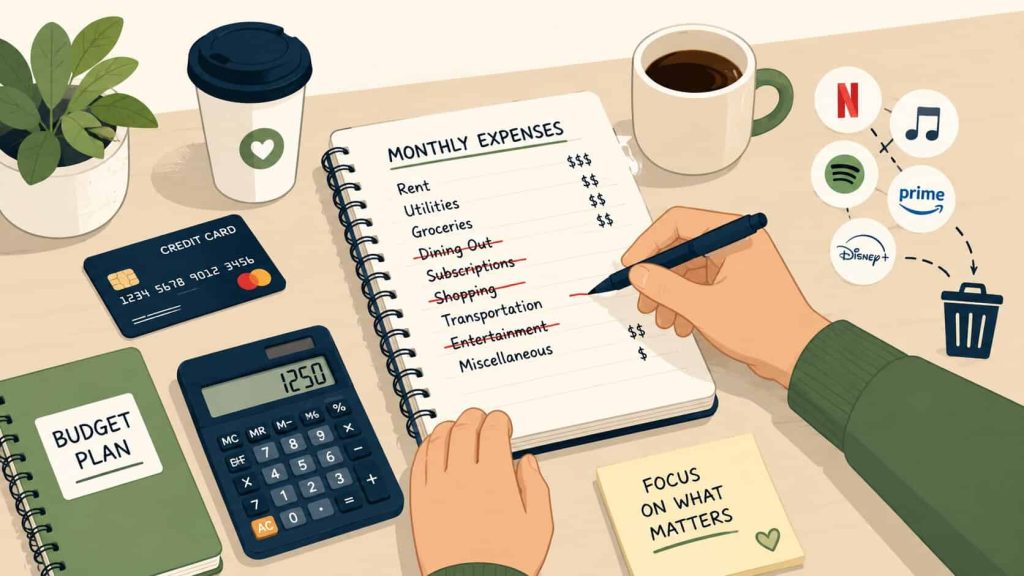
Now that you know where your money goes, identify the easiest areas to reduce spending.
Sort your expenses from largest to smallest and ask yourself one simple question for each: Can I reduce this by 10 to 30% over the next 90 days?
Here’s what that looks like in practice. Let’s say someone spends $5,750 a month across rent, car insurance, groceries, eating out, shopping, Ubers, utilities, subscriptions, bars, and coffee.
- Rent is tough to move quickly, so we’ll leave that for now.
- Ubers at $225 a month is a great place to start. A lot of people don’t even realize how much they’re spending here. Cutting back or eliminating it altogether could save $100 to $225 a month.
- Car insurance is another easy win. Most people never call around to compare rates, but doing so could save you around $100 a month.
- Eating out and shopping are usually easy to trim a little. Even $50 to $100 less in each category adds up to another $100 to $200 in monthly savings.
- Subscriptions: cancel anything you barely use.
If you’re able to cut $400 a month, that’s $4,800 a year. That could be a Roth IRA contribution, a trip to Europe, or extra money thrown at your debt.
Week 3: Build a Cash Flow System
This week focuses on creating a system that ensures your bills are paid on time, your priorities are funded first, and your money is allocated automatically before you have the chance to spend it impulsively.
According to the Consumer Financial Protection Bureau (CFPB), using a bill calendar and aligning bill due dates with your paychecks can help you avoid late fees, overdrafts, and cash flow problems.
Here’s what to do.
Create a Bill Calendar
A calendar gives you a complete picture of when money comes in and when it goes out.
Write down:
- Payday dates
- Rent or mortgage due dates
- Utility bills
- Insurance payments
- Credit card minimums
- Subscription renewals
Use a paper calendar, spreadsheet, or phone app, whatever you’ll actually check.
Match Bills to Paydays
Compare due dates to your income schedule.
If several large bills are due before your paycheck arrives, contact service providers and ask if they can move your due dates. Many companies allow this.
Set Up Automatic Bill Payments
Automate fixed expenses like rent, utilities, insurance, and minimum debt payments. This reduces late fees and ensures the most important obligations are handled first.
Use the “Pay Yourself First” Method
One of the most effective money habits is to set aside a portion of each paycheck for your financial priorities before you spend anything else.
This approach works because it treats your long-term goals as a fixed expense, just like rent or utilities. Instead of waiting to see what is left over at the end of the month, you intentionally reserve money as soon as you get paid.
A practical starting point is to earmark at least 10% of your take-home pay for your most important goals, such as:
- Paying down debt
- Building your emergency fund
- Investing for the future
Keep a Spending Buffer
Leave a small cushion (even $50 to $100) in your checking account to absorb timing differences and prevent overdrafts.
The goal is to create a dependable cash flow system so that your money is automatically directed where it needs to go, and your essential bills are paid on time every month.
A lot of financial stress comes from poor timing rather than low income. When you organize cash flow, your money becomes predictable, and financial decisions become much easier.
Week 4: Make a Plan for Your Debt
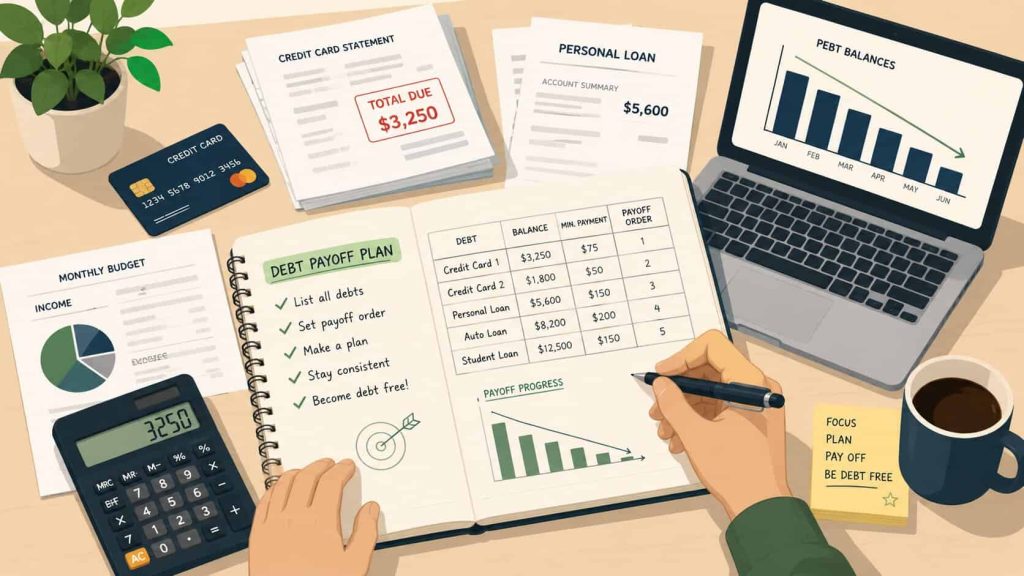
If you’re carrying high-interest debt, especially credit card debt, this week is about facing it head on.
Start by figuring out the total balance and what you’re currently paying each month. Then use a free credit card payoff calculator online to see what happens when you increase your payment.
Paying just $75 extra per month on a $2,500 balance, for example, could cut eight months off your payoff date and save you a significant amount in interest.
Set up automatic payments, so you’re chipping away at it consistently without having to think about it.
One more thing worth doing this week: call your credit card company and ask them to lower your interest rate. Bring up the fact that other cards are offering competitive rates and that you’ve been a loyal customer.
They’ll often say yes, even if it’s just temporary, because they want to keep your business. The worst case is they say no. The best case is you save hundreds or even thousands in interest. It takes five minutes.
With average credit card APRs sitting above 19 % right now, any reduction in that rate is an instant return on your investment.
Week 5: Build Your Emergency Fund
Start with a small but meaningful financial cushion like $1,000.
It sounds simple but consider this: 59% of Americans can’t cover a $1,000 emergency expense.
Getting to four digits in your savings account is a real psychological milestone, and it gives you a cushion so that one unexpected expense doesn’t derail everything else.
If you already have $1,000 saved, your goal this week is to work toward three to six months of living expenses in your emergency fund.
To get there faster, you can sell things you’re not using, old electronics, clothes, furniture, or pick up a side hustle for some extra cash. You can also redirect any savings you found in weeks one and two directly into this fund.
Week 6: Set Up Your Investments
Over the past 100 years, stocks have produced the best returns of any asset class, averaging 8 to 10% annually.
Real estate, gold, bonds, and other commodities all fall behind. If you want to build real wealth over time, you need your money in appreciating assets.
The simplest way to start: invest in an S&P 500 index fund or ETF.
A single S&P 500 ETF gives you exposure to hundreds of the top U.S. companies with one purchase. It’s a passive, set-it-and-forget-it strategy that relies on the market’s long-term historical returns. Low cost, simple, and highly effective.
You can open a brokerage account at Vanguard, Fidelity, Schwab, or M1 Finance, then automate a portion of each paycheck to go in and just buy the ETF on a regular basis.
Here’s what the numbers look like over time at an 8% average return:
- $100/month for 30 years grows into a meaningful nest egg
- $500/month gets you much further
- $1,000/month for 30 years grows to around $1.49 million
The most important thing is consistency. Stay in it, trust the process, and let your money compound over time.

Week 7: Focus on Growing Your Income
You can only cut expenses so far. There’s no limit on how much you can earn, so this week we shift the focus from cutting costs to growing income.
Here are three ways to approach it:
1. Ask for a raise. If it’s been over a year since your last raise, it’s time to make the case. If it’s been two years or more, you’ve almost certainly lost ground to inflation. Research your market salary, prepare your case, and have the conversation. Even if you don’t get it right away, at least you asked.
2. Start a side hustle. Freelancing, flipping items on Facebook Marketplace, dog sitting, DoorDash, there are a lot of accessible options that don’t require much to get started.
3. Learn a high income skill. Coding, video editing, sales, and design are all skills with strong demand and real earning potential. This takes more time but can pay off significantly down the road.
Here is a list of some high income skills you might be interested in.
By the end of week seven, identify one concrete thing you can do to make more money moving forward.
You should definitely check out these money-making principles that help you grow financially.
Week 8: Write Down Your Savings Goal
This week is about putting a real number to your goals and committing to it.
A psychology professor found that people who write down their goals, make a plan, and share it with a friend are 42% more likely to achieve them compared to people who only think about their goals. So this week, write it down.
Figure out exactly how much you need to hit your goal. For example, if you want $8,000 in your emergency fund and you currently have $1,000, you need $583 a month for the next year to get there.
That may or may not be realistic for your situation, but at least now you have a number to work with.
Then tell someone. Tell your parents, your friends, anyone. Accountability makes a real difference.

Week 9: Use Credit Cards Wisely
Credit cards are a double-edged sword, and whether they’re right for you really comes down to self-awareness.
If you have good self-control, using a credit card can be genuinely rewarding. Run all your purchases through it, pay it off in full every month, and you’ll collect cash back, travel points, hotel upgrades, and lounge access.
The card issuers make their money off people who carry balances, so if you’re disciplined, you’re essentially getting free money.
If you tend to overspend, stay away from credit cards for now. The average APR is above 19%, and the average American carries over $7,200 in credit card debt. That’s an expensive hole to dig out of.
Not sure which category you’re in? Start with a card that has a low credit limit and test yourself for three to six months. That’ll give you a clear picture of your self-control before you scale up.
One more thing worth knowing: using a credit card responsibly actually builds your credit score. On-time payments make up 35% of your score, and a strong credit history eventually unlocks better rates on mortgages and loans, which can save you thousands over your lifetime.
Week 10: Start Tracking Your Net Worth
Net worth is simple. Add up everything you own (assets), subtract everything you owe (liabilities), and that’s your number.
For example: a house worth $100,000, plus $25,000 in savings and investments, minus $30,000 owed on a car, equals a net worth of $95,000.
Track this monthly, quarterly, or twice a year.
Whatever cadence you’ll actually stick to. The point is to watch it grow over time and stay connected to the bigger picture of your financial progress. It’s one of those habits that’s genuinely motivating once you start.

Week 11: Review Your Spending Again
It’s been about eight weeks since you first analyzed your expenses. This week, do it again.
Pull up the last two months of statements, re-categorize everything, and compare it to where you started. Have your spending stayed flat or gone down in the categories you targeted? Or have some old habits crept back in?
If you find any financial leaks, patch them up now before heading into the final stretch. This review is what keeps the whole plan from falling apart.
Here are a few bad spending habits you should probably rethink.
Week 12: Set Long-Term Financial Goals
You’re basically at the finish line. The last 7 to 10 days are about zooming out and planning what comes next.
Stretch goals are the big, ambitious targets that go beyond just getting by. Things like buying a home, paying off major debt, launching a business, or retiring early. This week, define yours across three time horizons:
- One year: save $10,000, pay off a card, build your emergency fund
- Five years: buy property, hit a net worth milestone like $100k or $250k, launch a business
- Ten years: financial independence, early retirement, traveling the world
Once you have those goals, break them down into monthly savings targets so you know exactly what you need to do each month to get there.
The last step: schedule a quarterly financial check-in with yourself. Set a reminder every three months, March 31st, June 30th, September 30th, December 31st, to review your progress. This is what keeps the work you’ve done over these 90 days from going to waste.

Final Thoughts
Building wealth doesn’t happen overnight. It happens through consistent action, disciplined habits, and a long-term vision.
The hard part is getting started, and you’ve already done that.
This post is based on insights shared by Humphrey Yang, who’s a former financial advisor, and talks about money and personal finance.