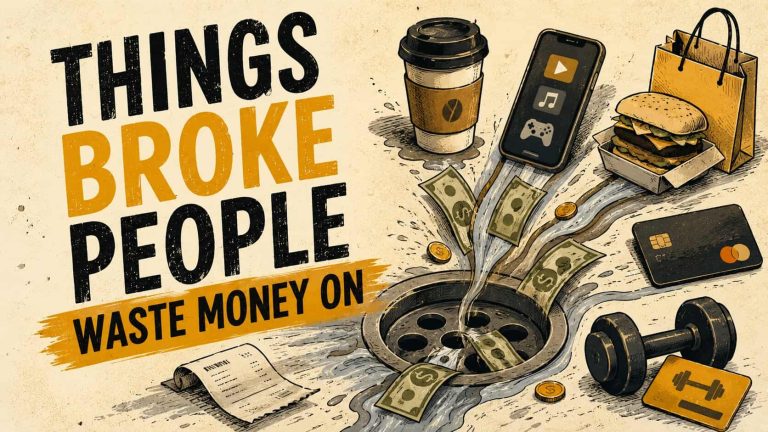
Going from broke to financially free in just a couple of years is possible. And yeah, some wild stuff might happen along the way. But looking back, it’s never the big crazy things that build wealth and freedom.
It’s a bunch of boring tiny habits done consistently over a long period of time. And even if you only pick a few of these, they’ll really help out your finances, as long as you’re okay with being a little different.
1. Be Selfish
I know that sounds awful. Hear me out.
The moment you get paid and money hits your account, you need to take that money and steal it from yourself so you can have financial freedom. It’s this idea of robbing yourself, tricking yourself.
If you’re a naturally addictive personality who spends a lot on video games, going out to eat, clothes — you name it — you’re essentially stealing from yourself. It doesn’t affect anybody else; it just screws up your own life. And not having money sucks.
So instead of paying everything and saving whatever’s left over at the end of the month, which is what most Americans do, with about 74% putting 10% or less aside, start with 10% and keep trying to up it.
Set your goals a little high, keep getting better with your spending, and work your way up to a higher savings rate. Stay there for years, even while not making a lot of money.
The trick is to make it automatic and hide it from yourself before you ever see it. What are the chances that you need exactly the amount of money you’re making? Probably not.
If you just had less money, you’d figure it out. You’d figure out how to earn more or spend less, you’d land on one of those two.
When you remove money before you see it, you force yourself to adapt. You either:
- Earn more
- Spend less
- Or get creative
And that’s when growth happens
2. Never Finance Stuff That Loses Value
If you want a boring, incredibly unsexy finance tip: drive an older car. It’s literally one of your biggest expenses. As long as it works and is reliable, that’s really the important thing, you don’t need anything else.
Most cars lose 60% of their value in the first five years. It’s just one of the worst ways you can burn money imaginable, just to have a fancier thing that gets you from here to there.
If you need to get scared straight about this, calculate how many days a month you work just to pay for your car payment, insurance, and all that.
There are people out there working one week a month just to pay for the car that gets them to work. Incredibly dumb. Take the boring route. Get an older, cheaper, reliable car. Just go with that.
3. The One Month Rule
Every time you want to buy something over $100, either make yourself wait 30 days or send a picture of it to someone you trust and ask if you should really get it.
If you want something over $100, leave it in whatever cart it’s in. Click all the way to checkout. And then don’t buy it.
About 30 days later you’ll have completely forgotten about it, which means your life has not changed. Most things are like that. It’s a small little tip but it really helps.
4. Don’t Impulse Buy
62% of supermarket sales come from impulse purchases. “Oh, that’s a cool shirt.” “Oh, I totally forgot I need an eighth pair of shorts. I need that now.”
I’ll be honest, it happens to a lot of us at the grocery store, which is why making lists before you shop is so useful.
But outside of that? Just don’t impulse shop. It’s incredibly boring because you’re not just randomly getting stuff all the time, but it saves you a lot of money.
There is a list of frugal chic habits I discussed in another post that can help you save money while still living well.
5. Live in About Half the House You Can Afford
Just because you’re approved for a $300,000 or $500,000 house doesn’t mean you should buy one.
One great option is house hacking, living for free or even getting paid to live where you do. But even without that, the point stands: housing is generally your biggest expense. If you can just live in a cheaper place for longer even just a couple more years, it can drastically change your entire financial future.
Boring and unsexy, but one of the biggest things you can do.
6. Actually Figure Out Where Your Money Is Going
A lot of people think they’re on top of their finances until tax season rolls around and a giant bill shows up.
When all your income, payroll, expenses, and taxes are jumbled together in one account, half the time you’re just guessing what your income even is. Total chaos.
The fix isn’t trying harder, it’s having a system.
Separate accounts for income, expenses, taxes, payroll, and savings. Once everything has its own place, you stop guessing and start actually knowing. Clarity creates confidence.
7. Create More Than You Consume
If you want to stop being broke and stop hating what you do every day, you need to build something you actually enjoy, and give up things that add nothing to your life.
That might mean giving up video games, TV shows, most of social media, and spending that time on side hustles, learning, and reading books instead.
The average person consumes about six hours of content a day, broken up into little pieces. You can trade that for building a skill, earning more, or learning something useful.
Scale that out over 10 months or 10 years and it’s not even comparable. Not all consumption is bad, just like not all food is bad, but most of what the average person consumes is just worthless noise.
In another post, I’ve talked about this and other small habits that can lead to your financial success.
8. Focus More on Earning
Once your budget is set up and you have some frugal habits in place, stop obsessing over saving and start focusing on earning.
Finding a way to get a 2% raise at your job will outperform almost everything you’re doing all year with a little $5 savings here and there.
Think about how you can start a business, negotiate a raise, and build skills that make you more valuable. That’s going to be a much better use of your time.
9. Treat Your Savings Like a Bill
Say you spend $100 a month on internet without thinking about it, and yet you don’t save $100 a month.
What if you had to? What if it was a bill and your bank account would stop working if you didn’t pay it?
Treat savings like it’s a non-negotiable bill. Make it automatic. Make it feel urgent. If you can make that shift, everything gets easier.
10. Value Your Time Like It Costs Money
Try looking at everything through the lens of your hourly rate. Let’s say you’re making $20 an hour, would you spend $20 to watch one episode of a TV show? Probably not. But would you spend $20 to see family, play with your kids, go for a walk outside? Yeah, actually, you would.
If you reframe every hour of your day as having a dollar value, would I spend $50 on this? Would I spend $100? It becomes a lot easier to figure out what’s actually worth your time and what’s just noise.
11. Surround Yourself With People Who Level You Up
We all know the saying, you’re the average of the five people you spend the most time with and it’s absolutely true.
When you start going to conferences, networking, reaching out to people online, and deeply consuming the work of people you admire, you start thinking differently. You ask yourself: What would this person do in this situation? And that changes your decisions.
Find people who are trying to better themselves, stay in shape, eat healthy, care about their families, want some of the same things you do.
That energy is contagious. If you want to get good at pickleball but you only hang out on the basketball court, it’s going to be hard to improve.
12. Use the 10-10-10 Rule Before Spending
Before any purchase, ask: Will this matter in 10 days? Will it make me happier in 10 months? How about in 10 years? If you zoom out far enough, Most purchases fail this test.
But investing in a book, learning a skill, starting a business, those things look better the further out you zoom. That one filter makes a lot of decisions automatically.
13. Just Be Boring
I know, I know, but it might actually be the most important one.
Talk to people who’ve reached financial freedom in their 20s and 30s, and you’ll hear the same thing over and over: “Yeah, I did this thing and then I did it for four years straight. Six years straight. Ten years straight.”
That was it. That was the whole thing. They didn’t try to get rich quick. They didn’t bail after two months. They just did consistent, thought-out things for a long period of time.
Staying at a 50% savings rate for seven years. Investing the other 50% in the same areas for seven years. It wasn’t crazy. It was just consistent.
That’s how you succeed in business. That’s how you get in shape. That’s how you have a good relationship. Everything is very boring, and that’s okay. Chase growth and the rest will come.
Rapid-Fire Rules
Pick a simple budget. Try 60% essentials, 30% growth, 10% fun. A budget that simple will put you way ahead of most people.
Annual money detox. Pick 30 days a year, don’t spend money, freeze your credit cards, let the unused subscriptions run out. Reset your habits.
Start investing small. Even if it is $10 a week. Make it automatic. Then slowly keep increasing until you’ve tricked yourself into freedom.
Negotiate on the big stuff. Your house, your car, your monthly bills. Sometimes you can save thousands of dollars by negotiatin a little bit more by getting on a phone call. Don’t just focus on the coffee, focus on big things.
Get 1% better every day. 1% daily doesn’t make you 365% better. It makes you 37 times better because it compounds. Read a page a day. Do some push-ups. Do something small, every day, for a long time. You won’t recognize yourself.
Ask what a smart person would do. Or as Dwight Schrute put it: “Whenever I’m about to do something, I think, would an idiot do that? And if they would, I do not do that thing.”
Final Thought
Financial freedom isn’t built in one dramatic year.
It’s built in hundreds of quiet decisions that nobody sees.
If you can embrace being a little different and a little boring, you can build a life that feels anything but boring.
Curious about what sets the wealthy apart? Check out these habits of highly successful people.