

Everyone’s trying to find the secret high-income job or skill to learn. But what if that’s the wrong question?
Think about it: there are people doing the exact same job title, the exact same skill, and making completely different amounts of money.
An accountant making $20 an hour versus one making $200 an hour. An illustrator earning $8 an hour versus one charging $150 an hour. A web developer at $5 an hour compared to $150 an hour. A graphic designer at $6 an hour versus $220 an hour.
The difference? High-income skills are skills that solve high-income problems.
Table of Contents
What Are High-Income Problems?
High-income problems are problems for people who can pay you a lot of money to solve them. Here’s how I like to think about the scale of problems:
Small problems are issues that aren’t super frustrating; they’re annoying, not ideal, but not urgent.
When you solve small problems, you generate small amounts of value.
Especially if you do it for people who don’t have a lot of money or disposable income to spend on solving a problem that’s not as pressing. That leads to people willing to pay you small money.
Big problems are the ones keeping you up at 3 AM, worried, destroying your life quality.
If you solve a big problem, you generate big value.
If you do that for people who have more money, who have the disposable income, who want to throw money at the problem, you end up with people willing to pay you big money. That is how you get up the scale of your rates with the same type of skill.
How Do Tell If Something Is a Big Problem?
When evaluating a skill, service, or business idea, ask yourself:
1. How closely tied the problem is to everyone’s three precious resources (time, money, energy). If it’s keeping them from making money or saving money, or it’s sucking up all their energy or time when they’re already sparse on time, that’s big.
2. How much impact it has on reaching someone’s desires. Their core deep desire, whatever their big dream is. The closer it is to that desire, the bigger of a problem you’re solving for them.
3. How much the person hates doing this themselves. The more they hate it, the bigger of a problem you’re solving. Because it’s not really a problem if this person’s like, “Well, I don’t actually need help solving this thing. I’m good to just Google and figure it out.”
4. How scarce the skill is. How hard is it for somebody else to just learn and pick it up? If it’s super easy for everyone to learn it, then it will become more competitive and it’s not solving as big of a problem because they have more options.
So instead of asking “What skill should I learn?” or “What job title should I put on LinkedIn?”
Ask:
- What problem am I solving?
- How big is that problem?
- Who has this problem, and can pay to solve it?
The Five Big Business Problems
Business owners have a plethora of problems. And guess what? They have the money to pay to solve their problems.
I would say the majority of problems that a business owner has can fit into one of these five buckets. And if you learn a skill that solves one of these and you do it in the right way, you’ll always be able to make money.
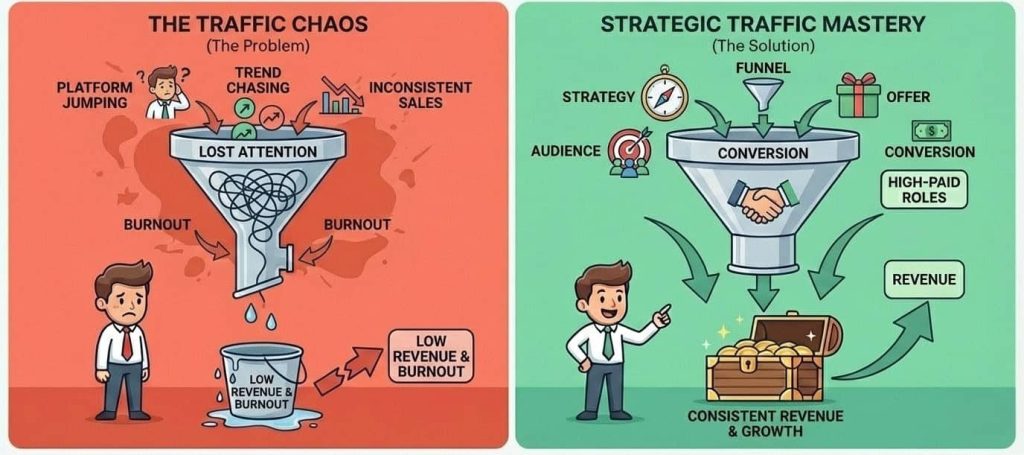
Problem #1: The Traffic Problem
Every single business that wants to make money needs a healthy traffic source.
And business owners are very busy. They are wearing 47 hats, being pulled in a million different directions. Sometimes the traffic thing is not as high of a priority as it really needs to be for steady cash flow.
Which normally means they end up being completely inconsistent, following random trends, starting on this platform, then quitting, then starting on this platform, then quitting, having no strategy in place to convert people, all of which leads to no sales. Huge problem.
When there are no sales coming into a business, everything else screeches to a halt.
1. Social Media Manager
Great skill, great job. Some people charging very little money for it, some people charging a lot of money for it. Here’s how you can be a social media manager solving smaller problems versus bigger problems:
Smaller problems might look like:
- Positioning yourself as a task doer and really lacking that contextual strategy of understanding everything holistically
- Not adding any uniqueness or novelty or creativity to your social media content strategy (especially with AI, if you don’t have uniqueness or novelty or human element and authenticity, it’s just not going to perform)
- Developing strategies that don’t align with the business or funnel goals, leading to no results
How could you do it in a way that solves big problems?
- Get 100% clear on the customer’s problems and desires
- Manage the entire workflow
- Understand how to capture and keep attention
- Always be up to date on what’s working currently (social media moves so fast)
- Be thoughtful and creative
- Your strategy is intentional and tied to the business and funnel goals
- You’ve done extensive audience and competitor research
2. Ads Manager
Ads managers can be paid very, very well if they do it in the right way.
Small problem solving:
- Run basic campaigns that focus on clicks and impressions with no real funnel or offer strategy
- Reporting on surface metrics that don’t really show the ROI
Big problem solving:
- Build an ad funnel actually tied to business goals
- Focus on metrics that actually matter
- Do proper A/B testing, conversion tracking
- Stay up to date on ad platforms and the algorithm (they’re changing all the time)
3. YouTube Strategist
Youtube strategist are paid well and can make a lot more if they do it in the right way.
Big problem-solving YouTube strategist:
- Deep in their craft, studying constantly
- Thinking strategically about what makes something work, what not
- Really super studious about what’s going on
The Key Soft Skills
Even though I hate that it’s called soft skills because these are actually the most important skills:
- Studious — They care about their craft and they want to be as good as they can at what they are doing and they’re studying constantly and they have that curiosity to learn. That makes a huge difference to how much money someone earns.
- Deep understanding of storytelling, tension, human psychology, curiosity.
- Understanding context — They can adjust advice based on that context. Every client has so much context. If you don’t take the time to learn that context, you cannot craft a strategy or advice that is a unique and good fit for them.
- Holistically understanding what somebody wants and listening and processing what they’re saying versus just giving them some kind of blanket statement or blanket advice. So important.
- Creativity — Especially now with AI, creativity is one of the top three skills I’m hiring for. If somebody is truly creative, they can be novel, take something working in another industry and make it work for my thing, it’s unique, fresh, interesting. I’ll pay big money for that.
The above skills are closely and distantly related to digital marketing. This post will help you learn the basics and stuff.
High earners don’t just “post content.” They understand the funnel, the audience, the offer, and how attention converts into revenue.
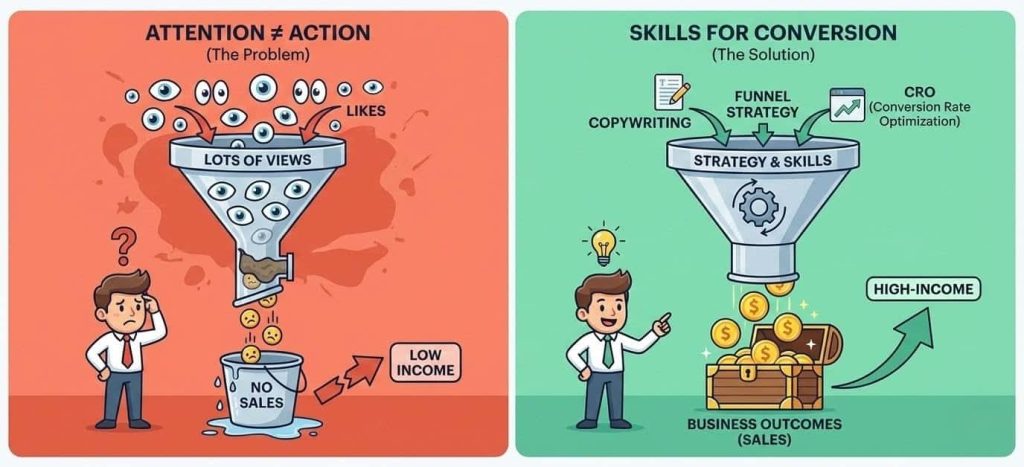
Problem #2: The Conversion Problem
The business owner has people’s attention, maybe lots of it but nobody wants to take action, which leads to no sales. Think of content creators getting millions of views but nothing converting on the back end.
4. Copywriting
It is a very highly paid skill if you do it correctly.
Solving a small problem could be:
- Positioning yourself as a content writer that can write anything (which means you have less specialty, less niche skill, which maybe leads to okay quality work)
- It probably makes it harder to land clients as well if you don’t have a specific niche that you’re dominating
- Getting straight to writing the topic without properly understanding the context for the business, what they’re doing, the context of the audience
- Using AI without quality control (using AI to be lazy versus using it to make work better)
Solving big problems could look like:
- Positioning yourself as a proper copywriter in a specific niche
- Taking a strategist approach
- Understanding buyer psychology, the context that guides people through each stage of a funnel
- Learning and adapting to the brand’s unique voice
- Doing market research
- A/B testing
- Optimizing for ROI
5. Web Developer
Lots of web developers making great money, over six figures.
Solving small problems:
- Just building simple drag-and-drop sites
- Focusing on aesthetics but not so much functionality or goal
- Maybe having limited technical problem-solving or you don’t really care about problem-solving for the client
- When something comes up, no result for client
Solving big problems:
- Building websites with the contextual goal of leads and sales for the business owner
- Being intentional about the customer and the market that you’re developing for
- Being thoughtful, creative, strategic in approach
Skills like copywriting, funnel strategy, web development, and CRO become high-income when they’re tied directly to business outcomes. Writing words isn’t the value. Driving conversions is.
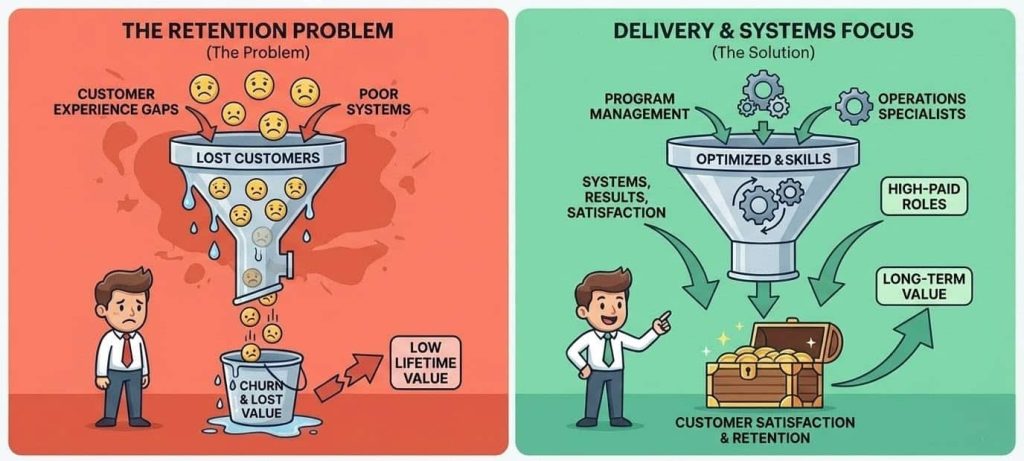
Problem #3: The Delivery Problem
The business can get customers but can’t always keep them. The challenge is being able to deliver an amazing product experience by improving the core products or service itself, and increasing lifetime value of each customer. It’s always cheaper to get someone who already trusts you to buy again than to acquire cold leads.
6. Program Manager
Small problem version:
- Focusing on random admin tasks, scheduling calls
- Manually organizing things
- Not thinking systematically
- Managing daily to-dos instead of business outcomes
Big problem solving:
- Hyperfocusing on customer satisfaction and getting results for the customers
- Thoughtfully designing the proper client journey so people are truly delighted and satisfied every step of the way through
- Creating systems that highlight results and help them identify problems before they become problems
- Finding out where the program is draining time, energy, or profit and fixing it
Roles like program managers or operations specialists become highly paid when they focus on systems, results, and customer satisfaction, not just admin tasks.
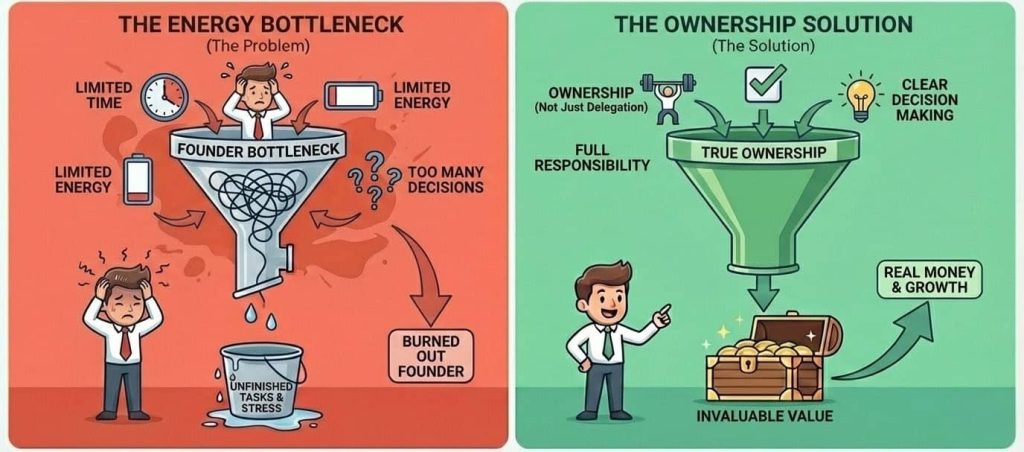
Problem #4: The Energy Problem
The business owner is one person with limited time and energy. There comes a point where it’s actually physically, mentally, emotionally impossible to do absolutely everything that they have to do in their business. They need more people, better systems, automations, and support.
7. Digital Business Manager / Virtual Assistant
Small problem solving:
- Position yourself as a virtual assistant and you’re a task doer that handles the day-to-day small things as they come up
- You handle admin tasks, email, basic things
- Maybe you have limited knowledge of tools, frameworks
- You’re not really thinking contextually or strategically for the client
And again, there’s nothing wrong with that. I’m just talking about how to potentially level up the way you’re thinking so that you can make bigger money because you’re solving bigger problems.
Big problem solving:
- Deeply understand the business needs and desires, what kind of business lifestyle do they actually want?
- Help them make and drive actionable plans, actually making the project plan and making sure things get done
- Find bottlenecks, unblock their team
- Take proper ownership
I think delegation and ownership are very different things.
People who truly take ownership — not just delegation — become invaluable. When something is fully off the founder’s plate, that’s worth real money.
Problem #5: The Clarity Problem
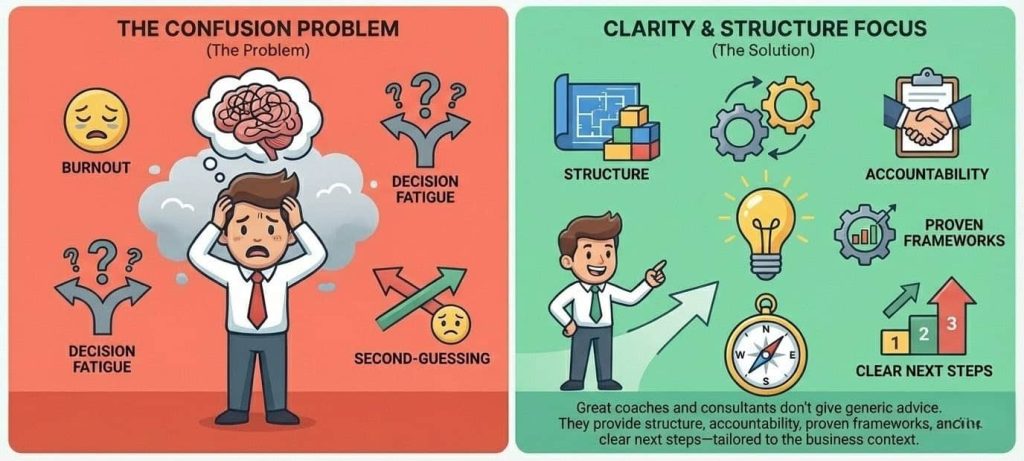
Running a business is actually kind of really hard and confusing and frustrating. There are so many decisions you have to make. There’s burnout. There’s not knowing which direction to take or what tasks to work on.
Business owners often feel stuck, second-guessing everything, not having a clear path. They need expert help with clarity.
8. Business Coaching and Consulting
Lots of people doing great things with this.
But many people slap on the title of coach without full understanding of what they’re solving or the problem they should be focused on.
Solving small problems:
- No clear contextual understanding (huge problem when they don’t understand the big picture of what I’m trying to do, don’t ask questions)
- Give general advice based on personal opinions rather than data-backed proven methods
- Don’t hold you accountable or track your progress
How do you do this in a way that solves big problems?
- Position as a proper coach with actual proven coaching frameworks
- Understand what they’re going through, have something laid out where you can help them follow
- Keep them focused instead of overwhelming them with options so they actually take action
- Work with the CEO to understand context and goals, create an action plan
- Identify the real bottlenecks and really give them a way to work through them
- Hold the CEO super accountable, keep progress, get them what they need
Great coaches and consultants don’t give generic advice. They provide structure, accountability, proven frameworks, and clear next steps — tailored to the business context.
The Real Takeaway
Making great money isn’t about chasing trendy skills.
It’s about generating high value for high-income clients by deeply understanding the big problem you’re helping them solve and doing a good job of actually solving that problem, aka actually making an impact on the business.
If you focus on impact instead of titles, and outcomes instead of tasks, your income naturally follows.
If you’re looking for a career change or a side hustle, these high-income skills are actually worth your time to learn.