People see print-on-demand success stories everywhere. They see someone take a brand new store from zero to $5,000 in less than six months. They get excited and hopeful and start their own store, and most of them end up failing.
This begs the question: why do some stores succeed while others fail? Honestly, as harsh as it sounds, it’s not random. The difference comes down to avoiding critical mistakes that a lot of beginners make. These are the mistakes that practically guarantee a store will fail.
And so if you want your store to be successful, then you need to know what these mistakes are.
Here are the eight mistakes that could be the difference between building a profitable business and wasting countless hours on a dead-end project — pulled from real stores, real product comparisons, and real case studies.
Product Mistakes
Mistake 1: Not Creating Designs That Fill a Gap in the Market
The phrase “fill a gap in the market” is very important. It means creating a product that people want but doesn’t yet exist. And honestly, it’s one of the most important ways to get people to buy from your store even when you have zero reviews and zero social proof.
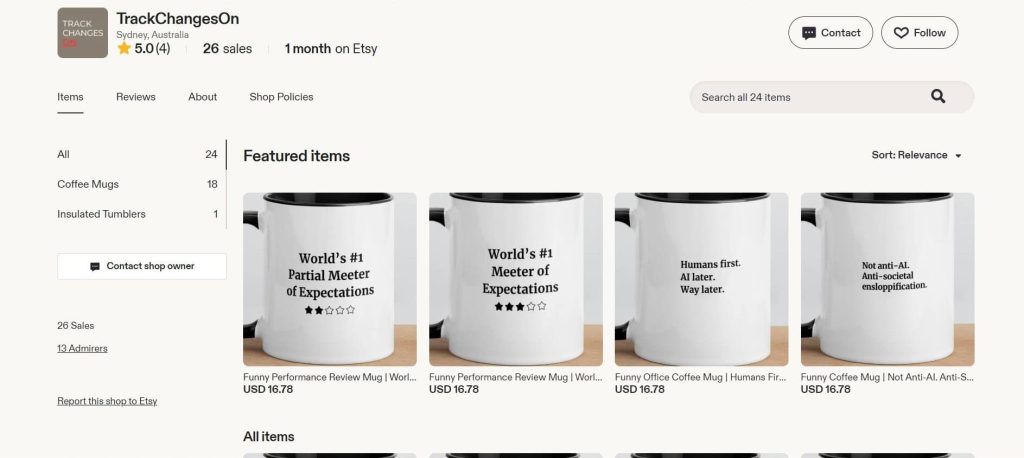
Here’s a real example. Take an Etsy print-on-demand store called TrackChangesOn. It’s brand new — only four reviews, barely any branding, no welcome message. If you landed on it cold, you’d probably scroll right past. It looks unfinished, easy to skip.
And yet it pulled in 26 sales in its very first month.
Two things made that happen. The product is genuinely funny. But the bigger reason is that it targets a specific type of person and fills a gap nobody else had touched.
That’s the real lesson here: a brand-new, barely-branded store can still sell fast, as long as it’s the only place selling something a specific group of people actually wants. You don’t need reviews or polish to get that first wave of sales. Being irreplaceable is enough.
Mistake 2: Creating Copycat Stores
You’ll see people saying things like, “I uploaded a bunch of designs and nobody bought anything.” And here’s the harsh truth, when you look at these stores, they’re not creating original products that fill a gap. They’re what’s known as copycat stores.
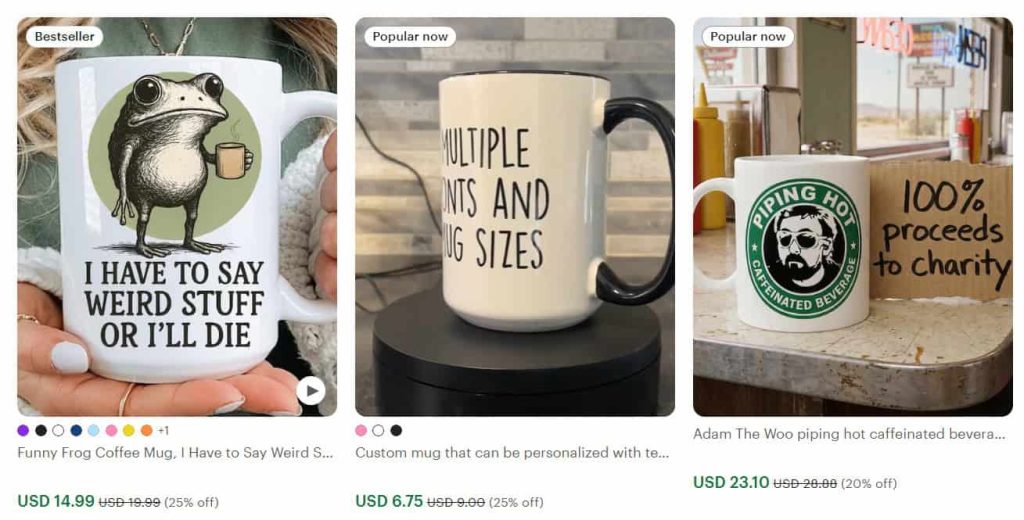
They’ll come to Etsy, see that dog dad mugs are popular and selling well, then think, “I know, I’ll create my own dog dad mug.” And guess what? That boring, unoriginal design flops. Nobody buys it.
And here’s why: look at how many other dog dad mugs exist on Etsy. There are tons of similar designs, many from stores that already have thousands of reviews.
So think about it: would you rather buy a dog dad mug from a store with thousands of reviews, or a store with zero reviews? Obviously, you’d pick the established store.
Being a copycat store is a great way to waste tons of time creating unoriginal designs that nobody wants to buy. Meanwhile, a store like TrackChangesOn gave themselves a huge advantage by creating something original that nobody else had made.
Think about it this way: you’re an Etsy customer looking for a joke gift for your coworker. You find this mug and think, “That’s hilarious, I want it!” But then you visit a store and hesitate — no reviews, so you’re not sure if you can trust them.
You do a search on Etsy to find an established store selling the same design. But nobody else is. Now you’ve got a dilemma: either buy a different gift from an established store that you don’t like as much, or take a chance on the new store to get the item you loved.
Some customers will pick the first option, but some will take the risk. And when the only way to get what you want is from a new store, that’s a powerful advantage.
Mistake 3: Selling Popular Products Instead of Products Where You Have an Unfair Advantage
One of the most popular print-on-demand niches on Etsy is dogs. There’s this custom phone case that, according to an Etsy research app, has made over $500,000. And that’s just one product in this niche. There are tons of others that have made hundreds of thousands of dollars each.
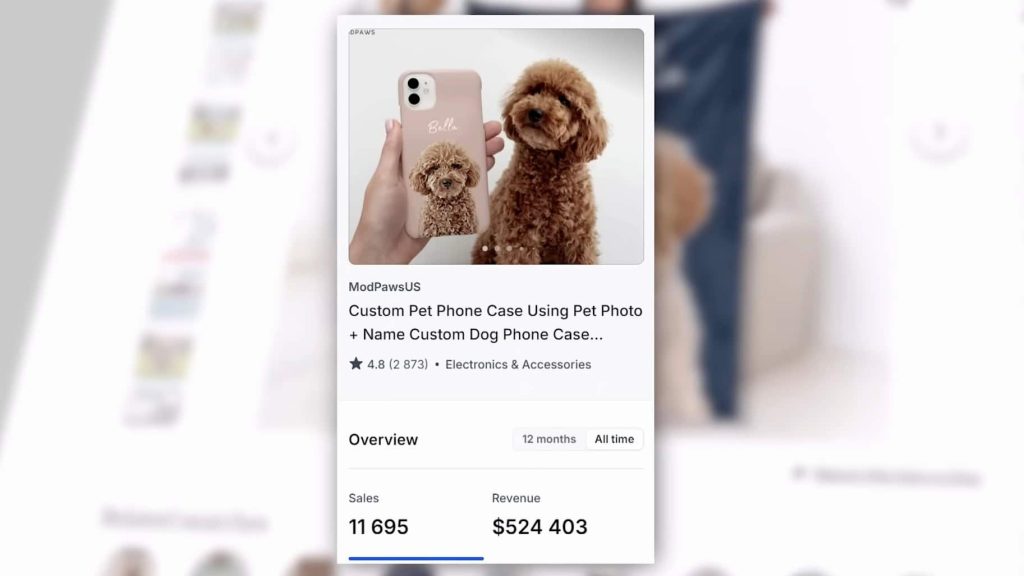
So naturally, a lot of people see this and think, “I’m going to make a product in this niche so I can make a bunch of money too.”
But here’s the problem: usually, these people don’t actually have dogs themselves, or they own a dog but aren’t super fans. They wouldn’t actually buy a dog-themed blanket or mug for themselves.
The most successful sellers often have an unfair advantage: they’re actual customers in their own niche. They can use themselves as a yardstick, asking: “What product would I like to buy but can’t because it doesn’t exist yet?”
It’s honestly the easiest way to come up with original product ideas, and it gives you a hugely unfair advantage.
That’s why you should avoid niches where you’re not a target customer.
Take sports, for example: if you don’t follow any sports and you tried to start a sports store, you’d be at a disadvantage compared to actual sports fans. They’d just ask themselves, “What tennis-themed t-shirt would I buy?” and boom, they’ve got a good idea.
Even though sports and many other popular niche products can be very profitable, it’s best to stay away from niches where you’re completely ignorant about the topic, especially if you’re just starting out. Because you’re going to be at a huge disadvantage when it comes to brainstorming original good ideas in it.
Here are some digital product ideas with good growth potential on Etsy.
Pricing & Fulfillment Mistakes
Mistake 4: Pricing Your Products Too Low
So many new stores make this mistake. They think they need to price their products super low to compete, and as a result, they end up breaking even or even making a loss. It’s absolutely ironic because pricing your products too low can actually hurt your sales, not help them.
In fact, a lot of stores find that they can increase sales simply by raising their prices. And it’s because of something called the price-quality heuristic, a psychological cognitive shortcut most people use when buying products.
Here’s how it works: imagine you’re buying a laptop. One costs $1,000 and another costs $2,000. How do you know which is better quality? Most people assume the more expensive one is better. It’s not always true, but studies show people use this shortcut consistently.
Two researchers did a psychological pricing study called the denomination effect. They gave participants chocolate to try and told them how much it cost, then asked them to rate the quality and how much they’d pay for it. As expected, the more expensive the chocolate, the better people rated it.
But here’s the twist: the researchers lied. All the chocolate was identical. It was the exact same chocolate sold at the exact same price at the supermarket.
So then how should you price your products? The better approach is looking at your competitors and setting your price somewhere in the middle.
Don’t match or go lower than the low-end competitors — you’ll risk people worrying something’s wrong with your product. But don’t match the high-end either, or people will worry they’re getting ripped off.
Focus on middle-ground pricing. Thanks to the anchoring effect, that’s what most consumers prefer — it’s the sweet spot between not buying a bad product and not getting overcharged.
Mistake 5: Assuming More Expensive Print Providers Are Better
This price-quality bias doesn’t just affect customers, it affects sellers too. Many new sellers assume that more expensive print providers produce better quality, but that’s not always true.
A side-by-side test compared two print providers through the printfight app: Fulfill Engine and Monster Digital. Both received the exact same print image to fulfill.
The results? Fulfill Engine’s t-shirt was much worse. The colors on the Monster Digital shirt were much closer to the original image.
So it’s a no-brainer. Monster Digital would cost more, right?
Wrong. Fulfill Engine’s t-shirts actually cost less than Monster Digital’s.
Never assume that price equals quality. When choosing print providers, check reviews instead.
Growth & Traffic Mistakes
Mistake 6: Using Paid Ads Before Using Free Traffic and Advertising
There’s a common assumption that paid advertising is the fastest way to grow a print-on-demand store. And while paid traffic and ads can work, they can also be a very expensive way for beginners to lose money quickly.
Consider this: someone took a new store to almost $5,000/month in six months. In that process, they turned $25 of Etsy paid ads into $150 in sales. That’s a success story, but it’s not the whole story.
A closer look at the store’s full sales data reveals something interesting: only about 39% of the products released actually generated sales. In other words, 61% of the products completely flopped.
This makes sense when you think about it. Big companies like McDonald’s, Starbucks, and Legoland do market research and focus groups before releasing anything new. They test product ideas on customers and only release the tiny fraction that passes testing. That’s why big corporations have good success rates.
Smaller businesses can’t afford to spend millions running focus groups, so the equivalent is uploading as many good designs as possible and seeing which ones the market buys and which ones flop. Unlike big companies, smaller sellers probably have a higher flop rate, but they save millions of dollars on research.
This is why beginners shouldn’t jump straight into paid ads. Even experienced sellers can’t always guess exactly which products will be big hits. Since most products statistically will flop, you can end up spending a lot of money running ads for products that were doomed from the start.
Now, if you have a large budget and don’t mind spending on failed ads to find winners, there are plenty of talented beginners making money this way, good for them. But most beginners don’t have the extra cash to comfortably lose on advertising flops.
If that’s you, there’s a free way to do market research: use free marketing and traffic techniques to identify your winners first.
Is this slower? Absolutely. But is it a more financially sustainable way for many people to start? Many would say so.
Mistake 7: Lacking a Systematic Approach
The reason that 99% of people really never reach their goals is because when their motivation fails and they’re feeling discouraged, they don’t have a system to fall back on.
A good system allows you to sit down and work on your business at different stages of the process, regardless of how you feel about the work.
Which is why the templatized product post system is so powerful. You build out a template, which is an almost finished product that you can slightly modify in multiple ways to get a completely new product.
Large shops have understood for a while that having more listings directly correlates to more sales. Just look at the top seven-figure shops. They all have thousands of listings, making them millions of dollars.
A strong system means that even when you don’t feel like doing something, you can walk through the process and the system will help you knock it out.
But here’s what happens all the time: 99% of people who start this business just start throwing stuff at the wall, hoping that something will stick. And you know why they fail? Because only a very, very small percentage of people take the time necessary to build out a great system that allows them to continuously scale their business.
The Mindset Mistake
Mistake 8: Expecting Overnight Success
This might be the most common mistake of all. Many people starting a print-on-demand store expect results after just months, or even weeks. But the reality is different.
Stores that become successful typically take about six months to build serious traction. And that’s completely normal and expected.
Building a successful print-on-demand store is a lot like building a snowball. It starts out small, but over time, as a successful store creates winning products that customers love, it grows. Eventually, that snowball becomes a snowman.
So be patient. Success doesn’t happen overnight — it happens through consistent effort and iteration over time.
Final Thoughts
The print-on-demand space is full of opportunity, but it’s not a shortcut to quick money. The stores that succeed are the ones that avoid these eight critical mistakes. They fill genuine gaps in the market, play to their strengths, price strategically, validate ideas with free traffic first, and most importantly, they’re patient enough to build something real.
That’s the difference between a store that fails and a store that thrives.
If you’re planning to sell digital products, you’ll need to know the basics of digital marketing. Here’s a guide to help you get started.