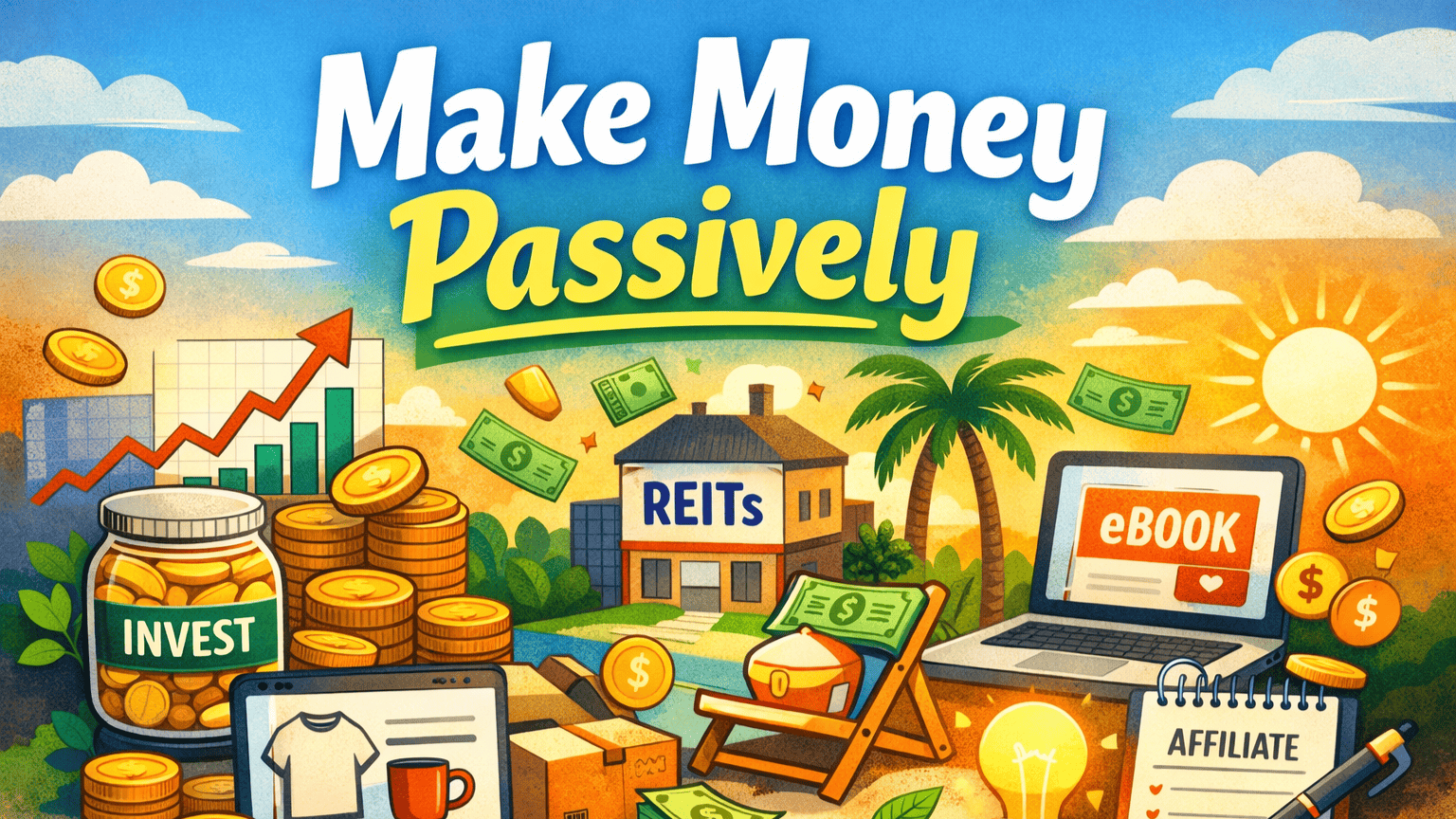
You might think you need thousands of dollars to start making passive income. That’s not true. In this post, you’ll find five ways to start building passive income with less than $100, including exactly how to get started, what to expect, and how much you can realistically make from each one.
Print on Demand
Print on demand is the version of this for people who want to sell physical products without ever touching inventory.
Print-on-demand platforms like Printify and Gelato let you design and sell all kinds of custom products, including t-shirts, mugs, photo books, calendars, and posters, all with no upfront costs and without ever holding inventory. When someone orders from your store, the platform handles everything: printing, packaging, and shipping.
How to Get Started:
First, sign up for a print-on-demand platform (many are free to join). Then connect your store, whether it’s Etsy, Shopify, TikTok Shop, or even Amazon.
After that, pick your product from their catalog, upload your design, create your mockup, set your description, decide your price, and publish to your store. In less than 10 minutes, you could have your first product ready to sell.
The thing is with print on demand, you won’t know what’s going to take off ahead of time, so plan to test a handful of designs before you find one that lands. Pick a niche that lines up with your interests, because you’ll be the one creating the content and promoting it. The more it fits you, the easier it is to keep going long-term.
If you’re a beginner, you should check out this post that talks about mistakes that beginners make running a POD store.
2. REITs (Real Estate Investment Trusts)
Most people picture real estate investing as buying a whole property: tens of thousands for a down payment, a mortgage, tenants to manage. REITs skip all of that. You can start investing in real estate with as little as $100.
A REIT (real estate investment trust) is a company that owns a large portfolio of real estate. Buying its stock gives you a stake in the properties without owning any of them directly.
REITs are legally required to pay out 90% of their profits to shareholders as dividends. When these companies collect rent, most of it flows straight to you. Instead of the risk of one property, you get exposure to thousands, plus professional management running the portfolio.
Some REITs focus on apartment buildings, others on shopping centers, data centers, or storage facilities. Dividend yields typically run 3-6%, with the added chance of the stock price appreciating on top of that. Most platforms let you buy in for $50-$100.
3. Affiliate Marketing
This one gets a bad reputation from all the videos claiming “$10,000 a month from affiliate income.” In reality, if you’re a content creator, it’s one of the most accessible income streams available. You don’t need a large following to start earning something.
Compare that to sponsorships or product sales, which both require an existing audience, or YouTube AdSense, which needs 1,000 subscribers before it pays out anything. Affiliate income has a much lower floor to clear.
How It Works:
The mechanics are simple: create content (blog posts, newsletters, reels, TikToks) and link to products you actually use. When someone clicks and buys, you earn a commission. There’s a more detailed guide on getting started with affiliate marketing if you want the full walkthrough.
Getting Started:
You can start for free with a newsletter on Medium or Substack, or by posting on Instagram or TikTok. Pick a niche you already know well, and stick to products you actually use daily: finance apps, productivity tools, books, whatever you’re already spending money on.
Amazon Associates is the obvious starting point; apply to three or four programs in your niche beyond that. Plum, Trading 212, and Notion are examples of tools with their own affiliate programs.
Amazon’s commission runs 1-3% in most categories, so a $50 sale nets you $0.50 to $1.50, sometimes plus a cut of whatever else the buyer adds to their cart within 24 hours.
4. Digital Products
Digital products let you package knowledge you already have into something scalable that reaches people well beyond your immediate reach.
You build the product once (a PDF, guide, ebook, or video course) and sell unlimited copies with no printing, shipping, or stock to manage. The effort is the same whether 100 people buy it or 100,000.
That said, there are real trade-offs to weigh before you commit:
| Challenge | What It Means for You |
|---|---|
| Saturation | You’re not competing with a few local businesses, you’re competing globally. Your product needs to solve a specific problem or it gets lost. |
| Copying | On marketplaces like Etsy, a good product often gets copied and resold with minor tweaks by someone else. |
| Perception | Some buyers still price digital products lower in their heads than physical ones, so pricing needs care. |
On the upside, the margins are hard to beat. Once the product exists, every sale after the first is close to pure profit, with no fulfillment eating into your time. Sales can come in while you’re asleep or on holiday.
Getting Started:
Keep your first product simple. Pick something you genuinely understand, built on a problem you’ve already solved for yourself. Make sure it clearly solves that problem, your listing photos stand out, and it’s easy to find through search.
These digital product ideas are a reasonable place to start if you’re not sure what to build.
If it’s your first product, Etsy is the easiest place to launch, since it already has buyers browsing rather than requiring you to build traffic from zero. Etsy does charge $0.20 to list an item, which is worth knowing before you list fifty variations at once.
5. Selling Online Courses
As a business model, online course are one of the more scalable options on this list.
Skill-based creators (spreadsheet tricks, home cooking, a language, a craft) routinely turn a single area of expertise into six-figure course businesses. The pattern is consistent: build an audience around the skill first, then package it into something sellable.
How to Get Started?
The hard part isn’t the platform, it’s figuring out what you know that other people would actually pay to learn. That’s worth being honest with yourself about before you invest the time.
Once you’ve settled on the topic, you can put your course on Teachable or Udemy, which require little ongoing maintenance, or host it on your own site and drive your own traffic. Platforms like Thinkific make this especially easy, letting you host a course for free while they handle the transactions.

Bonus: Royalties from Your Creative Work
Selling your work for royalties is another option worth considering.
Photographers, for instance, can upload images to Adobe Stock or Canva and earn a royalty each time someone downloads one.
Any intellectual property you own can work this way, including a book sold through Amazon instead of your own site. It’s another stream that keeps paying for work you’ve already done.
The Real Talk About Passive Income
Passive income gets thrown around as a buzzword, and someone implying they set something up once, walked away, and $30k now flows in every month while relaxing on a beach.
That’s not how it works. You still have to write the ebook, build the course, research the funds and REITs, and set up the systems in the first place.
The passive part only shows up after the upfront effort, and even then it’s not fully hands-off: things need updating, questions need answering, and at some point you might hand pieces of it off to someone else to manage.
What makes these income streams worth building isn’t that they’re effortless. It’s that they eventually earn money while you’re doing something else entirely.
Shifting a business from active to passive income is still real work. But there’s something genuinely rewarding about income that isn’t tied directly to your hours. Even $50 or $100 a month, once it’s not costing you time to maintain, is teaching you something bigger: how to make money work for you instead of you always working for money.
Expect a few of these to underperform before one sticks. A REIT might pay out a few dollars a month at first. A course might take three attempts before it sells. That’s the cost of building something that runs without you, not a sign you’re doing something wrong.
The goal isn’t to get rich fast. It’s to start, and let something grow over time. Even a year to your first $1000 in passive income is $1000 you didn’t have to trade your hours for.