
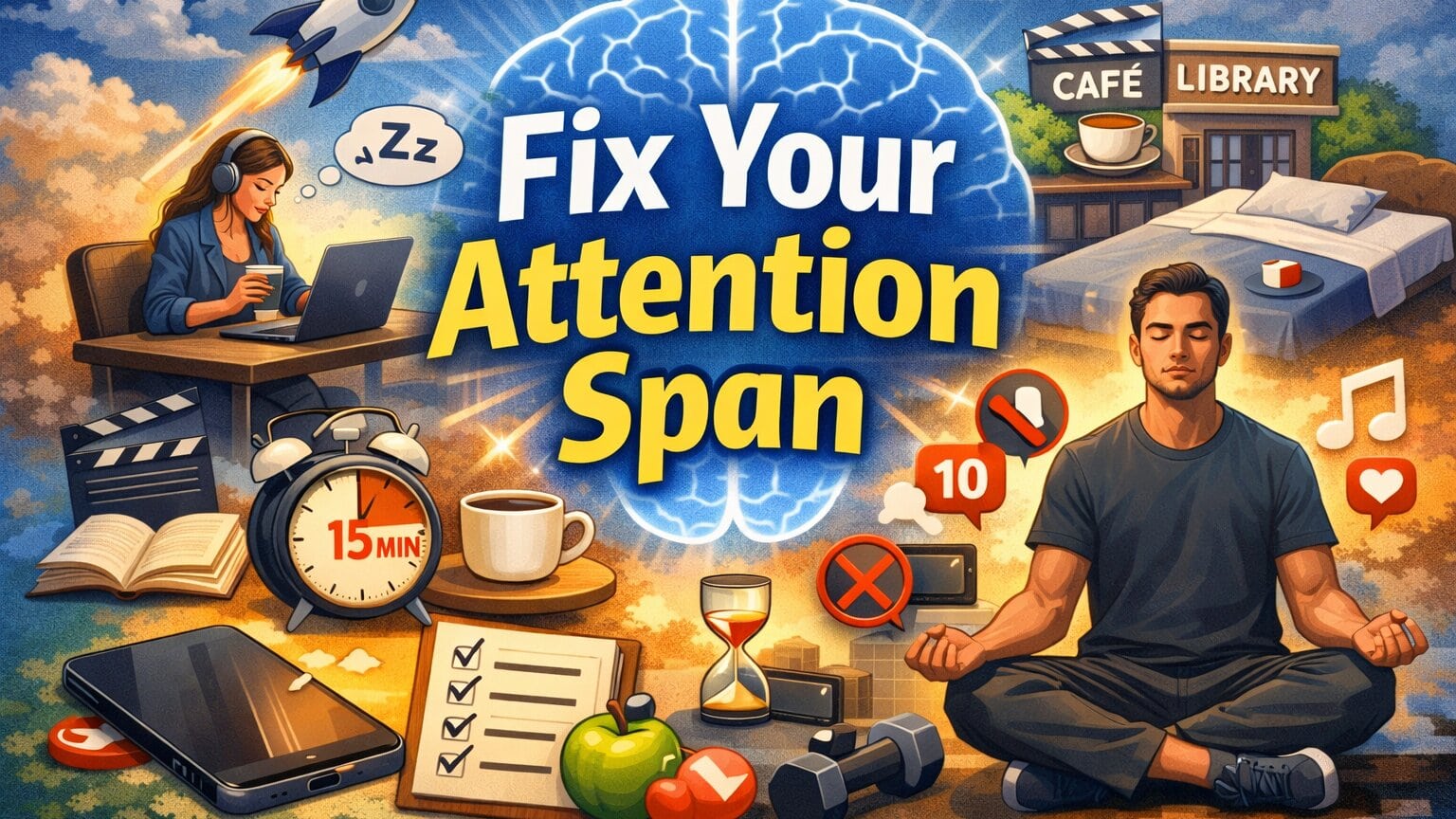
Attention fragmentation is the worst it’s ever been. We’re distracted, scattered, pulled in a thousand directions. And if we don’t fix it, we’re toast, as workers, as learners, as humans.
Here are the micro habits you can incorporate into your life to fix your attention span before constant distractions completely take over.
1. Set Your Baseline
Before anything else, grab a book and time yourself. How long can you read without getting up or checking your phone? Really try to push yourself, but don’t judge yourself if it’s only a few minutes. Write down your time, that’s your baseline.
Think of your attention like a muscle. You build it by starting small and gradually stretching it. The rest of these habits will help you expand that number over time.
2. The 5-Minute Rule
The first 5 minutes of any task are the ones where we’re most prone to getting distracted. There’s an absolute peak of this just before we start, and then usually about 5 minutes in, it’s actually a lot easier to stay focused than you were at the start.
So if you’re struggling to stay on task, just tell yourself you’re going to do it for 5 minutes.
Or if you’re in the middle of a focus session and finding yourself getting distracted, tell yourself, “I’m just going to do it for another 5 minutes.”
If you can sit through the discomfort of just those 5 minutes, you’ll usually find that staying focused becomes a lot easier from there.
3. Consume More Long-Form Content
I’m not saying you have to cut out all forms of entertainment. But in general, the more you’re consuming things that are longer form like books, audiobooks, or movies rather than TikToks and Instagram Reels and YouTube Shorts, the more you are able to train your attention span to focus on stuff for a little bit longer.
4. Get Your Phone Out of the Bedroom
Scrolling on your phone for no reason at late night is one of the biggest time sinks in the world. It’s terrible for your attention span, your focus, your sleep, your mood, basically all of the things.
Ideally, charge your phone outside the bedroom entirely so you can say good night to it before bed. But if it absolutely has to be in your bedroom, set up the charger across the room so you’re not tempted to reach for it when you can’t sleep.
5. Automate Your Limits
Set your phone to automatically block social media or any offending apps after a certain time. This removes temptation without needing constant self-control.
Don’t make it a battle you have to consciously fight every single evening, build the system once and let it do the work.
6. Watch TV Without Your Phone
If you are watching a TV show or a movie, do it without reaching for your phone. It’s another way of consuming long-form content, which is still entertainment, without having to do something else at the same time.
This trains your brain to stay with one thing at a time, something most people have lost.
7. Ditch the Subtitles
Try watching TV without the subtitles on.
I know sometimes it’s difficult to follow the plot to figure out, who is that character again? What do they actually want?
But when you remove them, you’re forced to pay closer attention, and you’re training your attention span while being entertained at the same time.
8. Change Up Your Work Environment
Don’t rely on one “perfect” setup. It’s good to have a nice productivity desk setup where you’ve got everything arranged as you like it.
But try working in different places like cafes, libraries, or even busy environments. It trains your brain to focus anywhere, not just under ideal conditions.
9. Turn Off Unnecessary Notifications
Turn off all of your notifications other than the ones from friends and family. We are constantly getting pinged by all of these apps that are just stealing our attention span.
Two seconds of effort, and one less thing pulling your attention sideways for the rest of your life.
10. Build Deep Work Rituals
Focus is a lot easier when you build cues that tell your brain it’s time to work. Some writers light a candle at the start of a writing session. Some coders put on the same playlist. Some entrepreneurs sit in the same chair with the same cup of tea.
The ritual itself doesn’t matter — what matters is the consistency. Rituals tell your mind: stop wandering, start focusing.
11. Understand Your Internal Triggers
Distraction isn’t always external, it’s often internal.
There is a wonderful book called Indistractable, and the research summarizes that in around 80% of cases, the key trigger for distraction is not an external notification — it’s an internal emotional state we’re trying to escape. Boredom. Anxiety. Fear. Perfectionism. Insecurity about what other people will think.
We feel those uncomfortable sensations come up when we’re trying to do tricky work, and instead of sitting with them, we reach for the phone to escape.
But here’s the thing, those feelings are just internal bodily sensations. They’re not actually going to harm you.
So when you feel that internal trigger, try this:
- Name the emotion. Is it fear? Doubt? Uncertainty? Anxiety? What’s the thing?
- Lean into it. Close your eyes and actually fully feel it rather than running from it.
You’ll usually find the feeling has not killed you. The more you practice this, the more you train your brain to stop fleeing discomfort, and the longer your attention span becomes as a result.
12. Minimize Friction During Deep Work
Make it easier to start and continue your tasks.
Think about the things that interrupt your flow before you’ve even really started a cluttered workspace, too many tabs open, constantly switching between tools, and try to remove them one by one. For example, if typing feels slow, try speaking your ideas instead.
The easier it is to just start, the more likely you are to stay in it.
13. Keep Your Phone Away While Working
While you are trying to focus on something, put the phone away from you.
Ideally, you would have it in a different room altogether.
Or it could be in the same room, but it’s in some kind of Do Not Disturb focus mode and it’s away from your desk.
Or you have it on some kind of Do Not Disturb focus mode so you don’t get any notifications, and you also have it turned face down so you’re not tempted to glance at it.
14. Set Screen Time Limits
Your environment is rigged against you. Billion-dollar companies are actively trying to hijack your attention, so you have to design your environment for focus:
So set screen time limits. All modern phones have them built in. Limit yourself to Instagram for 10 or 15 minutes a day, and I can guarantee your attention span is going to be way better compared to someone clocking 8 hours on TikTok.
15. Track Your Progress
We’re hardwired to seek progress. Whether it’s killing bears in World of Warcraft or a salesperson putting beads in a jar for every call they make, that feeling of making progress is profoundly motivating.
So find a way to make your progress visible, whatever the task is. Whether it’s word count, tasks completed, or hours focused, track it.
By tracking it, you’re actually improving your ability to stay focused on that task for longer.
16. Take Recharging Breaks
Your brain isn’t designed to focus for 12 straight hours. 90 minutes is about the max before performance falls off a cliff. So instead of pushing through until you’re completely fried, build in recovery.
A lot of people work for 45 to 50 minutes and then spend their break checking email and social media. Scrolling, emails, and notifications don’t recharge you, they drain you.
High performers know what a lot of people don’t: breaks aren’t deviations from your performance, they’re part of your performance. Wherever possible, use your breaks to actually restore your energy.
A good place to start, schedule a 15-minute walk outside, no phone, every day for the next week.
17. Surround Yourself With Focused People
Your environment shapes your behavior.
When you are in an environment where other people are working, it just naturally nudges you away from doing distracting things and towards actually working.
This is the real power of working in libraries or coffee shops where everyone’s got their MacBooks out and everyone seems to be working.
The more you’re able to do that, the more you’re training your indistractibility, your attention span, your ability to focus.
18. Fix the Hardware First
We tend to think of attention span as a software problem, something wrong with our brain or our habits. But the state of your body has a remarkable impact on your ability to focus. Have you slept well? Eaten decent food? Exercised recently? Had some basic human connection?
It’s the boring stuff like that the hardware problems, that often end up fixing the software problems. If your attention is struggling, check these basics before anything else:
- Sleep — are you getting enough?
- Nutrition — are you eating well?
- Exercise — have you moved recently?
- Socialization — we need connection with other people
If you haven’t ticked any of those boxes, you are leaving a lot of focus points on the table.
If you’re struggling with discipline, this post lays out simple steps you can follow to build lasting discipline.
19. Connect Your Focus to Meaning
Meaning sounds like a soft-hearted notion, but it can be a hard-headed strategy. Before you start anything, ask yourself: Why does this matter? Who benefits? Then write it down and keep it in view.
Focus becomes effortless when it has a purpose. When you connect your attention to meaning, it stops being a chore and starts being a choice.
20. Make It More Fun
With whatever you’re doing, ask yourself: what would this look like if it were fun?
We struggle with our attention span most on things we find boring. But if you can find a way to make the task even just 10% more enjoyable, you’re a lot less likely to be distracted, and you’re going to be more productive, more creative, and have more energy for the other important areas of your life.
Final Thoughts
It’s easy to overcomplicate focus, but the solution is surprisingly simple:
- Build your baseline
- Remove distractions
- Create focus rituals
- Take real breaks
- Work with purpose
Attention isn’t just about productivity, it’s about how you experience life. Because life isn’t meant to be lived in 15-second bursts.
The sooner you take control of your attention, the sooner you take control of your time, and your future.
You might be interested in microhabits that improve your life and finances.