
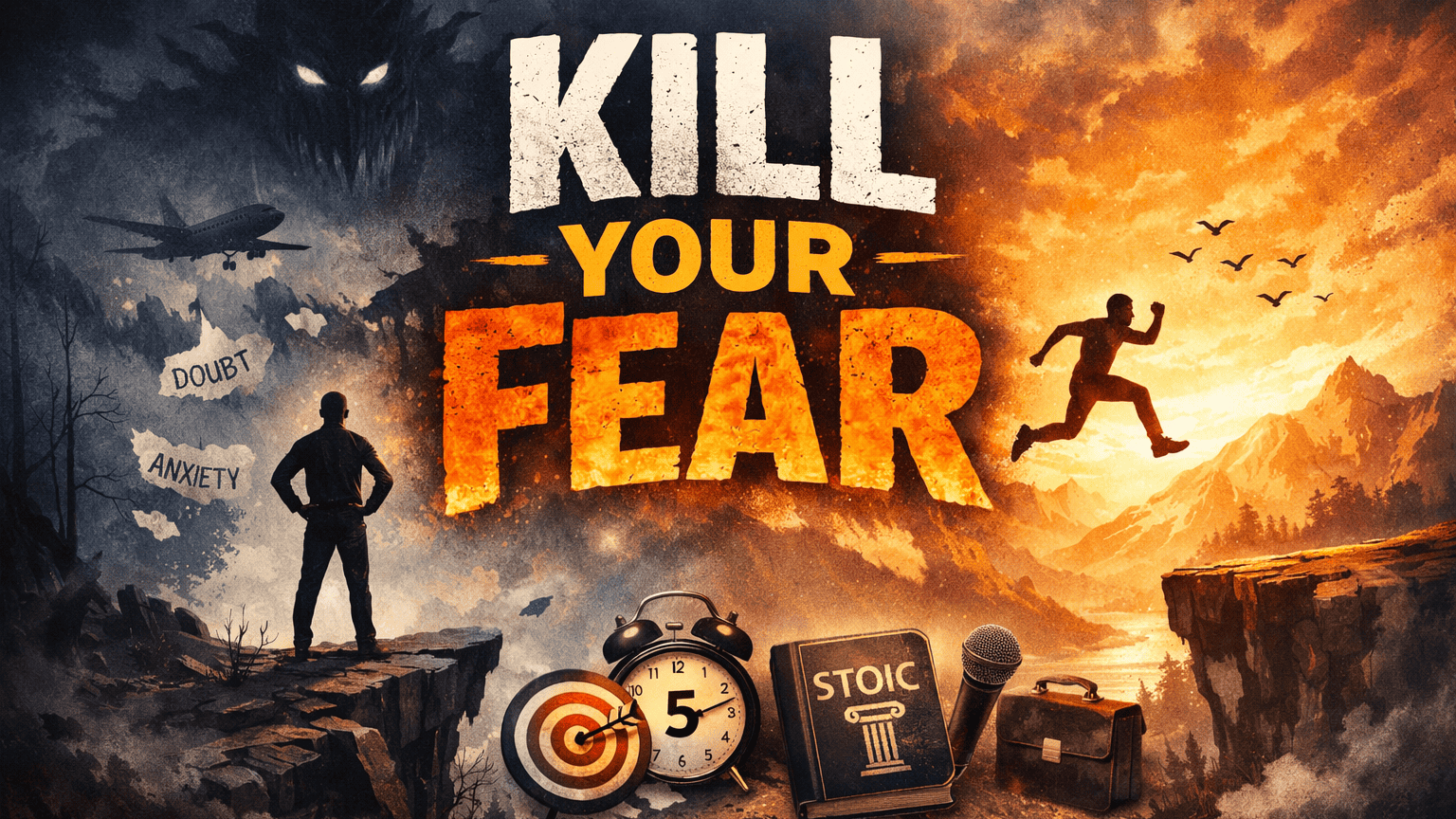
Fear is real. I’m tired of hearing people say fear isn’t real. That’s complete nonsense. Fear is absolutely real, and In fact, there are probably things that you’re afraid of doing right now in your life, in your relationships, your career, your dreams. And that fear? It’s stealing experiences from you. It’s limiting what you can do and who you can become.
I mean, if you’re afraid to fly, that’s going to limit your ability to travel and see the world. If public speaking terrifies you, you’re not sharing your brilliant ideas. If you’re afraid to ask for that raise, you’re literally leaving money on the table. And if you’ve been dreaming of starting that business but you’re too scared to tell people about it? I mean, fear is something that stops us all.
But here’s the good news: fear doesn’t have to control you. There are proven strategies, both modern psychological techniques and ancient wisdom that can help you beat every single fear that’s been stopping you.
Table of Contents
Understanding Fear: What It Is and What It Isn’t
First, before we get into these strategies, I just want to say that
Fear isn’t weakness.
Fear isn’t lack of confidence.
Fear isn’t something “wrong” with you.
Fear is simply a physical state in your body.
Fear and Excitement Are the Exact Same Thing
This is wild, but true. Fear is exactly the same as excitement. Let me say that again, fear and excitement create the exact same physical response.
Your heart races. You might sweat. Your chest tightens. You get that pit in your stomach. Cortisol surges through you. Your body goes into this hyperaware state because it’s getting ready for action.
So what’s the difference? Simple. It’s what your brain is telling you. If you’re excited, your brain says, “This is going to be amazing!” If you’re afraid, your brain says, “This is dangerous, get out of here!”
Same body response. Totally different story in your head.
Why “Just Calm Down” Doesn’t Work
Second thing I want you to understand is that you may have heard the advice “feel the fear and do it anyway.” Or “oh, just try to calm down, think positive.” Yeah, it doesn’t really work, does it?
There’s actually a reason for that. When you’re afraid, your body’s in this super agitated, high-arousal state. You’re all amped up, hyper-aware of what’s going on, kind of freaking out.
Now think about what it’s like when you’re calm. You’re chill, right? Low arousal, relaxed.
Trying to go from totally jacked up and anxious to calm and peaceful? It’s like trying to stop a speeding train by throwing a rock at it. Not only does it not work, but it can actually make things worse. It can derail the whole thing.
Research backs this up that when you try to ignore your fears, they actually get stronger. Similarly, positive thinking alone can sometimes make fears worse. So what are the real solutions?
Strategy 1: The 5-Second Rule Plus Anchor Thoughts
This is the technique I’ve used for years to beat every single fear that used to stop me. It’s turned me into someone who thrives in high-stress situations. And it’s going to work for you too.
How You Do It
You’re going to combine two things: the 5-Second Rule and what I call an anchor thought. Together, these are going to reframe what your mind is doing, taking you from agitation and fear to excitement.
Here’s a trick that’s proven by science that I use every time I’m going for a big meeting. When I start to sweat, when I start to have butterflies, when I start to have my heart race, I say “I’m excited. I’m excited to get out there. I’m excited to talk to these people.
Remember the first thing we talked about? Fear and excitement are the exact same physical state. The only difference is what your brain calls it.
Step One: Count Backwards
The moment you feel that fear starting — 5, 4, 3, 2, 1.
This countdown is critical. It switches the gears in your mind. It wakes up your prefrontal cortex. It tells your brain “Hey, I’m in control now.” You’ve just interrupted the fear pattern and your brain is ready for the next step.
Step Two: Drop in Your Anchor Thought
Right after you count down, think about something specific, your anchor thought. This is something you’ve prepared ahead of time. It’s going to anchor you so you don’t spiral into a full panic attack. It keeps you in control of what you’re thinking and how you behave.
Here’s the key: your anchor thought needs to be related to what you’re actually doing.
Flying home to see your mom? Your anchor thought might be a vivid picture of walking on the beach with her. About to have a tough conversation with your boss? Visualize yourself after it’s done, calling a friend and saying “I did it. It went well.”

Step Three: Tell Yourself You’re Excited
As you’re holding that anchor thought in your mind, start saying “I’m excited.” Say it over and over. “I’m excited to see my mom.” “I’m excited to share this idea.” “I’m excited to get out there.”
Why This Works Like Magic
Something incredible happens in your brain when you do this. You’ve interrupted the fear. You’ve used the countdown to assert control. And you’ve given your brain an image that makes sense for what you’re doing.
So when your body’s all worked up and you’re thinking excited thoughts about something that makes sense, your brain buys it. Your brain goes “Oh, you’re excited!”
You just tricked your brain. And it works.
Using The Stoic Approach
Strategy 2: See Fear as a Signal, Not a Sentence
Ancient wisdom has something powerful to teach us here. The Stoics understood fear differently than we do.
Marcus Aurelius, a Roman emperor who also happened to be a philosopher, put it this way: If something external is bothering you, the pain isn’t from the thing itself, it’s from how you’re judging it. And you can change that judgment any time you want.
Think about what that means. Fear isn’t caused by what’s happening. It’s caused by what you’re telling yourself about what’s happening.
Fear Is Pointing to Something
When anxiety shows up, it’s actually giving you information. It’s a signal. It’s showing you where you’re making judgments that might not be helping you.
So when fear hits, ask yourself: What am I telling myself right now? What judgment am I making about this situation?
Here’s the real power move: focus only on what you actually control. Your thoughts. Your actions. Your responses. That’s it.
You can’t control whether your business succeeds, but you control how hard you work. You can’t control what people think of your presentation, but you control your preparation. You can’t control the turbulence on the plane, but you control what you think about it.
When you recognize fear as a signal pointing to unhelpful judgments or things you can’t control anyway, you can start making better choices about what to think.
Strategy 3: Change How You See It
Your reality is shaped by how you interpret what happens to you. The same exact event can feel like a threat or an opportunity, depending entirely on how you look at it.
Epictetus, another Stoic philosopher, nailed this: “What upsets people is not things themselves, but their judgments about these things.”
Think about public speaking. That racing heart, those sweaty palms, that heightened awareness — it’s all neutral. One person feels that and thinks “I’m going to fail. This is terrible.” Another person feels the exact same thing and thinks “My body’s giving me energy to perform well.”
Same sensation. Completely different experience.
You Get to Choose Your Interpretation
This is huge. When you notice fear coming up, stop and ask:
- How else could I look at this?
- What would a confident person think right now?
- Is this actually dangerous, or am I catastrophizing?
- Could this challenge actually be an opportunity?
I’m not talking about fake positivity or pretending real dangers don’t exist. I’m talking about recognizing that you have a choice in how you interpret things.
That job interview? It’s not just potential rejection. It’s also a chance to show what you can do. That difficult conversation? It’s not just conflict. It’s an opportunity to make the relationship stronger through honesty.
When you realize perception is a choice, you take back control of your emotional experience.
Strategy 4: Stay in the Present Moment
Here’s something most people don’t realize: most anxiety isn’t about what’s happening right now. It’s about the past you’re replaying or the future you’re worried about.
Marcus Aurelius said it simply: “Confine yourself to the present.”
And he was right. When you actually anchor yourself in this moment — right here, right now — it’s usually manageable. The anxiety exists in your mental time travel, not in present reality.
Think about it. When you’re anxious about next week’s presentation, you’re suffering now for something that hasn’t even happened. When you’re beating yourself up about yesterday’s mistake, you’re suffering now for something that’s already over.
In both cases, the only moment you’re actually experiencing pain is right now, but the pain is about a different time entirely.
Bring Yourself Back to Now
When anxiety hits, take three deep breaths. Notice five things you can see. Four things you can touch. Three things you can hear. This grounds you in what’s actually real right now.
Ask yourself: “What does this present moment need from me?” Then do that one thing.
When your mind wanders to future worries, gently redirect it: “That’s the future. Right now, in this moment, I’m okay.”
Most of the time, when you’re fully present, you’ll find that this moment is actually fine. It’s manageable. You’re safe.
Strategy 5: Imagine the Worst
This might sound backwards, but one of the most powerful ways to reduce anxiety is to deliberately, calmly imagine the worst-case scenario.
Seneca, another Stoic philosopher, understood this: “He robs present ills of their power who has perceived their coming beforehand.”
Why This Actually Helps
When you consciously imagine what you fear, you take away the power of the unknown. We’re often more scared of vague threats than specific ones. When you clearly picture the worst that could happen, you usually realize you’d survive it.
Plus, this practice makes you grateful for what you have right now. When you imagine losing your health, your relationships, your opportunities, you appreciate them more deeply.
And it prepares your mind. If you’ve mentally rehearsed handling a setback, you won’t panic if it actually happens.
How to Do This Right
Pick a calm moment, not when you’re already anxious. Imagine the feared outcome specifically. What would actually happen? How would you handle it?
Ask yourself: “If this worst case happened, how would I cope? What resources do I have?”
Here’s the thing: imagining something doesn’t make it more likely. But it does make you more prepared.
Say you’re anxious about starting a business. Spend time imagining it failing. What would really happen? You’d probably need to get a regular job again. Is that the end of the world? You’d have experience, lessons learned, and proof that you had the guts to try.
Often, the worst case is uncomfortable but far from catastrophic.
Strategy 6: Build Resilience Through Hard Things
Resilience isn’t something you’re born with. It’s something you build by enduring challenges. The Stoics understood that hardship isn’t an obstacle, it’s how you grow. Friction sharpens the blade.
Every single time you face a fear and push through it, you get stronger. Every time you endure discomfort, your capacity expands.
Build Your Mental Strength
Start small. Face little fears regularly. Socially anxious? Start with small talk at the grocery store. Build from there.
Try voluntary discomfort sometimes. Take cold showers. Fast for a day. Sleep without your usual comforts. Go without your phone for 24 hours. This teaches your brain that discomfort isn’t dangerous and that you can handle more than you think.
When challenges show up, reframe them: “This is making me stronger. This is training.”
Look back at your life. You’ve survived 100% of your worst days so far. You’re more resilient than you give yourself credit for.
The point isn’t to go looking for suffering. The point is that challenges are inevitable, and each one is a chance to build mental strength. When you stop avoiding all discomfort, you stop being so afraid of it.
Strategy 7: Detach from Outcomes
One of the deepest sources of anxiety? Being desperate for things to turn out a specific way. We’re terrified of failure, rejection, disappointment, because we think we need certain results to be okay.
Epictetus taught something liberating: “Some things are up to us and some things are not up to us.”
You control your actions, your effort, your intentions. You don’t control the outcomes.
What You Actually Control
You can control how well you prepare for that interview. You can’t control whether you get the job.
You can control asking someone out. You can’t control their answer.
You can control launching your business. You can’t control whether the market responds.
This isn’t about not caring. It’s about caring about what you can actually influence.
When you detach from outcomes, you experience incredible freedom. You can give full effort without being paralyzed by “what if it doesn’t work?”
Focus on the process. Did you show up fully? Did you act with integrity? Did you try your best? If yes, you succeeded in what matters, regardless of external results.
Here’s the thing: this detachment often leads to better outcomes because you perform better when you’re not suffocated by outcome anxiety. But more importantly, it gives you peace no matter what happens.
Strategy 8: Be Brave (Even When You’re Scared)
Let’s get something straight: courage isn’t the absence of fear. It’s acting despite the fear.
Seneca said it perfectly: “He who is brave is free.”
Real courage, the kind the Stoics practiced, means embracing discomfort, learning from failures, and acting with integrity even when it’s terrifying. It’s a muscle. And it gets stronger every single time you use it.
What Real Courage Looks Like
It’s starting before you feel ready. You’ll rarely feel completely prepared. Brave people act anyway.
It’s being vulnerable. Being willing to fail, get rejected, or look foolish for something that matters to you.
It’s learning from fear instead of running from it. “I’m afraid of this because it matters.”
It’s doing the right thing even when it’s hard. Speaking truth when silence is safer. Admitting mistakes when pride wants you to hide them.

Build Your Courage Every Day
Do one thing daily that scares you. It doesn’t have to be huge. Send that email. Have that conversation. Try that new thing.
Stop waiting to “not be afraid.” Instead, celebrate yourself every time you act despite being afraid.
Remember: every person you admire for their courage still feels fear. The difference? They’ve decided that what they’re pursuing matters more than their comfort.
Bringing It All Together
Fear and anxiety are real, and they have real consequences for your life. But you now have eight powerful strategies to transform your relationship with fear.
These strategies aren’t just theory; they’re proven approaches used by countless people to overcome fears that once controlled their lives. People terrified of flying now take helicopter tours. People who couldn’t speak in public now confidently share their ideas. People paralyzed by starting a business now run thriving companies.
If public speaking is something you’re struggling with, this guide talks about speaking habits that’ll help you a lot.
The question isn’t whether these strategies work. The question is: will you use them?
Start today. Choose one strategy that resonates most with you. Pick an upcoming situation that makes you nervous. Prepare yourself with these tools. When the moment comes, take action despite the fear.
It’s one thing to stop being afraid, but pairing that work with confidence-building makes the whole process so much easier. Don’t skip that part of the process.



Leave a Reply