

If you don’t want an average life, you’ll have to make choices and sacrifices that most people aren’t willing to make.
Avoiding these seven common traps can make a huge difference. When you focus on building skills, making smart decisions, and growing beyond your comfort zone, you create a much stronger path toward long-term success and financial freedom.
1. Working Only for Money
There are two paths most people face early in their careers:
Path A — Take a boring but well-paid job. You quickly start stacking some nice cash. Your friends think you’re absolutely killing it, and your parents are probably pretty proud too. However, over time, your earning potential starts to plateau.
Path B — Take a challenging but lower-paid job. You might struggle for a couple of years as you improve and adapt, maybe even struggle to pay the bills. Your friends will probably think you’re falling behind, and your parents may not agree with the path you’ve taken. However, over time, your earning potential starts going through the roof.
The difference? Path A prioritizes money early on. Path B prioritizes two key things: skills and equity. Every self-made millionaire I know has followed path B, it’s the only way to build that kind of wealth.
Take Mark Tilbury, for example. He says when he left school at 16 with no qualifications, he immediately went out looking for jobs and got offered more than five opportunities. He had a big decision to make. He decided to become a carpenter’s apprentice.
The pay wasn’t great, but the skills he’d learn were extremely valuable, so he prioritized those. There was no way he was going to get equity in the business, but at least he was working for more than just money.
That job taught him a lot, and although he was forced to quit after being relentlessly bullied by his manager, he still uses many of those skills today when designing his bestselling brand of radio-controlled planes that he sells across the world.
By learning a wide range of high-income skills, it makes it almost impossible for you to ever be broke again, you become your greatest asset.
Think of every job as adding another tool to your Swiss Army knife. The more you collect, the more valuable you become.
Nowadays, I’d recommend prioritizing online-based high-income skills such as:
- Copywriting
- Video editing
- Coding (AI tools has made it easy)
The main takeaway: too many people get blinded by money, forgetting the importance of skills and equity. This is the biggest trap, the more you obsess over earning just money, the less you’ll likely make in the long run.

2. Buying a Luxury Lifestyle
Picture yourself cruising through Dubai’s sun-drenched streets in a bright yellow Lamborghini. You pull up to a swanky restaurant and order a $500 filet steak without batting an eyelid. Pretty successful feeling, right?
Here’s the truth: most people you see living that way are far from successful.
The majority are:
- Paying for cars they can’t afford
- Taking trips to Dubai on credit cards they’ll spend 5 months paying off
- Ordering steaks at Salt Bae’s restaurant that leave them with a bill they can’t handle
It’s all smoke and mirrors. It’s much easier to impress others on social media than to build real wealth.
Seeing people live these luxury lifestyles might tempt you to start playing the flexing game too, like everyone is living a better life than you. But this is far from reality.
The stats tell the real story:
- 37% of Americans can’t afford an unexpected expense over $400
- 39% worry they can’t pay their bills
- 60% of American households can’t afford to buy a new car
Once you’ve made your millions, you can buy whatever you want, that’s the point of becoming wealthy. But in the early days, you can’t live like a king and build wealth at the same time.
Instead of buying depreciating items like flashy cars, designer clothes, and expensive restaurants, invest in assets such as stocks, shares, crypto, and real estate. These assets will increase in value and generate income that you can then use to do whatever you want.

3. Doing Everything Yourself
You might be really great at what you do, but no matter how hard you try, you’ll never be able to outperform a group of talented people working together.
Look at anyone who’s made it big in sports or business, and you’ll see they all had help.
Take Elon Musk. On the surface, it might appear like he’s a genius entrepreneur who achieved everything single-handedly. But that couldn’t be further from the truth.
He was part of the group that launched PayPal. When eBay acquired PayPal for $1.5 billion in 2002, those newly wealthy tech experts spread across the industry like a virus.
Now they’re known as the PayPal Mafia. They’ve since launched companies like YouTube, Yelp, LinkedIn, and SpaceX, and regularly invest in and advise each other’s projects.
But what if you’re not aiming to launch the next billion-dollar company?
Here’s something worth knowing: a lot of older business owners are kind of lost when it comes to everything tech-based.
Many of them don’t even know there are online tools for literally everything, whether it’s managing your team, handling invoices, keeping track of projects, or building a website.
I don’t blame them. But now the younger generation has a real advantage.
So if these older business owners don’t know how to do a lot of this online stuff, and they understand they can’t do everything themselves, guess who they need? You.
You can help them bring their businesses into the 21st century and make a lot of money in the process.

4. Having Too Many Inputs
Do you ever feel like you’re being pulled in a million different directions?
This happens with everything in life, from side hustles to fitness; everyone seems to have a different opinion on what you should be focusing on.
All these competing voices create hundreds of paths you could follow:
- Becoming a doctor
- Starting a business
- Joining the family business
- Getting a stable 9-to-5
- Traveling
- Starting a family
The sheer number of options creates something called cognitive overload, where your brain simply can’t cope with the overwhelming amount of information and choices.
Left unchecked, this leads to decision paralysis, where you find yourself completely unable to take action or move forward.
People often mistake this for laziness, but in reality, your brain is just overwhelmed.
The solution: Start with your end destination or long-term goal in mind and work backwards.
Once you know where you want to go, it becomes easier to filter advice and only listen to inputs that help you reach that destination.
Focus on quality advice from experts or mentors, rather than random opinions from everywhere.
- Cut out general opinions from people without relevant experience.
- Seek expert advice, from a mentor, someone successful in your field, or focused educational content.
- Fully absorb and implement what you learn from one input before looking for the next.
Remember, even when you work your way backwards from your goal, you still don’t need to know everything at once. Tackle one challenge at a time, seek the input you need for that specific challenge, and move forward from there.
Having trouble staying on task? Check out this guide to fixing your attention span.

5. Being Ego-Driven
Arrogance is one of the most dangerous obstacles to growth.
Arrogant people think they already know everything, so why bother? But that’s exactly the problem. Arrogance blinds you to the opportunities that could genuinely change your life.
Ego-driven people are often too focused on the big picture, constantly dreaming of the end goal. This might sound productive, but it’s a dangerous trap.
When you’re always looking too far ahead, you end up overlooking the small but crucial steps that lead to true success.
For example, some people might be tempted to skim through this just to see all seven things, rather than sitting down and actually absorbing the knowledge in each one. By doing so, they miss out on the valuable insights that could fast-track their journey.
When you’re too egotistical, you start to believe that you don’t need advice from others, especially from those who might know more than you. You dismiss the wisdom of people who have already walked the path you’re trying to take.
But here’s the truth: real wealth isn’t just about being confident. It’s about having the humility to keep learning, and accepting that you don’t know it all. That’s where the real growth happens.
The more you learn, the more you realize how much you don’t know. This is called the iceberg principle:
What you know is just the tip. The massive chunk of knowledge sits underneath the surface, and arrogance makes you forget it’s even there.
In short, arrogance is a silent wealth killer. It convinces you that you’re too good to learn, too smart to listen, and too important to take the small steps that lead to greatness.
Staying curious and open to learning is what keeps you growing.

6. Passing the Blame
There’s a powerful proverb that says:
“The man who blames others has a long way on his journey to go. The man who blames himself is halfway there. The man who blames no one has already arrived.”
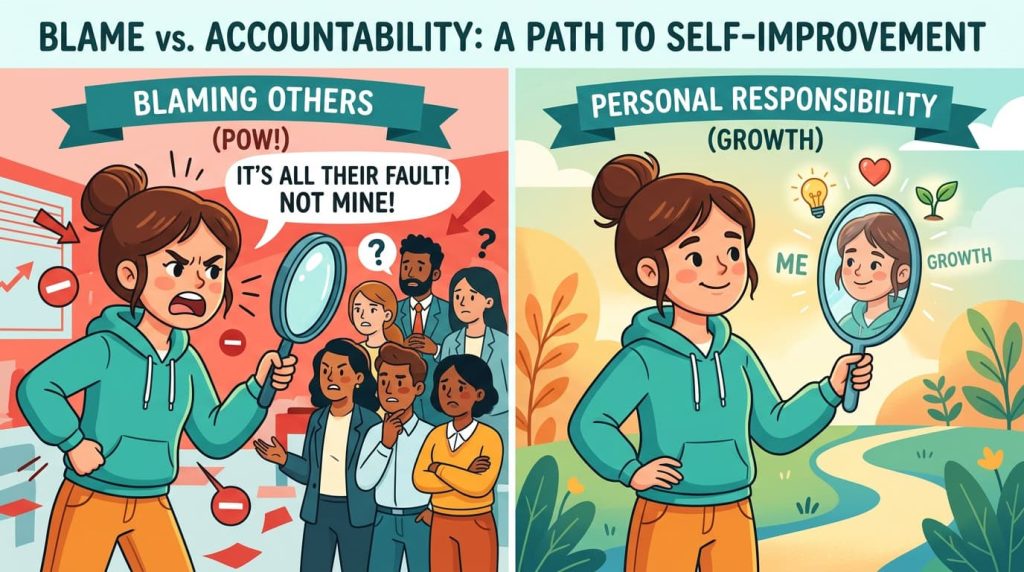
Think of two objects: a magnifying glass and a mirror. In life, you’re going to have to choose between them every single day.
If you pick up the magnifying glass, it gives you the ability to hyperfocus on other people. It’s a dangerous path, it leads straight to the blame game.
And look, I kind of get it. When things go wrong, it’s natural to want to pass the blame onto someone else.
I’m sure there’ve been times you’ve blamed your teacher for a test you failed, even though you spent more time binge-watching Netflix than studying. Or blamed traffic for being late, even though you left the house 10 minutes later than you should have.
But here’s the thing: these small instances of blame don’t stay small. Over time, they grow into a habit that’s hard to break. The excuses get bigger:
“The government hates young people”
“The system is rigged against people like me”
“My boss doesn’t like me”
“I’m not rich enough to start a business”
“Life didn’t give me the right opportunities”
The more you reach for the magnifying glass, the bigger your excuses become.
If you pick up the mirror, you focus on the stuff you can actually control: your own thoughts and actions.
To be the person who has already arrived at their destination, put down the magnifying glass, and pick up the mirror.
7. Staying Static
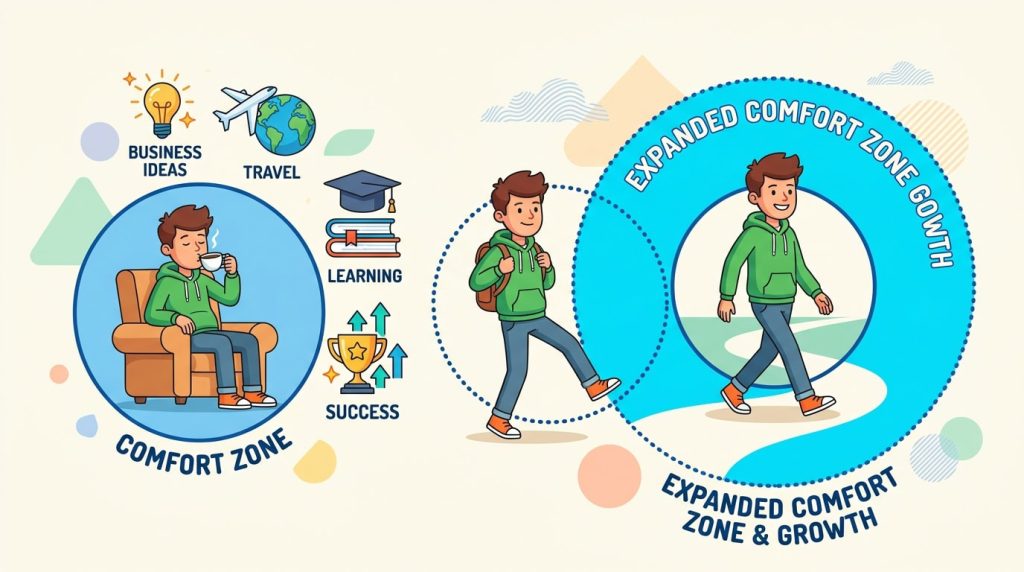
Your comfort zone is where you retreat seeking safety and security. Notice how there are no gaps in that circle, almost like a self-imposed prison with no way out and no way to grow.
If you’re currently there, you’re not alone. Studies show that over half of Brits don’t leave their comfort zone, and 45% of them worry that one day they might regret it.
So what can you do to break out of this prison? You need to expand the circle.
Here’s how Mark Tilbury expanded his comfort zone over the years, and the path you can follow too. He says:
“Starting point: I wasn’t good at like maths and English. The traditional education system didn’t suit me. I didn’t want to be a banker, doctor, or lawyer. I wanted something more hands-on.
Step 1: I stepped out and pursued the carpentry apprenticeship. This created a new space, but I wasn’t satisfied yet.
Step 2: I started experimenting with side hustles, pushing further into unfamiliar territory. Suddenly the world felt full of possibilities.
Step 3: I started my own business, a pivotal moment that required a big risk: a bank loan. It was the best decision I ever made.
Step 4: I traveled to China to find a manufacturer for my own brand of radio-controlled models. Despite the language and cultural barriers, I managed to build valuable connections.
Step 5: I ran my business for many years and enjoyed success, but eventually felt complacent. My family was happy, my bank was happy, but my mind wasn’t. So I started posting videos on YouTube at the age of 53. I wanted to share real knowledge with people who, like me, didn’t fit the traditional path, or who wanted to grow their wealth and feel more secure in life.”
Here’s what you can take away from this:
This space is infinite. You can expand your comfort zone as much as you want, but you have to claim it for yourself.
Growth only happens when you push beyond familiar boundaries.
If you don’t push beyond your current boundaries, you’ll miss out on all the possibilities that could have been yours.
If you’re ambitious but lazy, it’s worth checking the steps that help you get unstuck in life.
Bottom Line
Building long-term wealth and success isn’t about chasing quick money or trying to look successful on the outside. It’s about making smarter decisions that compound over time.
Focus on developing valuable skills, building equity, and investing in assets instead of spending on things that only create the illusion of wealth.
At the same time, remember that success is rarely a solo journey.
Surround yourself with the right people, stay open to learning, and avoid letting ego or outside noise distract you from your goals.
Take responsibility for your actions, keep improving, and don’t be afraid to step outside your comfort zone.
In the end, the people who achieve real success are usually the ones who stay curious, disciplined, and willing to grow, even when the path is difficult or uncertain.
Small, consistent decisions in the right direction can completely change where you end up.
If you liked this post, you probably also want to know the specific habits that are secretly sabotaging your success.
You might also want to know the things rich people do that drive them to success.






Leave a Reply