
So what’s the deal with dairy? Is it good for you? Is it inflammatory?
Should you be eating it… or avoiding it?
In this post, we’ll talk about dairy and some of the misconceptions that some things you thought were true might not be true.
Table of Contents
Is Dairy Actually Inflammatory?
First thing: dairy has gotten a bad reputation over the years, especially when it comes to inflammation.
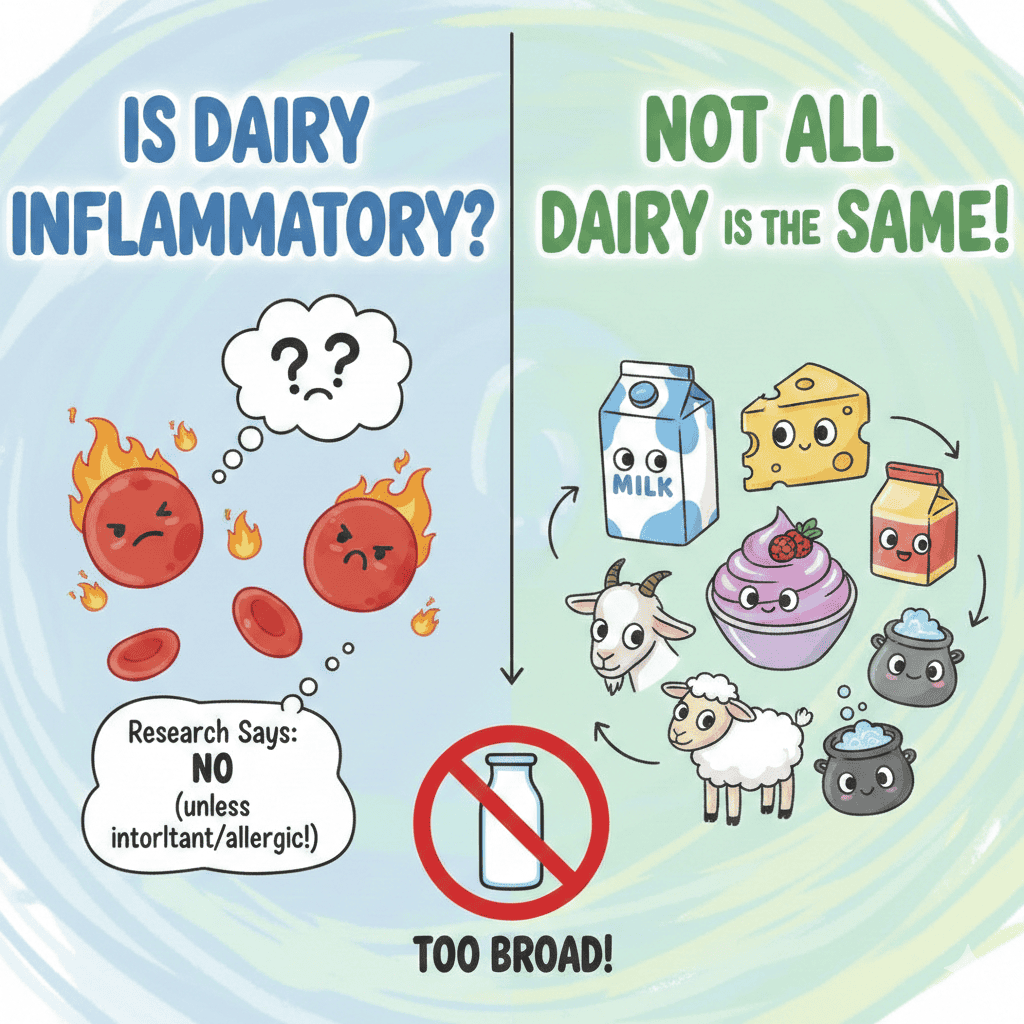
Here’s what the research shows: If you are not allergic to dairy and not lactose intolerant, there’s no strong evidence that dairy causes systemic inflammation.
What that means is there are blood markers we can measure that go up when you have some type of inflammatory toxin or insult, and dairy does not typically make them go up. These would be:
- C-reactive protein
- ESR (sedimentation rate)
- Interleukin-6
So apparently, in the average person who doesn’t have a problem with dairy from an allergy or lactose intolerance point of view, it doesn’t cause inflammation.
Not All Dairy Is the Same
Now, the problem with looking at dairy is it’s a very heterogeneous collection of foods. Dairy ranges from:
- Billions of different types of cheeses (that’s a lot of types!)
- Different milks have different percentages of fat, different animals (sheep, goat, cow)
- Yogurt
- Fermented vs non-fermented products
Right there, it’s impossible to lump all dairy together as one type of food. So keep that in mind as we discuss dairy.
What the Studies Actually Say
One study I looked at was titled: “No association between dairy intake and markers of gastrointestinal inflammation in healthy adult cohort.“
The thing is the whole thing’s in the title.
This study objectively looked for inflammation in people who ingest dairy, and it could not find any association.
The Bias Problem in Dairy Research
Historically, there have been a lot of studies run by companies that have vested interests, and the dairy board is guilty of this on lots of occasions.
That doesn’t automatically make them invalid, but it’s always smart to check the conflict-of-interest section.
Many studies compared yogurt consumption to a control group. But the control groups were:
- Juice
- Granola bars
- Cookies
Which aren’t exactly neutral comparison foods.
So whenever you’re reading any type of study, whether it’s big pharma, big agriculture, take it with a grain of salt. Look closely at whether it’s a well-run study and whether there’s a specific agenda.
What If Dairy Makes Your Joints Hurt?
There are studies that preceded these that said people who take in dairy end up getting their hip replaced more often. Some studies did talk about and make the leap to inflammation associated with dairy.
Here’s the reality: The way everyone reacts to different dairy products is different.
If you have a bit of arthritis in your knee, hip, or shoulder and you find that when your dairy intake goes up you feel worse, that could be very real for a variety of reasons:
It could be an allergy: You might have some kind of allergy to one of the many components of dairy. The proteins or different molecules might trigger your immune system slightly to get you inflamed.
It could be lactose intolerance: You could have an intolerance to the way you digest the lactose in dairy.
Understanding Lactose Intolerance
The way we digest lactose is with an enzyme called lactase. After we get through about age six, about 65% of the world does not have an enzyme that allows us to properly digest lactose.
This varies by where you live and your ethnic background. Some cultures have approaching 100% intolerance or absence of lactase.
Lactase helps break down lactose (milk sugar). Without it, dairy can cause:
- Bloating
- Gas
- Discomfort
- Digestive upset
Important distinction: This is not an allergy. Only 2-5% of people are actually formally allergic to milk or dairy products. But yes, lactose intolerance could lead to inflammatory-type properties.
How to Test If Dairy Is Bothering You
Try an elimination-style diet:
- Remove dairy for a while
- Gradually reintroduce it
- Monitor how you feel
- See if there’s a difference as you gradually reintroduce it
That’s one way to test it on yourself.
Bottom Line on Inflammation
In terms of the inflammation of dairy, remember:
- It’s very hard to say anything definitive because there are so many different types of dairy
- The studies have bias
- We couldn’t find any convincing evidence that says definitely dairy is inflammatory
Is Dairy Actually Good For You?
Just because it’s not inflammatory, should you be eating it?
How Government Made Us All Drink Milk
Historically, dairy has been promoted particularly in North America by the US Department of Agriculture because they had a vested interest in it.
Hundreds of years ago, we didn’t really eat a lot of dairy. But in northern Scandinavian countries where winters were really harsh, those people relied on it more because of the high fat content. That’s why northern Europeans actually have very low incidence of lactose intolerance. They have genes actually modified to be able to tolerate this.
The point: Anytime an industry or government has a vested interest in some type of free market, it changes the role of that product in society.
“Milk Does a Body Good”, Or Does It?
All of us growing up were told:
- Have a glass of milk
- Get a glass of milk with every meal
- Milk does a body good
Then eventually, we realized: no, maybe milk doesn’t do everybody’s body good. And that what’s the controversy is.
The Shortcomings of Dairy: What You Should Know
1. Saturated Fat Content
One concern with dairy is saturated fat, especially in high-fat dairy products.
If you’re someone who
- Have high cholesterol
- Have high triglycerides
- Have a genetic predisposition to heart disease
You may need to monitor high-fat dairy intake more closely.
That’s why a lot of these studies dealt with low-fat dairy products to reduce the saturated fat and reduce inflammatory markers.
The flip side: Some studies did show that some dairy products do reduce inflammation as well, fermented ones. That overlaps with the probiotic world of science, which shows certain probiotics (which can be found in some dairy products) can be good for you.
2. Lactose Intolerance or Allergy
No brainer. If you have lactose intolerance or an allergy to it, it might not be good for you.
Good news: You can actually purchase enzymes to help you deal with it. If you love dairy so much that it hurts you, you can buy lactase; it’s commercially available, and some milk comes with lactase in it already to help you digest it.
3. Strong Bones? Not So Fast
We’ve always been told that milk is a way to develop strong bones.
But here’s the paradox: There is research that shows countries that consume the most dairy actually have the highest incidence of hip fractures, which is inverse to what we would intuitively think.
There are hypotheses about why this may happen, maybe related to the rest of the diet, maybe some people think it’s the excess vitamin A. But certainly the calcium you drink in dairy is not protective as we get older to reduce your incidence of hip fractures.
4. Dairy and Heart Disease
Large reviews have not found consistent evidence that dairy directly causes atherosclerosis (plaque buildup in arteries) in the general population.
However, if you’re genetically prone to lipid issues, moderation becomes more important.ful.
5. Hormones in Dairy—This Is a Big One
The presence of hormones in dairy products is significant.
In Canada: You cannot give growth hormone to cows.
In the US: They estimate one in six cows is given a synthetic type of growth hormone.
The concern for the Canadian government was it hadn’t been shown to provide significant benefit other than increasing yield, and we didn’t really know the long-term risk. So they said no thanks.
But growth hormone aside, the other hormones that definitely are present in milk are estrogen. 75% of milk comes from cows that are pregnant. These are not cows given hormones, but because of their pregnant state, they have estrogen in there.
This has been linked to:
- Early onset of puberty for women
- Delayed onset of menopause
- Some types of cancers, particularly prostate and endometrial cancer
So there is an increased risk due to the hormones that are present in milk.
So… Is Dairy Good or Bad?
Here’s the honest answer:
There’s no convincing evidence that all dairy is bad for everyone.
There’s also no strong evidence that everyone needs dairy to be healthy.
It depends on:
- Your genetics
- Your digestion
- Your cholesterol profile
- Your overall diet
- Your personal tolerance
Bottom Line
If you’re eating it because you like it, that’s one thing.
If you’re eating it because you think it’s a healthy choice, be objective. Look at what your goals are for what dairy is providing for you, then see whether this is the best way to get it. There are other sources of calcium and protein.
I couldn’t find any evidence that said all dairy is bad for you. Definitely in the Blue Zones, where they’ve investigated where people live a super long time, there’s some dairy. But the one thing I always say: it’s in moderation.
If you’re going to eat a wheel of extra sharp cheddar cheese every day, it’s not going to be good for you.
In fact, there’s nothing that we need in abundance or excess, no type of food.
The only thing is water. That’s really the only thing we need a lot of. Other than that, you don’t need a lot of anything.
A variety of foods is what I find to be the most healthy. If you are into dairy, in moderation, just like anything else, I don’t think it’s bad for you. And if you don’t like some of the other sources of protein, vitamins, and vitamin D, then dairy is good for you in that sense if you can’t enjoy taking it in from other forms.
You might want to take a look at other foods that are most likely to cause inflammation in your body.
This post is based on insights shared by Dr. Paul Zalzal and Dr. Brad Weening of Talking With Docs, who regularly review medical research and break down complex health topics into practical, evidence-based advice for everyday life.
Disclaimer:
This content is for informational purposes only and is not medical advice. Do not use it for medical emergencies. Always consult your physician or a qualified healthcare provider regarding any medical concerns or before making changes to your health routine.