
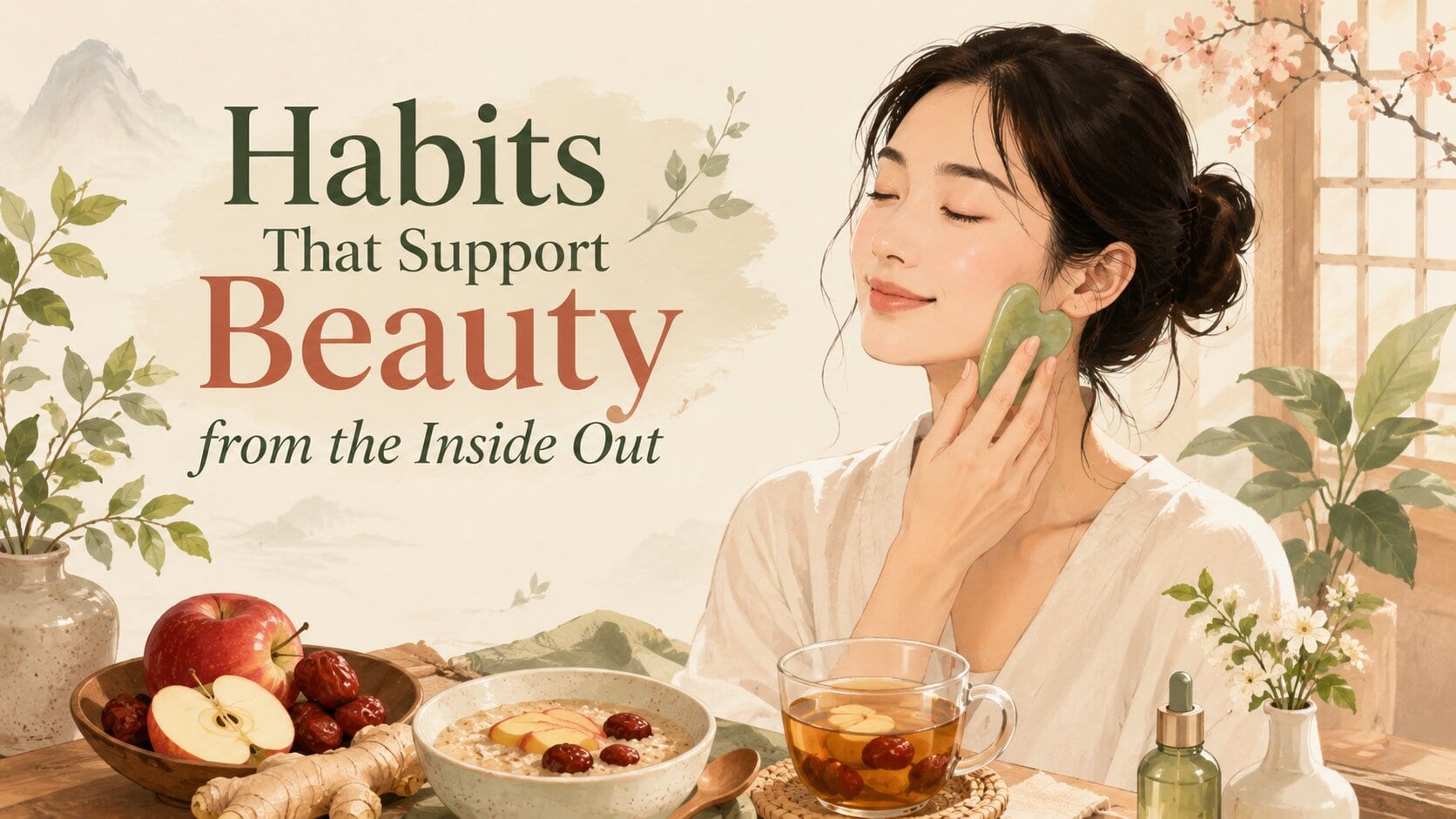
The goal isn’t to stop aging, it’s to age more slowly and gracefully. At the heart of many traditional Asian wellness practices is a simple belief: prevention is always better than cure.
When you take care of yourself well, you wake up more refreshed. Your body feels lighter and cleaner.
Across many East Asian cultures, beauty is viewed as a reflection of overall health.
Rather than relying solely on treatments after problems appear, the focus is on daily habits that support the body, skin, and mind over time. These habits are built around three core principles: hydration, blood circulation, and muscle relaxation.
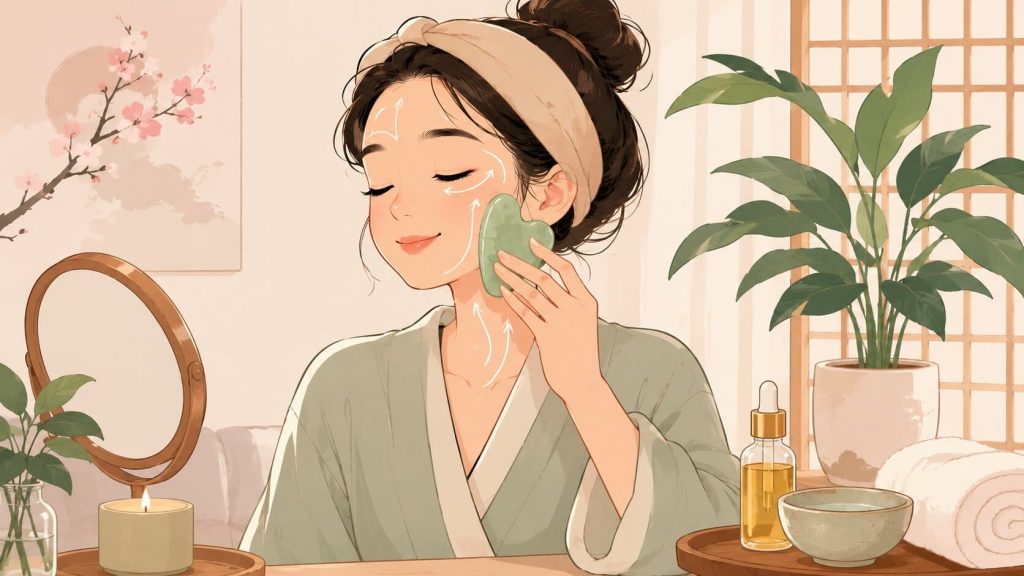
Habit 1: Gua Sha Every Morning
One popular self-care practice is gua sha, a traditional facial massage technique that has been used in Chinese culture for centuries.
A gua sha tool, ideally marble and widely available on Amazon or at Sephora, used with a few drops of organic jojoba oil is one of the simplest anti-aging rituals you can adopt.
But if you don’t have one, your knuckles work just as well.
The cardinal rule: always move upward.
You’re fighting gravity, which is essentially what aging is. Whether you’re applying cream, oil, or doing your gua sha, upward strokes help lift the skin rather than drag it down.
Here’s how to do it:
- Apply a few drops of jojoba oil all over your face.
- Use the gua sha tool or your knuckles, starting around the dark circles area and working upward toward the temples.
- For smaller areas like under the eyes, use one or two knuckles. For larger areas like the cheeks, use four.
- Work the jawline sideways but still angling upward, pushing everything toward the lymph node area.
- Move to the forehead, always going upward.
- Finish by draining downward from the lymph node area, just behind the earlobe, all the way down to the collarbone. Do this five or six times with firm but gentle pressure.
A note on pressure: you want to feel it, but never hurt yourself. If you’re getting bruises, lighten up. The goal is enough pressure to feel the movement, not to make a dent.
A note on spots: avoid massaging directly over any active breakouts. Massaging around a spot can make it worse. Let it dry out instead.
You’ll know it’s working when you see a little redness. That’s blood circulation being activated. You can actually see one side of the face looking less swollen than the other before you’ve even finished.
After you’re done, you can wipe off the excess oil with a damp cotton pad, or leave it on if your skin is particularly dry.
Don’t neglect your neck. It’s one of the first visible signs of aging. Treat it just like your face: hydration, upward strokes, and regular attention.
Habit 2: Understand Yang Sheng
Yang sheng (养生) is a concept thousands of years old that roughly translates to “nourishing life” or “life maintenance.”
It encompasses everything you eat and everything you do daily, rooted in the belief that prevention is far more powerful than treatment.
Once a symptom appears, it’s much harder to reverse. But maintaining a good state? That’s entirely within your control.
There’s a beautiful Chinese idea that goes with this: when you treat yourself like something precious, like a crystal vase, you naturally want to handle yourself with more care. Self-care becomes self-reinforcing.
Habit 3: Know Your Body Constitution
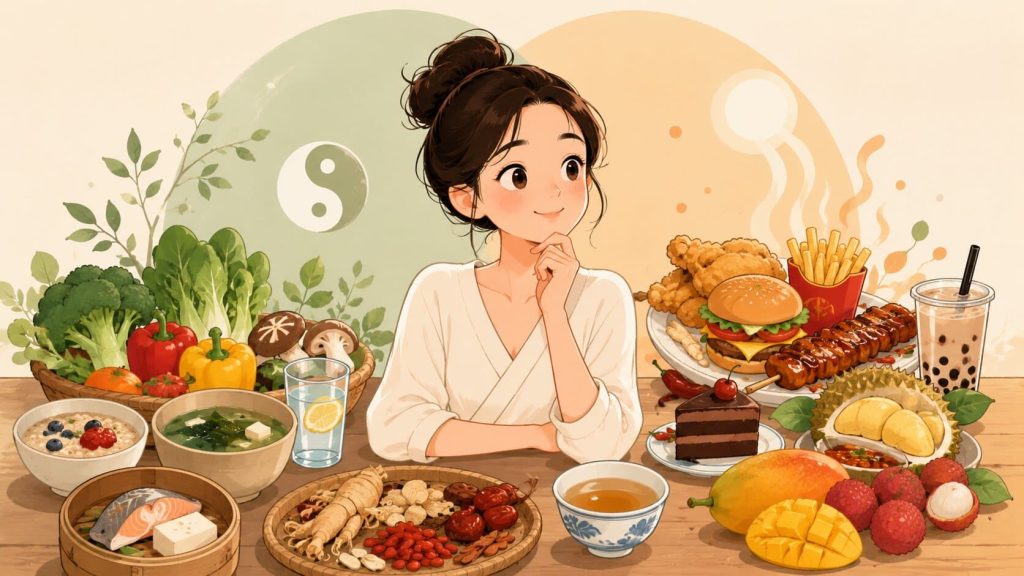
In TCM (Traditional Chinese Medicine), it’s not just food that has a nature. Your body does too. There are three constitutions:
- Cold constitution: you tend to feel cold easily, and eating cold foods often causes stomach aches or digestive issues.
- Hot constitution: you run warm, and foods high in internal heat tend to cause acne or overheating.
- Neutral constitution: relatively balanced, though still something to maintain.
The logic is simple: if you have a cold constitution, lean toward warming foods. If you have a hot constitution, lean toward cooling foods.
It’s always about balance, which is the core of yin and yang. Illness tends to appear when that balance is lost, physically and mentally.
The most important thing is learning to be in tune with your own body. Pay attention to how you feel after eating certain foods. That’s your best guide, more than any list.
Habit 4: Understand Internal Heat
TCM introduces the concept of re qi or shang huo, what we’d call internal heat.
Foods and habits that raise harmful internal heat:
- Fried foods, barbecue, fast food
- Mangoes and lychees
- Staying up late
- Ginger tea in the evening (Ginger is wonderful during the day. It raises good internal heat, improving circulation and warming the body from within. Just avoid it in the evening as it’s too stimulating before sleep)
Too much internal heat leads to breakouts, dark circles, poor sleep, and mood disruption, because everything in the body is connected.
The closest Western equivalent is inflammation. If a food is inflammatory, it’s likely high in internal heat. Here’s a quick list of foods that are great for fighting inflammation and massively cut your risk of disease.
When there’s too much internal heat in your body, there are a few ways to bring it back down:
- Herbal teas are widely available in Hong Kong and China, sold ready-to-drink from street stalls for almost nothing. If you can find a Chinese grocery store, look for gua sha herbal tea blends or cooling herbal drinks.
- Cooling and detoxifying foods include certain vegetables, fruits, and herbal teas. A general reference chart for these is worth looking up.
- Foot soaking in hot water, sometimes with ginger or herbal tea bags, is a common TCM practice, especially in winter. It increases good internal heat, which is especially helpful if you tend toward a cold constitution or often have cold hands and feet.
Habit 5: Eat According to the Season
A general TCM principle: during summer, lean toward foods cooler in nature to help cool the body down.
During winter, lean toward foods warmer in nature to support internal warmth.
However, there’s an important nuance here. Even if you have a hot constitution, you shouldn’t have cold foods too regularly. Cold foods damage the spleen and stomach and deplete the body’s yang energy over time. This is called the doctrine of the mean in TCM: balance, not extremes.
Salads are a good example. They’re cooling and light, great for summer and lunch. But avoid them at night. Your digestive system is naturally weaker in the evening, so cold raw food puts extra strain on it. If you want salad, keep it to daytime, preferably at lunch.
Habit 6: Start the Morning Right
First thing: a glass of warm or lukewarm water, before anything else.
It wakes your stomach gently and prepares your digestive system before anything else enters it.
Second: never have coffee on an empty stomach.
Coffee is highly acidic, hard on the stomach lining, and destabilizing for blood sugar. Before your coffee, have something gentle and neutral:
- A boiled egg
- A spoonful of olive oil
- A banana
Whatever you choose, just don’t skip this step.
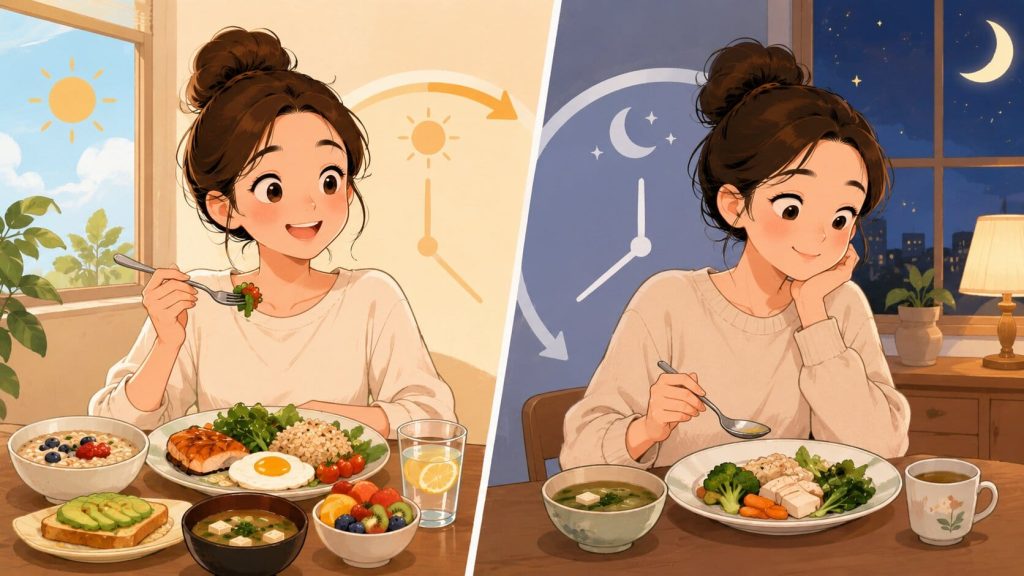
Habit 8: Eat Like a King in the Morning, a Beggar at Night
There’s a famous Chinese saying that captures this perfectly: eat your most nourishing, filling meal in the morning and keep dinner light.
The logic is practical. Your body doesn’t have to work as hard before sleep, digestion improves, sleep quality improves, and in the long run, this supports both health and staying youthful.
A simple, solid breakfast looks like:
- Oatmeal for warmth and easy digestion
- Eggs for protein
- Banana for carbs and energy
- A piece of fruit for vitamins and fiber
It doesn’t have to be fancy. It just has to be consistent.
Habit 9: Eat Clean and Stop at 80%
Women who look 20 years younger than their age tend to eat incredibly clean. And clean doesn’t mean bland. It means simple: steamed or boiled vegetables and meat with a little salt and olive oil.
When you add too many sauces and condiments, you add preservatives and additives your body has to work harder to process.
The second part of this habit is just as important. In Japanese it’s called hara hachi bu, eating only until you’re 80% full. Here are a few more Japanese habits that are great for your health and longevity.
Chinese culture has similar proverbs around this. The reason it matters: if you consistently eat until you’re overly full, your stomach stretches and you need more food each time to feel the same fullness.
Eat slower. Chew more. Give your stomach time to send the signal that it’s full.
When you eat mindfully without distractions, your satiety signals come through much more clearly, and you naturally eat less without trying.
If you want to go deeper on this, the book Ultra-Processed People is a fascinating read on how ultra-processed foods mess not just with your body but with your hormones, gut health, and satiety signals too.
Habit 9: Ditch the Cold Water
Two parts to this one.
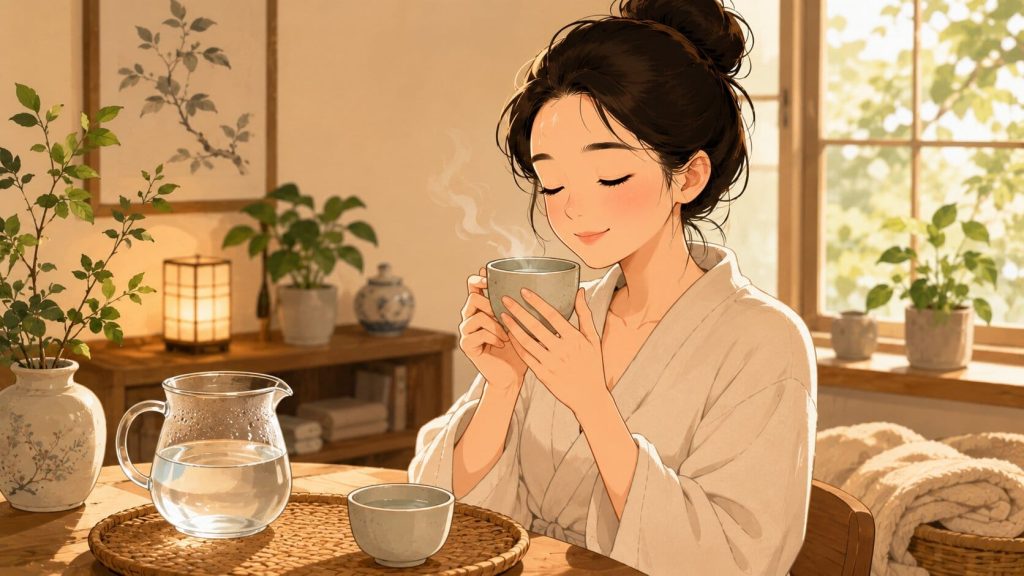
First: swap cold water for warm or lukewarm.
In TCM, keeping the body warm protects women’s organs, reduces period pain, improves skin quality, and helps you feel lighter. If you live somewhere cold, this shift is especially noticeable. This is also why cold water is rarely offered in China or Hong Kong. It’s so embedded in the culture that it’s simply not the default.
Second: drink a lot of it. Aim for at least ten glasses a day.
Hydration from the inside is one of the most essential and underrated tools for slowing aging.
If there’s only one habit to start with, this might be it. The results tend to be felt quickly.
Habit 10: Make Daily Micro-Decisions
One of the most important principles in Asian self-care isn’t a product or a ritual. It’s a mindset.
Every small daily choice compounds over time:
- Choose warm water over a Coke.
- Choose steamed over fried.
- Choose cooked vegetables over cold salads at night.
These aren’t dramatic sacrifices. They’re 1% improvements that add up enormously over weeks, months, and years.
The practical approach: commit to healthy choices Monday through Friday, and give yourself more flexibility on weekends. You’ll be surprised how much better your body feels with just these small, consistent shifts.
Habit 11: Make This Daily Herbal Tea
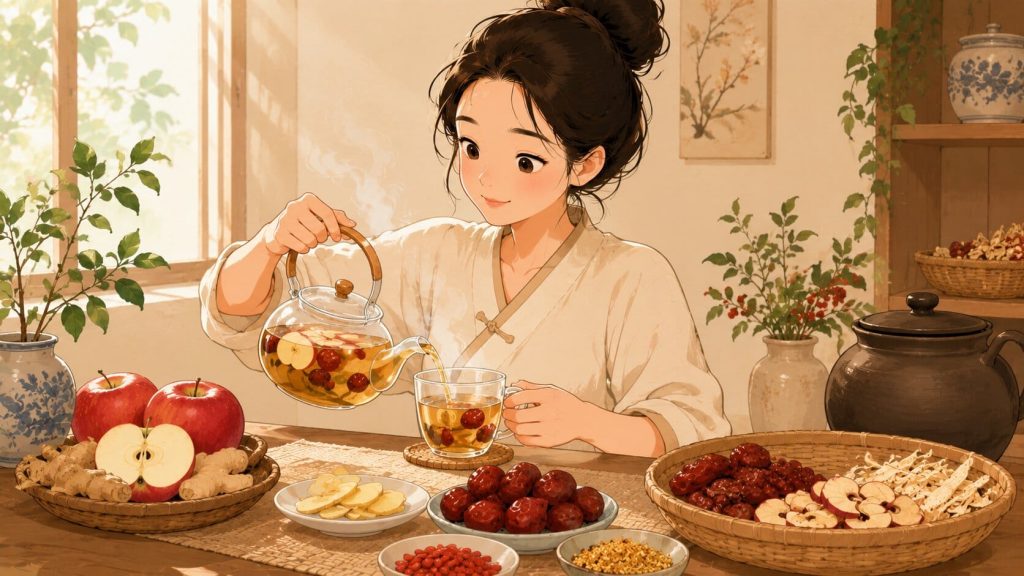
A simple homemade tea that’s a staple in Chinese health culture. All you need:
- Fresh ginger, sliced
- 2 apples, cut up
- Dried dates, stones removed (available at Chinese grocery stores or online)
- Optional: a handful of goji berries
Bring to a boil with about two medium bowls of water, then reduce to medium-low heat and simmer with the lid slightly on for 15 to 20 minutes.
It supports circulation, warms the body from the inside, and feeds directly into the yang sheng philosophy. Drink it during the day, not before bed.
The Bottom Line
Ultimately, youthful skin and healthy aging aren’t created by a single product, treatment, or beauty trend. They are the result of consistent habits practiced over many years.
Your outside reflects your inside. Small daily decisions matter more than any single product. And the key is always finding the approach that suits your specific body type, because being in tune with your own body is ultimately what all of this is pointing toward.
Treating yourself well creates a positive loop that makes you want to treat yourself even better. That’s not just skincare advice. That’s a philosophy for living.