
If your first thought in the morning is coffee because that’s literally the only way you can poop, you’re not alone. But that actually might be a red flag that your digestion and motility are out of balance. So in this post, I’m going to break down:
- Why your digestion might be out of whack
- How to actually fix it
- How to stop relying on coffee as your morning laxative
You can naturally improve your digestion simply by looking at the things that you eat, how you eat, the things that you drink, and really just doing an overhaul on of your lifestyle.
And once you improve your digestion, you can have so many benefits in other aspects of your life, whether it’s your energy, your skin, or your mood.
And it’s true. Your poop tells you a lot more about your health than you might think.
Check Your Poop
So the first thing you need to look at is the quality of your poops. Now, this is going to be TMI, but this is what we’ve got to do. We’ve got to talk about the poops.
What you should do first of all is Google the Bristol Stool Chart.
It’s basically an infographic which breaks down seven different types of poops that you might have, and from that it tells you whether your poop is healthy or not and what potential health issues you might have based on what your poop looks like.
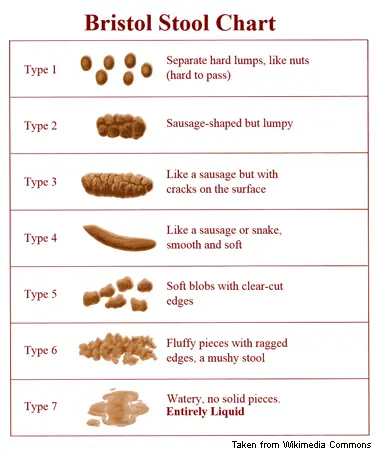
Type 1-2
What it looks like: Hard, lumpy
What it means: Constipation, slow transit, dehydration, low fiber, sluggish motility, possible gut dysbiosis or excess methane producers.
Type 3-4
What it looks like: Smooth, sausage-shaped
What it means: Ideal and healthy, balanced microbiome, good motility, enough fiber and hydration.
Type 5-7
What it looks like: Mushy, fluffy, raggedy, or completely watery
What it means: Food intolerances, potential inflammation, gut dysbiosis, malabsorption, stress, or gut inflammation.
I’d recommend getting a stool test, also known as a GI Map test. You can order this through your doctor or a naturopath. With this test, you give a poop sample and essentially it tells you a ton about your gut microbiome and bacteria levels.
What’s Actually Going On in Your Gut
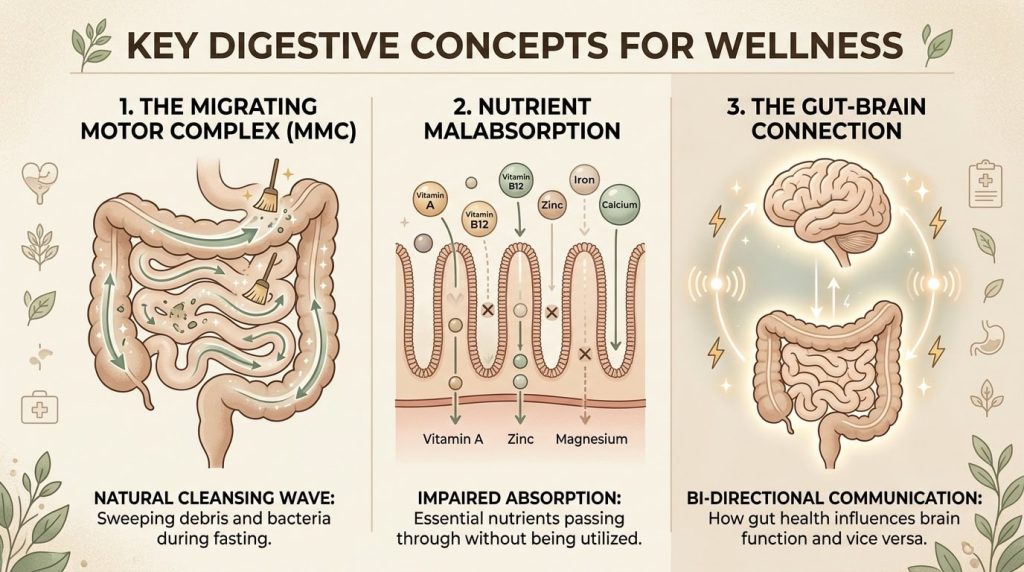
The Migrating Motor Complex (MMC)
Specifically, what I want to talk about within your gut microbiome is the MMC, which stands for migrating motor complex. The migrating motor complex is basically your gut’s cleaning team.
It’s a sweeping contraction pattern that happens in the stomach and the small intestines that occurs during fasting and it helps clear out any residual food and bacteria in the gut.
So it helps keep your GI tract clean and healthy. This process happens every 90 to 120 minutes when you’re fasted.
So if your migrating motor complex is sluggish, that’s when food sits in your gut and bacteria literally build, which results in bloating and indigestion, and that’s why stimulants like coffee will help trigger bowel movements if your MMC is not functioning the way it should be.
Nutrient Malabsorption
Another reason why you might have poor digestion is that you might not be absorbing the nutrients that you’re actually feeding your body.
If you’re someone who eats healthy, like you eat fiber, you eat probiotics, you do all that, but you still have poor digestion, you might have nutrient malabsorption.
The Gut-Brain Connection
And then lastly, the gut-brain axis. Basically, we all know that your gut and your brain are connected.
Another thing that can cause slow motility is low serotonin or low GABA. And these are some primary functions that help regulate your gastrointestinal motility, absorption, and secretion.
Basically, if your nervous system is also dysregulated, that can also impact your digestive health.
What Can We Do? 14 Tips to Improve Your Digestion
Now that we know more about our poop, what can we actually do to improve our bowel movements, improve our digestion, and just stop feeling bloated every time we eat?
I’m going to break down all the tips for you. Most of them are free, and it really just comes down to having awareness of your body and being more intentional with subconscious habits.
Tip 1: Slow Down Your Mornings
Rushing puts your body into stress mode, which shuts down digestion.
This is going to involve a whole lifestyle change because it is not easy to have a slow morning, especially if you work a typical 9-to-5 or you work for someone or you work in a culture that is quite strict with what time you get to the office or what time you have to be online or whatever your job is.
But you have to do it for your gut health. Even a few extra calm minutes can help.
Tip 2: Drink warm water first thing, not cold water
In Traditional Chinese Medicine, cold water can be damaging for your spleen and for your digestion, especially if you drink it on an empty stomach first thing in the morning.
The Chinese take warm food and body temperature seriously for a reason. We have a post that discusses Chinese wellness and habits in detail, you should check it out too.
When you drink warmer or hot water, this helps prime your digestion and get it ready for the rest of your day and for your breakfast.
Add lemon if you’re feeling sluggish, or make an herbal tea with ginger, fennel, and mandarin peel to gently stimulate digestion.
Tip 3: Eat breakfast before you have coffee
When you just have that acidic coffee hitting your stomach and gut lining first thing in the morning, that is really just creating a reliance on coffee for bowel movements.
And on top of that, studies show that when you allow your cortisol to naturally rise in the morning, that gives your body the chance to naturally get its own energy and wake up on its own. While talking about cortisol, we have a post about the signs of high cortisol in your body, which you might want to check out.
Tip 4: Take deep breaths while you’re getting ready
As you’re brushing your teeth, putting your clothes on, getting your bag ready for the day, you might catch yourself holding your breath because maybe you’re running late.
And holding your breath is literally a signal to your digestion that hey, we’re in fight-or-flight mode right now, we don’t have time to be getting your bile ready, to be getting your digestion moving. So, it slows down digestion.
Slowing down and breathing intentionally is going to be way better than rushing. Deep breathing supports your gut. And honestly? You’re usually only saving a minute or two anyway.
Tip 5: Don’t skip breakfast
Breakfast is definitely the most important meal of the day. We need the nutrients, we need that energy in the morning, especially if you like to work out in the morning as well.
If you really don’t have time to sit down and eat breakfast, and you’re really running low on time, I really suggest just waking up 15 minutes earlier and allowing yourself to have a calm moment of breakfast with tea or warm water or whatever you’re drinking.
This gives you time and space to actually properly chew your food and properly look at your food when you’re eating.
Tip 6: Eat Mindfully
Nowadays we get into the habit of being on our phone while eating, or scrolling on TikTok, or watching TV, or just doing something mindless when we’re eating.
Because your brain needs to register that you’re eating in order to signal your digestive system to do its job. Not only does it help with digestion, but it also helps with feeling satiated, and there’s lots of studies done on this.
It’s really all connected and it’s important that you look at your food and think about what you’re eating.
Aim to chew 30 to 40 times each bite. I know it sounds like a lot, but trust me, making the food more broken down is going to make it way easier for your digestive system when it gets down there.
Tip 7: Get movement in after breakfast
Even a 15-minute walk with some sunlight is great for motility. If you’re office-based:
- Take the stairs instead of the elevator
- Walk during your breaks
- Suggest walking or standing meetings with coworkers
- Bring a thermos of hot water to sip on throughout the morning
Tip 8: Add Foods and Herbs to Your Routine
Ginger
Ginger is really a power food in my opinion. It’s been shown to stimulate gastric emptying which supports your digestion, and if you’re ever feeling bloated, ginger is the way to go.
Peppermint tea
Peppermint helps relax the gut muscles and helps with bloating and IBS symptoms.
If you feel very hot and bothered internally, peppermint is a great tea to have, especially in the mid-afternoon.
But if you tend to run cold, avoid drinking too much peppermint because it can have too much of a cooling effect.
Bitter greens
Think of any bitter type of vegetables, bitter melon, dandelion, arugula. All those vegetables that have a bitter taste can help stimulate bile and digestive enzymes.
Tip 9: Pay Attention to Meal Timing
Earlier we talked about the migrating motor complex. In order to support that, we also want to look at the timing of our meals and how often we eat.
The MMC starts working every 3 to 4 hours, that’s when it does its sweep inside your intestines and gut. So we generally want to space meals every 3 to 4 hours.
If you’re constantly snacking or munching, that’s also going to disrupt the MMC and doesn’t allow it to do its job.
Our body also likes routine and structure, so generally keeping your meals at around the same time every day is going to be helpful in regulating your bowel movements.
Tip 10: Support Your Nervous System
Believe it or not, your nervous system is deeply tied to your digestive system.
Let’s say you’re someone who has constantly been living in fight-or-flight mode for many years. This is going to impact your digestion over a long period of time because it is a lot of stress that you’re putting on your body and that can slow digestion.
But when you do things to support your nervous system and activate your parasympathetic state, that’s when you really have good gut motility. There are lots of things that can help activate your parasympathetic nervous system, your rest-and-digest state.
Tip 11: Stay Hydrated
Adequate hydration is super important for digestion.
When you’re dehydrated, it leads to harder stools and makes it harder for you to push
When your body is hydrated, it is much easier to have smooth type 3 and 4 logs.
Warm water throughout the day or warmed herbal teas are great options to make sure you’re staying hydrated.
Tip 12: Try Magnesium
Magnesium is a wonderful supplement that can help with improving your digestion, especially if you tend to be someone who has constipated poops.
Tip 13: Prioritize Sleep Quality
When you have good sleep, this supports your migrating motor complex, which supports your digestion, which supports your poop.
When you have a consistent bedtime as well, this helps support your circadian rhythm, which ultimately helps keep your digestion on a schedule.
Tip 14: Move Your Body and Work on Your Posture
Posture and movement is going to be a huge game changer for your digestion.
A lot of us sit in chairs nowadays, working at a desk or on our phones, and it’s not healthy for us. We’re not meant to be sitting constantly.
So what you want to do is take breaks and stand, stretch, move your body, move your legs.
And also for women, it’s important to take care of your pelvic floor muscles. Sometimes constipation can be because you’ve been sitting for a long time and your pelvic floor muscles are weak or very tight. What you want to do is make sure that you’re breathing into your belly and doing exercises for your pelvic floor. Great options include:
- Hip bridges
- Pigeon pose
- Upward dog
All those yoga poses are going to be really great for strengthening your pelvic floor.
Still Can’t Poop? Try These Hacks
The mini trampoline
If you’ve been doing everything right and you still can’t poop, try this. Obviously, not everyone has a trampoline at home, but if you shake and jump, it’s more or less the same effect.
Malasana (deep squat)
If you don’t have a trampoline and you don’t want to be jumping around, or if you have knee problems, don’t worry. There’s another great position for you. It’s a yoga pose called malasana.
Basically, doing a deep squat. This really opens up your hip flexors and any tight muscles. You can just hold this for like 5 minutes. Or you can just do regular squats as well.
Chia seeds and basil seeds
If you really still feel like you can’t poop, bring out your chia seeds and basil seeds.
A teaspoon of this, it has lots of fiber, so it’s going to help you go to the toilet.
Add about a cup of water, let it sit for 10, 15, or 20 minutes, and it’s going to turn into a gelatin-type texture. The chia seeds are going to expand and then you just drink it, and I promise you, you will go to the bathroom.
The Bottom Line
There’s nothing wrong with enjoying coffee. But if your body depends on it just to function, it might be time to look deeper.
When you support your digestion naturally, everything improves, your energy, mood, skin, and overall health.
Hopefully, one of those tips is going to help you with improving your digestion and your bowel movements and ideally reducing your reliance on coffee for poo.
It might be TMI, but let me know if your poops have improved by trying out some of these tips!
Disclaimer: This content is for educational and informational purposes only and is not a substitute for medical advice. If you’re dealing with ongoing digestive issues, severe bloating, constipation, or any unusual symptoms, it’s important to speak with a qualified healthcare professional for proper guidance and support.